The Bearings, Vol 12, No 13
Articles in this issue
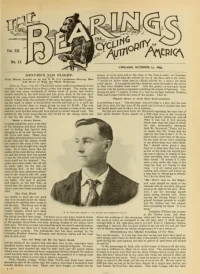
- The Denver Wheel Club's $1,500 note comes due unpaid on the day of its record-breaking three-day meet, so creditors seize the vaulted gate receipts and leave the racing men unable to collect their prize money; L.A.W. president A.C. Willison, watching the meet, endorses The Bearings' percentage table and promises to press Chairman Gideon for its official adoption, while Cooper's worry over the California trip costs him points and lets Murphy close the gap on Bald.
- Day-by-day dispatch from the Denver Wheel Club's national circuit meet: the Class A competition mile falls to 2:02 4/5 behind a quad on day one, Bald and Murphy dead-heat for the world mile competition record of 1:55 1/5 on day two, and day three yields four more marks -- B.B. Bird's paced half-mile in :51, a quad half-mile in :51, Murphy's :58 2/5 competition half-mile, and two exhibition-mile records -- before Murphy beats out Bald in a disputed two-thirds-mile winners' race.
- At Pueblo, Colorado, on a bitterly cold day for the Rover Wheel and Athletic Club meet, Murphy holds the Denver pacing quad to beat Bald by half a length in the mile open, Bald takes the third-mile, and Bird defeats Cooper in the only other race before Cooper, Bliss and their trainer turn back while the rest of the circuit continues to Salt Lake City.
- Bicycle races held on the Washington Boulevard asphalt as part of Fort Wayne, Indiana's centennial celebration draw 5,000 spectators, with Clark Brown, J.O. Goff and John Clarke sharing the quarter-, half- and two-thirds-mile events, each first prize a $100 bicycle.
- At Hedrick, Iowa, Orlando Stevens lowers his own unpaced flying-start quarter-mile world record to :23 4/5 on the kite-track and also breaks M.F. Dirnberger's third-mile record with a :33 2/5 ride.
- An editorial marvels at the season's record harvest -- Johnson and Ziegler's Louisville marks and the ten records broken at Denver, including Bald and Murphy's dead-heat mile -- and predicts the pace of record-breaking, aided by ever-improving pacemaking, shows no sign of slowing.
- A discursive editorial on whether the bicycle is necessity, luxury or nuisance turns to needling an English cycling paper for swallowing whole a chain-patent story claiming a $2,500,000 sale price, notes the drawbacks of large-diameter frame tubing, jokes about the Duke of Marlborough's Central Park coasting arrest and Cap Anson's Michigan Avenue tumble, and predicts Cooper's retirement from the circuit leaves Bald an easier run at fifty wins.
- The newly completed quarter-mile cement track at Athletic Park, built by Frazier & Whitney of Louisville with spiral (non-circular) curves banked nine inches higher than the Fountain Ferry course, is hailed by track association president H. Charles Furton as bound to draw top racing talent and develop local riders.
- The Duke of Marlborough, soon to marry Consuelo Vanderbilt, is arrested for "scorching" while coasting in Central Park and dismissed with a reprimand by a Tammany judge, an episode The Bearings dresses up with a comic Irish-dialect poem about the arresting officer, Michael Sweeny, and his partner Mike.
- A Philadelphia dispatch reports the Pennsylvania, Reading and Baltimore & Ohio railroads following the New York Central's lead in charging cyclists an excess-baggage rate to carry wheels, while new tracks rise at 16th/17th and Wolf/Jackson streets and at Point Breeze Driving Park, and C.W. Dannenhauer breaks two Manual Training School bicycle-race records.
- Washington D.C.'s military cyclists, under Captain Wiggin and Lieutenant Libby, finalize a relay run to New York to carry a message from General Ordway to a government official within twenty-four hours, as Gen. Albert A. Ordway is elected president of the newly formed United States Military Wheelmen.
- Rain-soaked and later sun-favored heats at the new Vincennes municipal track see Geo. A. Banker, Barden, Jacquelin, Morin, Protin, Verheyen and Gougoltz qualify through the Grand Prix de Paris preliminaries, while Bourrillon and Tony Reboul's tandem sets a European quarter-mile record and Arthur Linton laps Lesna five times in a Buffalo (Paris) six-hour race stopped by rain.
- C.S. Henshaw and Oscar Hedstrom, riding a Syracuse tandem, are called nearly invincible in New York state Class A racing, setting new state records at White Plains of a flat-minute unpaced half-mile and a 2:06 3/5 mile.
- At the Springfield, Ohio fairgrounds, Claude Doty wins the Bushnell Cup for the fastest mile in 2:26 and also takes the half-mile open, while Worth Cummins sweeps the 2 1/2-mile handicap and one-mile open and C.J. Wagner wins the two-mile lap race.
- At St. Louis only George A. Perkins and A.C. Willison of the L.A.W. executive committee show up to report nearly $5,000 cash on hand and all debts paid, and to launch an aggressive road-improvement campaign, before being banqueted by local wheelmen.
- The California cycling clubs' annual ten-mile Fruitvale-to-Hayward road race draws a record crowd but is marred when Harry Harvey is struck and killed by an electric car en route to the finish; John Wing takes the time prize and McDougall's win is protested by the California Cycling Club over his club-membership eligibility.
- An innovative combined white-and-colored race meet at Philadelphia's Tioga track sees J. Beverlin out-sprint scratch man R.W. Crouse for the five-mile handicap and J. Wesley Mitchell dominate the events for colored riders, while C.F. Benedict and John Benner race the two-man Linkham machine and McCurdy/Rumford beat Dampman/Buzzard in a professional tandem match.
- At the Niagara Wheelmen's second annual ten-mile road race on Providence's Butler Avenue Boulevard, C.J. Swenson breaks the state ten-mile road record by two and a half minutes starting a minute behind scratch.
- Two days after Swenson's mark, H.B. Hills Jr. lowers the Rhode Island ten-mile road record again by twenty-one seconds in the Rhode Island Wheelmen's race on Blackstone Boulevard, paced by L.N. Wolleston, George Gill, Monte Scott and Swenson himself.
- At the Sedalia, Missouri Cycle Club's second annual meet, J.E. Morrow sweeps the one-mile open, two-mile handicap and five-mile handicap, while J.H. Hall takes the two-mile handicap race and the Sedalia one-mile championship.
- Johnny Johnson rides an unpaced flying mile in 2:00 2/5 despite a bad cold, and Otto Ziegler lowers Johnson's own two-mile paced standing-start record by ten seconds, while De Cardy's dangerous double-quad pacing mishap costs him a shot at the one-mile standing-start mark and four-year-old prodigy Charley McAdams begins training on a 12-pound Rambler racer.
- About 200 wheelmen brave a cold wind at the Cleveland Wheel Club's blue ribbon meet at C.A.C. Park, where P.J. McIntyre wins four of five events, as the club also opens its social season with a well-attended reception and ball.
- A dozen Cleveland cyclists out "chestnutting awheel" trespass on Farmer Ingram's South Brooklyn field and threaten him when ordered off, but an hour later the neighborhood farmers arm themselves with clubs, capture four of the offenders, and see them fined $10 and costs apiece the next day.
- Nashville breaks ground on a winter coliseum track under manager Jack Prince, who promises a fast covered course and a six-night, twelve-hour-championship opening tournament featuring Johnson and Gardiner, as local dealers stocking Triangle, Peerless, Rambler, Columbia and other lines gear up for '96 business.
- Milwaukee's semi-centennial parade draws 3,000 costumed wheelmen and wheelwomen, including a menagerie-themed North Side Cycling Club contingent, Captain Birkhauser's 100 mounted "soldiers," and the "Hoolihan's Picnic" and "1845, Progress 1895" floats, with $500 in prizes awarded amid complaints from clubs left out.
- New York's military cyclists elect Gen. Albert A. Ordway president of a new national organization after Gen. Nelson A. Miles endorses the wheel for army courier service, while a Bowman's Academy mass meeting presses the city to address dangerously flooded concrete streets.
- H.G. Fritz returns to Governor's Island after a July-to-October round trip from Fort Hamilton to Fort Snelling, Minnesota and back, carrying seventy-five pounds of gear on a 25-pound Spalding and averaging about ninety-five miles a day despite five sick days and having to substitute rawhide for his tires crossing an Indian reservation.
- The National Board of Trade's executive committee, facing 310 space applications for only 210 available at the Madison Square Garden show, adds eighty-five spaces on the parquette circle and a promenade over the boxes.
- A.F. Laybourn revives his proposal to Hennepin County commissioners for an elevated bicycle sidewalk from Minneapolis to Lake Minnetonka, offering the county 30 percent of terminal receipts and 3 percent of road receipts if granted permission.
- A Wellington, New Zealand correspondent traces three years of rapid cycling growth under "the southern cross," crediting women's clubs like Christ Church's pioneering Atalanta Cycling Club and long tours such as Miss Alice Mitchell's, and wonders why no American-made wheels have yet reached the colony despite their being lighter than English machines.
- In a gale and snow flurries, sixty-three riders finish the second Dunlop trophy road race over Toronto's Woodbine-Kingston course, with A. Boake of the Athenaeums first home and the Royal Canadians' club scoring topping the table despite bookmakers offering only even odds against them.
- Paced by the entire Morgan & Wright team, B.W. Twyman completes a 100-mile record of 4:26:32 at Louisville while partner Ross Miller drops out at thirty-seven miles, and the Century Road Club of America ratifies a batch of new state and American records including C.F. Manahan's Iowa marks and C.P. Slaubach's New York-Philadelphia course records.
- Rochester riders trade the Rochester-Buffalo record twice in one day -- A.B. McDonell cutting it to 2:57:02 on a Viking before L.H. George of Lockport lowers it further to 2:55:44 on a Barnes -- as William Martin's European racing success against French and Italian riders is noted ahead of his move to Australia.
- A veteran road racer describes in first person the dressing-room nerves, the surge of confidence on catching the scratch bunch, the exhaustion at the half-way turn, and the final sprint to the tape that make up a big handicap road race.
- An American spectator at the Michael-Barden fifty-kilometer match on the banked Buffalo track in Paris describes the small army of tandem, triplet and quad pacemakers used, Michael's trick of back-pedaling to shake Barden off his wheel, and Barden's repeated sprints to stop Michael taking a drink of water mid-race.
- The Madison Square Garden managers finalize 299 of 342 available spaces for the January 18-25 New York Cycle Show, with makers from Yost and Davis Sewing Machine to Pope, Spalding, Sterling and Humber assigned booth numbers and forty-three spaces left for late applicants.
- A Belgian innkeeper recalls how, in the bicycle's earliest days, a village curate and constable mistook a hungry touring cyclist and his machine for a sorcerer and his devil-horse, locked him up, and rang the fire bell before letters from his home city proved his story true.
- The pairing of rider Johnny Johnson with trainer Tom Eck as "Johnson and Tomek" turns out to echo an actual Chicago furniture firm of the same name, a coincidence noted alongside the fact that Johnson is the commonest surname in the 600,000-name city directory while Eck appears only once.
- Strong wind slows every event at Tomah, Wisconsin's races, where C.F. Foster wins the Monroe County one-mile championship and L.W. Bailey takes the five-mile handicap time prize from scratch.
- Pocahontas Center, Iowa inventor Michael Leahy unveils a chainless bicycle that uses the rider's pedaling motion to pump compressed air into a seat-mounted reservoir, which then drives cylinders on the rear wheel.
- San Bernardino, California plans a figure-eight one-mile horse track with a modern bicycle track built into one loop, alongside warm and cold swimming tanks.
- A traveling salesman shows off a new 1 1/2-pound, six-candle-power electric bicycle lamp, unbreakable in an ordinary fall, that charges for two and a half cents and burns for nineteen hours.
- The Syracuse Cycle Co. tallies a fresh week of records for its Crimson Rim riders, including Harry Clark's 4:30 4/5 two-mile unpaced Class A mark, C.C. Collins's 2:02 1/5 mile competition record, and the Swanborough-Stone-Dixon-Conibear quad's 1:47 4/5 unpaced mile.
- Chicago's first 100-mile road race, run by the Lincoln Cycling Club over the Wheeling-Waukegan course in a cold gale, is won by W. Raab in 6:57:00 as only eighteen of thirty-seven entrants start; days later C.A. Westcott finally breaks the Waukegan century course record in 5:40:00 and Matilda Anderson lowers the women's Elgin-Aurora record to 6:52:15.
- Buffalo-area riders topple five local and American road records in two days -- Iven and McDonell over the Buffalo-Corfu twenty-five miles, McDonell again on the Corfu-Rochester leg, W.L. Steimal's 4:45:10 Erie-to-Buffalo century, and Fred Fuhrmann's 11:58:15 double-century that also beats Searle's American record.
- Wretched weather mars racing at Herne Hill and elsewhere in London, while J.K. Starley hosts a Cafe Royal dinner marking the Rover's tenth anniversary with vintage machines on display, fresh road tests show the Simpson lever chain no faster than an ordinary chain, and a Guernsey twelve-hour contest on a rain-ruined cinder track is won by G. Froome with just 148 miles.
- Alexander B. McDonell rides from Erie to Buffalo unpaced in a time thirty-one minutes better than the previous best, claiming the world's road century record and every prior mark for the course.
- At Napa, California, Walter Foster breaks two world records in one day -- a paced third-mile in :30 flat and an unpaced third-mile in :32 3/5, the latter six seconds under the old mark.
- Though Toledo consumes over three million feet of tube a year it has no working tube mill yet, with Samuel Snell's steel-tube venture just getting underway, R.W. Smith experimenting with sheet steel at the Haughton foundry, and a cold-drawn-steel-tube company being organized by former Yost secretary W.C. Brewer.
- St. Paul's trade buzzes over B.B. Bird's :51 half-mile record on a Syracuse, with jobber Farwell, Osmun & Kirk preparing a western sales trip, the Hackett Hardware Co. aiming to double its bicycle business, and traveling salesmen throwing a box party for performer Nick Kauffmann at the Metropolitan opera house.
- Judge Tuley of the Cook County circuit court grants the March-Davis Cycle Co. an injunction barring August R. March and the A.R. March Mfg. Co. from manufacturing or selling bicycles under the "March" name, pending a $250 appeal bond.
- Cleveland dealers Collister & Sayle, led by former National Racing Board member Geo. Collister, will make the Peerless their 1896 leader with an advance order for 300 wheels.
- The Waltham Mfg. Co. triples its stock to $300,000 and plans 15,000-20,000 Orient bicycles for 1896, touting a new detachable front sprocket, adjustable bar clamp, and forged (not stamped) steel connections.
- The Sidway Mfg. Co. of Chicago develops a heated liquid compound that removes borax from brazed bicycle-frame joints in seven or eight minutes without the tubing damage caused by the standard sulphuric-acid pickle bath.
- The A.L. Moore Co. of Cleveland's Grothe pedal uses a cold-rolled steel frame riveted with German silver to avoid rust, and a case-hardened pin and cups, fully guaranteed against material or workmanship defects.
- Buffalo's Seyfang & Prentiss triple their Bison bicycle output for '96 in new quarters on Washington Street, adding enameling and nickeling plants and three models including a $100 ladies' drop frame.
- Touring American wheelman C. Ford Seeley visits Dublin on a 22-pound brakeless Columbia, kissing the blarney stone and touring Killarney before a fall at Ball's Bridge ends his bid to race in the Newspaper Sports.
- A French bicycle maker adopts the St. Etienne arms factory's bronzing process, said to rustproof metal parts and resist chipping better than enamel while shaving about ten ounces of weight.
- C.A. Benjamin sells 2,250 Barnes Cycle Co. wheels on a two-month western tour, placing new agencies in St. Louis, Kansas City, Denver and San Francisco, where Hooker & Co. will open a coast retail store.
- London's cycle trade stays brisk ahead of the shows as ladies' safeties gain popularity, fresh road tests find the Simpson lever chain slower than an ordinary chain by about 100 yards in a mile, Princess Beatrice takes her first cycling lesson on a Rudge-Whitworth, A.J. Balfour is pictured on a Crypto Bantam, and the Dunlop Tire Co. adopts an improved Wood-pattern valve for next season.
- Scattered US trade notes report the E. Howard Watch & Clock Co. entering bicycle manufacture in Boston, New York's C.F. Guyon Co. failing with $47,928 in liabilities, and new firms incorporating from Toledo's Standard Cycle Co. to a Cheyenne, Wyoming factory venture.
- Harry D. Simmons, who rose from the defunct Common Sense Bicycle Co. through the Hart Cycle Co. and A.G. Spalding & Bros., now manages the Indiana Bicycle Co.'s Philadelphia Waverley branch, the company's second-best-selling location.
- The Puritan Cycle Co. offers two 1896 models, the $100 Puritan and the $75 Hector, the latter tipped as hard to beat at its price.
- A Bearings reporter tours the Elgin Sewing Machine & Bicycle Co.'s 266-by-100-foot main building, powered by a 250-horsepower Hamilton Corliss engine, where three graded wheels -- the Gunning, Elgin Diamond and Elgin Favorite -- will be built from tubing already bought for over 12,000 machines.
- Chicago marble magnate John A. Davidson converts part of his Market Street manufacturing plant into a bicycle factory, advised by former March-Davis traveling man J.D. Lasley, while Miguel Serrano Jr. takes the International Mfg. Co.'s America agency for all of Mexico.
- The Mackie-Lovejoy Mfg. Co. tools up to market A.W. King's new tubular hub, with forged sprocket-side flanges, threadless cone seats for accurate bearings, and wash holes for cleaning with benzine or gasoline.
- With every maker rushing to build double machines for the tandem craze, the Marion Cycle Co. unveils a particularly handsome new tandem.
- 130 Toledo tool makers strike for a wage advance and stay out two or three days until manufacturers agree to a 5 percent raise for all factory employees.
- H.S. Robinson of Meadville, Pennsylvania, says a year of feedback has let him strengthen the weak chain and parts of his $35 home trainer so it can no longer be broken through normal use.
- Reader R.E. Van Dyke argues bicycle chains should be oiled at every rivet to cut friction by 20 percent and prevent rust, prompting an editor's note clarifying the original advice was against outside chain oil (which attracts dust) and recommending periodic kerosene soaking plus a sperm-oil and graphite treatment instead.
- The White Sewing Machine Co. of Cleveland's 1896 line includes the 22-pound, $100 White, built with steel drop-forged frame parts, seamless reinforced fork sides, and a double fork crown.
- M.E. Griswold patents a combination trouser guard, chain-bolt wrench, screwdriver and four-size spoke grip, and reports strong sales of his company's single-tube repair outfits and folding rubber mud guard.
- The Capitol Mfg. Co.'s new Climax saddle, an eighteen-ounce, four-dollar design with a bentwood frame and a hinged spring resting on a rubber cushion, is built to stay elastic without becoming too springy.
- W.O. Turrell leaves the Pope Mfg. Co. to join the Peerless Mfg. Co.'s sales force, bringing years of bicycle-trade experience with him.
- Syracuse Cycle Co. president John C. Bowe pranks ex-Mayor William Cowie of Syracuse at a Sycamore Club anniversary banquet, presenting him not with a promised crimson-rim Syracuse bicycle but a 56-inch ordinary painted bright red and inscribed with his name.
- Chicago Board of Trade man F.K. Dunn patents an adjustable handle-bar with a grooved collar and set-screw or eccentric clamp that lets a rider raise or lower the bar without dismounting or using a wrench.
- A technical primer explains that brazing depends on clean, well-fitted surfaces, sufficient heat, and a careful supply of borax flux, warning that oxidation scale from an unbalanced gas-air mixture is the chief cause of failed bicycle-frame joints.
- Philadelphia manufacturers' agents Sharpless & Watts, who also supply forgings, tubing, sprockets and stampings, plan to quadruple production of their lard-and-kerosene Favorite bicycle lamp next season.
- Despite the United States consuming 40,000,000 pounds of rubber a year, vast unworked forests along Brazil's Orinoco watershed show that cost of collection and transport, not scarcity, is what actually governs crude rubber's price.
- Philadelphia's newly formed Holbrook Cycle Co. plans 1896 samples by year's end, Weise & Bowen report a booming trade in the Stearns "Yellow Fellow," Thomas Benner brings his prodigy sons to sign with the Syracuse racing team, and the Pennsylvania Bicycle Co. adds factory floors to expand output of the Pennsylvania.
- The week's newly issued bicycle patents include Alfred Nicholas's bell (assigned to Joseph and Harry Lucas of Birmingham), William Grinden's frame connection, Augustine Davison's pedal, James Gilmour's vehicle tire, and Charles Duryea's tire assigned to the Indiana Rubber and Insulated Wire Co.
- The National Cycle Exhibition Co. assigns further Chicago cycle show booths, including spaces to the Kokomo Rubber Co., Auburn Cycle Co., Racine Bicycle Boat Co., Munger Cycle Co., and A.G. Spalding & Bros.
- Humber frame inventor P.L. Renouf tours Chicago factories showing off a new oval double-chain-stay frame braced at three points for extra strength without added weight, plus a crank bracket that lets a gear be changed in a minute and a Gardiner-designed back-pedal band brake.
- The Garside combination lock, built into the machine's head so it can never be left behind, offers 200,000 combinations that only the rider knows and has already drawn contracts for 40,000 units this month.
- Trade visitors to Chicago this week include Syracuse Cycle Co.'s John C. Bowe and W.D. Hawley, G.N. Pierce & Co.'s George N. Pierce, Boston's Sterling Elliott, and Eclipse Bicycle Co.'s George W. Houk and Samuel H. Haines.
- Among the week's trade snippets, the Monarch Cycle Mfg. Co. ships bicycles to France, Denmark, Finland, Australia and Holland within a fortnight, Orlando Stevens's Hedrick, Iowa records are confirmed at :23 1/5 and :33 3/5, and the Green County fair races at Carrollton, Illinois draw nearly 7,000 spectators.