The Bearings, Vol 5, No 1
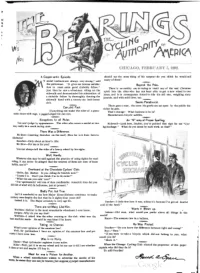
Articles in this issue
- The front page presents a column of humor squibs and comic anecdotes poking fun at wheelmen, dealers, and cycling culture, including jokes about sidewalk riding, pneumatic tires, the amateur law, and cycling club life.
- A lengthy humorous biographical sketch of champion racer Arthur Alexander Zimmerman of Camden, New Jersey, tracing his childhood pranks, early schooling, first bicycle (a Star pattern, 1885), and his remarkable record of winning nearly every race he entered; closes with a note that Zimmerman will ride in England and report back to the paper.
- A default judgment of $297.50 covering three suits on notes was entered against professional racers Morgan and Eck in Chicago in favor of Gormully & Jeffery Manufacturing Co., with a note on Eck's audacity in subsequently approaching that firm for a $100 loan.
- The editor rejects as fabricated an article purportedly from Cleveland that attacked The Bearings, reporting that four Cleveland readers called it invidious and that an Illinois man and an editor are believed to have concocted it.
- A poem by William D. Kempton casts the cyclist as a modern knight—pen for lance, stationary wooden steed for horse—who abandons ineffective pharmaceutical remedies and conquers his ailments by taking up the bicycle.
- The Bearings proposes organizing a relay bicycle ride of roughly 1,000 miles between Chicago and New York via Toledo, Cleveland, Buffalo, Syracuse, and Albany, listing all relay stations mile by mile and inviting cyclists, dealers, and club men to organize segments; the paper believes favorable conditions could see the ride completed in 100 hours.
- A fifth-volume anniversary editorial encloses a facsimile of the paper's first issue and reflects on the growth of cycling journalism, pledging to continue delivering honest cycling news, comment, humor, and unbiased views free from manufacturer control.
- The editorial engages with a Kansas City argument that a painter may sell work without being called a professional while a cyclist who wins a cash purse is instantly professionalized, agreeing that cash prizes cannot fully eradicate the true spirit of amateurism.
- Two R. G. Dun & Co. agent reports from Lidgerwood, North Dakota, and Fond du Lac, Wisconsin, are quoted to illustrate how impassable winter roads strangle commerce and underscore the case for the L.A.W.'s good roads campaign.
- A League delegate has been furnished Bearings extracts on proxy abuse at L.A.W. constitutional conventions, and a likely resolution for the Columbus Assembly would transfer constitutional amendment power to the National Assembly and restrict delegate proxy use.
- Editor L. J. Berger publicly retracts harsh personal language used against The Referee and its editor Sam Miles in the January 22, 1891 issue—withdrawing terms such as 'domestic brute' and 'scandal-monger'—while still criticizing The Referee's habitual system of personal attacks.
- The editorial lists agenda items for the upcoming National Assembly: election of vice-presidents and treasurer, restriction of Executive Committee powers, the 1892 national meet location, proxies, the Michigan election controversy, A.A.U. interference in New York racing, and the Bicycling World contract extension.
- Following The Bearings' earlier report on the L.A.W. Executive Committee's quiet extension of the Wheelman Company organ contract, the editorial reveals that the Wheelman Company opposes the plan to send Good Roads magazine free to all L.A.W. members because it would create a duplicate subscription list and undermine advertising revenue.
- A sustained editorial on whether cash prizes are the only cure for sham amateurism in cycle racing, considering Joseph Goodman's counter-argument that better-arranged meet programmes—requiring race managers to rigidly separate ability grades—would satisfy riders more effectively than any prize reform.
- A letter from 'A Member of the Lincolns' in Chicago praises the Dayton Bicycle Club for organizing a minstrel troupe that raised $1,200–$1,500 to fund the Ohio Division meet (July 4–5, 1892), led by president Carl Bauman, calling its members—lawyers, business men, and cycling enthusiasts—the kind that made the L.A.W. what it is.
- A brief profile of Geo. T. Brodnax, born near Memphis in 1869 and employed at jeweler C. L. Byrd & Co., who learned to ride in 1890 and was unanimously re-elected as Tennessee Division L.A.W. secretary-treasurer for his skill at collecting dues.
- A note from Wheeling reports that Strasburg's director of police has imposed new cycling regulations requiring every bicycle to carry numbered plates on front, sides, and rear, with the number also on the lamp and registered at the post office.
- Correspondent J. Jay Ross reports on a Toronto meeting of 75 riders chaired by Wanderers' captain J. H. Gerrie to form a Canadian Century Club, Dave Nasmith riding across frozen Toronto Bay on his pneumatic safety, and a burglary at Frank S. Taggart & Co.'s King Street jewelry and sporting-goods store.
- Denver correspondent 'Pedaller' reports on the Denver Cyclists' Union annual meeting, prizes offered for a spring road race, the Ramblers' amateur photographers, muddy club runs to Brighton and Littleton, and the Social Wheel Club's Washington's Birthday relay race from Colorado Springs to Denver.
- Springfield and Chicago notes include Springfield's push for the state division meet, a planned half-mile track, and the Columbia agency moving to G. A. Van Duyn Co.; Chicago notes cover the rousing Chicago C. C. smoker, Captain Van Sicklen's no-passing rule on club runs, and the Cook County Wheelmen's German stag and new club-house plans.
- Kansas City notes on the Inter-state Bicycle Co.'s $10 cyclometer mileage prize for K. C. C. members, a club run to Waldo where Norton took a header, a growing number of women riders expected this season, and hopes for an attractive race list at the inter-state fair.
- Buffalo Arsenal races won by J. W. Judge of the Riverside Wheelmen and E. C. Bald, with fifteen-year-old Joseph Dorntge (brother of world-record breaker Charley Dorntge) making a promising debut; the 200-strong Press Cycling Club quits the A.A.U. to join the L.A.W. and bid for the New York state championship meeting.
- Columbus, Cincinnati, and Cleveland notes cover a forthcoming talk at the Columbus Cycling Club by Dr. Geo. M. Waters, Cincinnati wheelmen unsettled by Ohio Division meet dates clashing with the Poorman road race and Porkopolis meet, and the Cleveland Wheel Club and Lady Cyclists entertaining the Lakesides with dancing.
- Philadelphia notes cover the Oxford Wheelmen's fair and its popular-wheelman voting contest, the Century Wheelmen's two-night minstrel show with a full cast and curtain by Oscar Righter, and the Wheelmen's Street Improvement Association's growing influence in city council elections.
- San Antonio correspondent reports that the Bexar County grand jury has forced county commissioners to account for $40,000 in annual road funds that had never been spent on road improvement, resulting in pressure likely to produce a marked improvement of local highways.
- Milwaukee correspondent 'W. G. N.' reports on B. F. Higgins of Oshkosh pushing a scheme for consecutive Western state meets in five states, Fenton S. Fox departing for England, and Wm. C. Wegner leaving Frankfurth's hardware store for Chicago.
- The Associated Cycling Clubs of Philadelphia's second annual cycle show at Industrial Hall (Feb. 15–22) will feature John Wanamaker's chief decorator, geared ordinaries, home trainer races, and Hickory Elliott novelties; all profits go to the better-streets movement.
- Sporting Life has sent engraved invitations to a cycling luncheon on February 18, expected to rival the paper's celebrated $1,500 baseball-magnate event of the previous year; The Bearings confirms it has not declined.
- Nearly all space is booked for the Rochester bicycle exposition, with an elaborate entertainment programme nearing completion and the committee working vigorously to assure visitors a great time.
- Ex-chief consul Bull of Buffalo tells a Bearings reporter he will decline the L.A.W. presidency if asked, having spent eight years in League politics and wishing to return to business; he favors T. F. Sheridan of Illinois for secretary-treasurer.
- Parker H. Sercombe wagered $100 that his English safety bicycle could beat Charles DeGroat's high-wheel ordinary over 21 miles; DeGroat won easily by 17 minutes, collected $100, and donated $10 to the Milwaukee Wheelmen who 'blew it in.'
- Brief profiles of Riverside Wheelmen riders George C. Smith, who can ride a heavy cushion-tired ordinary in 2:40 and plans a 65-gear pneumatic for 1892, and his brother William F. Smith Jr., organizer of the Gotham Wheelmen; both will be trained by Dr. Carlton Simons.
- Obituary for Walstein Seymoure, 29, of Des Moines—former secretary-treasurer of the Iowa Division L.A.W. and proprietor of the Hodgson Bicycle Exchange—who died of typhoid fever on January 28; Des Moines Cycling Club members attended the funeral in a body and sent a carnation-and-rose floral wheel inscribed 'Our Departed Comrade.'
- English professional racer Wood, who vowed before crossing the Atlantic to treat the American circuit as a pleasure trip, gave an unprintable reply when fellow racer Edlin asked how the pleasure trip was going during the unprofitable Boston race.
- The Velocity Manufacturing Company extends its naming contest for its new unnamed bicycle by one week, inviting readers to submit a good commercial name to 98–102 West Washington Street, Chicago, for a $25 prize.
- The paper's notes column reports that Hastings, Nebraska, will host the next Division meet; Germany has 200,000 cyclists and three cycling papers; the January 29 issue was mislabeled Vol. 5 No. 1 instead of Vol. 4 No. 26; the Philadelphia Cycle Show may be opened by Mayor Edwin S. Stuart; and various club and dealer items from across the country.
- Isaac B. Potter, chairman of the L.A.W. Bureau of Roads Improvement, reports 32,000 requests for the 'Gospel of Good Roads' pamphlet being met via the new Good Roads magazine, essays on European road engineering arriving from abroad, and Senator Richardson's $10,000,000 New York highway bill gaining cross-party legislative support.
- A short note reports that a non-mechanical cyclist successfully improvised his own pneumatic inner tube and valve from a sheet of rubber and a piece of hose, making a satisfactory and economical repair.
- A letter from Wm. Martin of Detroit contests claims that C. W. Ashinger is the world's best long-distance rider, citing Martin's victories over Ashinger in a 50-mile race and a six-day event at Omaha where Martin covered 308 miles; Martin announces he will enter the next New York race on a Columbia and win first prize.
- The paper's regular rhetorical questions column asks whether Bert Myers can ride a mile under 2:15, whether a successful geared ordinary would shake the market as the pneumatic tire did, whether chief consul Gerould's plan to bring Illinois members to the Washington L.A.W. meet deserves support, and whether Chicago racers could help Aurora's talented John Taylor train in the city.
- A brief note reprinted from the Scottish Cyclist praises the smooth, easy-running quality of Columbia bicycles as experienced when an editor rode an American tourist's heavy Columbia and found it surprisingly superior to a light English wheel.
- A humorous anecdote about salesman 'Conk' who demonstrated a pneumatic bicycle in Mauch Chunk, Pennsylvania, first climbing an unscalable hill and then barely surviving a high-speed, brake-jamming coast back down through debris and a crowd of spectators, concealing his terror until he confided in a Bearings reporter.
- A brief editorial cautions that Chicago's habit of centering national cycling organizations—the Century Road Club, the Two-Fifty Club, and the newly formed Midnight Wheelmen—risks overextension, warning that too much cycling nationalism concentrated in one city may provoke unpleasant backlash.
- A note reports that French road racers are studying Duncan and Suberbie's book on the recent Bordeaux-to-Paris race and, if the international amateur question is resolved, may challenge English competitors in future races, though The Bearings is skeptical.
- A recent Chicago arrival from Minneapolis reports that the Flower City Cyclists club there has declined to a 'mere shadow' after lady members resigned over immoral use of club rooms, leaving only six women enrolled last season.
- The trade supplement reprints praise from Longfelloe in Sport and Play for The Bearings' Christmas number as an excellent typographic and editorial production comparable to any cycling paper in its class, singling out the humorous sketch 'The Trials of Pelopidas, the Corinthian.'
- The Spirit of the Times reprints a letter in which an unnamed amateur racer in August 1891 proposed to ride for a New York athletic club at Providence, Hartford, and Springfield meets for roughly $150 in expenses, promising to push Windle and Berlo; presented as a case study in present-day amateurism.
- A comprehensive calendar of cycling events from February through September 1892 lists the National Assembly in Columbus (Feb. 15), the Philadelphia Cycle Show (Feb. 15–22), the six-day Madison Square Garden race (March 7–12), the DeSoto Road party (June 5), and the Ohio Division meet in Dayton (July 4–5), along with indoor ball and smoker fixtures for Chicago clubs.
- The McIntosh-Huntington Company of Cleveland named their new bicycle 'Sunol' after the famous trotter; owner Robert Bonner confirmed the name derives from a Southern Pacific Railroad station, is Spanish, and is pronounced 'Su-nol' (or 'Su-nole' by Spanish speakers).
- A trade note on the Protection Strip pneumatic tire by the New York Belting & Packing Company, which eliminates the separate inner tube and allows puncture repairs under the protection strip without disturbing the rim; J. F. Ives has taken large orders and will show it at the Philadelphia Cycle Show.
- A reprint from the Ink Fiend trade paper judges The Bearings—compared with the Bicycling World, The Wheel, and The Referee—as the typographically and editorially superior Chicago cycling weekly despite being only in its fourth volume.
- A brief trade note describes the Seymour saddle from Coventry Machinists' Company, whose rear frame is hinged and supported by a vertical adjustable coil spring to improve comfort and prevent side-rocking.
- A trade report notes that Baker & Watson plan to open a riding school, J. Fred Probst reports fair Columbia and Hartford trade (limited by the tire question), Rottman & Pugh sold Eclipses, and the Eagle high-wheel has had poor sales; two principal streets are to be paved in spring.
- More bicycles have been sold in Savannah since last August than in all previous years combined, with high-grade cushions leading; Linsey & Morgan handle Columbias, Warwicks, Hartfords, and Ormondes on time payments, while A. D. Thompson & Son focus exclusively on Victors and cannot keep pace with orders.
- C. C. Candy of Overman is booking orders through Kansas and Nebraska; the Phoenix has appeared at Hannan's store; a Warwick sample is praised for resiliency and easy running; Hedley Salmon expects a new Rambler consignment and is enthusiastic about its prospects.
- Moffat's bicycle store at 310 Wabash Avenue, Chicago (Auditorium building), run by F. Howard Tuttle, handles the Moffat wheel—demand for which is so strong that buyers must wait while the factory works continuously to fulfill orders.
- A trade description of the Joliet Light Roadster, built from cold-drawn weldless steel tubes and Bessemer-steel drop forgings with 30-inch wheels and 57-inch gear; sold by Thorsen & Cassady of Chicago at $125 with cushion tires or $150 with pneumatics, with a one-year guarantee.
- A description of the Gendron No. Seven pneumatic safety, featuring an extended wheel base, forward saddle position, and the S.P. protection-strip tire for easy puncture repair; weighs 42 lbs. equipped and 37 lbs. stripped, priced at $115 with pneumatics or $100 with cushions.
- A note reprinted from Wheeling reports a sudden boom in Coventry's cycle trade since the New Year, with major firms keeping men working late and optimism for the coming season, provided current prices can be maintained.
- The newly organized Kenyon Bicycle Manufacturing Company of Des Moines, capitalized at $25,000 under superintendent E. D. Kenyon, plans to produce its Pacemaker bicycle in small quantities from about June 1, focusing on quality and reputation-building over volume.
- A trade editorial recommends that cycle manufacturers who have not yet closed tire deals investigate the Clincher—the first easily removable pneumatic tire—praised by hard Chicago road riders and controlled in America by the American Ormonde Cycle Co. of New York.
- A brief humorous anecdote: while cleaning a sample bicycle on a hotel shed roof in Sioux City, Columbia traveler Mr. Bill lost his grip and the wheel fell 12 feet, breaking six spokes and one commandment.
- Trade notes report the arrival of the King of Scorchers bicycle (Kingman & Co., Peoria) for the Interstate Bicycle Co.'s four-county retail agency, a locally designed pneumatic tire with simplified rim attachment, and the Keystone Implement Co. receiving Western Wheel Works samples.
- The non-deflating pneumatic tire described in last week's Bearings was invented by John F. Palmer of Thomas Kane & Co., Chicago; it uses a pure raw rubber covering for the inner tube whose apertures close automatically after puncture to prevent air leakage.
- P. S. Hunt has taken charge of the bicycle department at Studley & Barclay of Grand Rapids, Michigan, which plans to carry about 62 different wheel lines, with Columbia and Victor as leaders and the Grand Rapids Clipper as the state-agency bicycle.