The Bearings, Vol 5, No 21
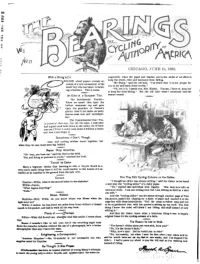
Articles in this issue
- A satirical sketch exposing how daily-newspaper 'cycling editors' simply clip articles from The Bearings, paste them on paper, and pass them off as original work, with a visitor catching the editor red-handed with scissors and a page of The Bearings.
- A humorous first-person column by 'William Twinkle' lampooning a small midwestern town's restrictive ordinances against cyclists—including a new lamp-carrying law—culminating in the narrator unknowingly asking a Casino wax dummy for a match as though it were a policeman.
- A column of miscellaneous cycling news items including four Sioux City mail carriers adopting the wheel, the New York Metropolitan A.C.C. planning a parade, the Kenwood Road Club's Chicago-to-Michigan City century, and Sacramento yielding its claim to the California Division meet in favour of Stockton or Alameda.
- Full account of Frank Waller of the Acme Bicycle Club, Oakland, riding 363 miles 1,590 yards in 24 hours on the Alameda track on June 10, breaking Holbein's world record; includes tabulated split times, pacemaker names, diet details (doughnuts and ale), and a biographical sketch of the Bavarian-born cement worker.
- An editorial rebuking self-styled cycling 'authorities' such as The Wheel for not sending staff to the major meets at New Haven, Syracuse, Cortland, and Rochester, contrasting their absence with The Bearings' hands-on reporting and strong reader endorsements.
- An editorial attacking Bicycling World's performance as the LAW's official organ, including a satirical verse; the article documents the paper's pattern of empty promises about new cylinder presses and argues the League deserves a prompt reliable bulletin rather than a monopolistic advertising vehicle.
- An editorial essay arguing that lean men make the most persistent cyclists because mild dyspepsia drives them to the wheel, while fleshy men are more easily satisfied with other amusements; married men are also noted to drift from cycling after the novelty of wedlock wears off.
- Attorney G. Newell answers a Milwaukee reader's question about whether the private Whitefish Bay drive can charge a five-cent toll to cyclists, confirming that the bicycle, classed as a road vehicle, enjoys no immunity from tolls applied uniformly to all road vehicles.
- A recurring reader-contest column: J.C. Pasqueth of Mexico, Mo. found 'lcft' for 'left' in an Ariel Cycle Co. advertisement; readers are invited to identify a new misspelled word in this week's advertisements, with the winner drawn July 9 receiving a framed pen-and-ink drawing.
- Advance notice of the Saturday June 25 cycling lantern parade in Chicago organised by the Associated Cycling Clubs; lanterns affixed free at the Second Regiment armory from 6:30 p.m., prizes up to $25 for tandems, singles, and tricycles, followed by coffee at the Chicago Cycling Club house where Henry George may hold an informal reception.
- A major multi-page investigative feature presenting candid interviews with LAW vice-president Thomas Sheridan, club presidents, division officers, and trade figures who uniformly condemn Bicycling World for late delivery, dull content, and monopolising L.A.W. membership addresses for private profit at $5 per thousand names.
- Telegraphic report of the Pennsylvania Division meet in Scranton, June 19-22: a 500-rider parade, the 25-mile road race won by Archie Grace of Philadelphia in 1:24:27, race results featuring Tyler and Munger, the Division meeting's resolution against Bicycling World, and the naming of 'Munger Hill' after L.D. Munger's hill-climbing victory.
- Report of the New York Division meet at Buffalo, June 19-20, including W.S. Campbell's victories on the geared ordinary, P.J. Berlo breaking the five-mile competitive record in 13:40, the Division business meeting's formal denunciation of Bicycling World for withholding applicant addresses, and praise for the Buffalo Press Cycling Club's hospitality.
- Race report from Detroit's Hilsendegen 25-mile road race on Belle Isle, June 20, where W.C. Rands of the Detroit A.C. covered the distance in 1:15:59 4-5 through a downpour, eclipsing Hoyland Smith's record of 1:17:11; a results table for the top twenty finishers is included.
- Warning signed by National Racing Board member Wm. C. Thorne urging all amateur cyclists to boycott the July 4 races at Oskaloosa, Iowa, managed by Emmett McDowell, who previously ran fraudulent races at Marshalltown, defies the League of American Wheelmen, and plans to feature 'lady champions' competing against horses.
- Report that 23 relay teams covered the 254.5 miles between New York and Boston on June 16 in 14:51:00 (over 18 mph), with C.F. Seeley reportedly setting a world record of 25.5 miles in 1:14 at Hartford and Hoyland Smith riding the final eleven miles into Boston in just 36 minutes.
- Correspondent C.W. Hartung reports from London on F.J. Osmond's illness, A.A. Zimmerman's N.C.U.-ratified quarter-mile records (:32 3-5 and :30) and a new German 1,000-metre mark, T.A. Edge's Land's End to John O'Groat's ride beating Mills' record by over ten hours, and the tenth annual Woodford meet with 37 clubs and 2,500 riders.
- Race report from Parkside track covering one-mile to ten-mile handicap events; highlights include Brooks on a pneumatic Hickory, Githens' plucky ten-mile effort, Spooner preparing for a July 9 twenty-four-hour record attempt, Nicolet's one-wheel safety riding, and Van Sicklen's pacing throughout.
- Training notes on Chicago Club riders at Parkside: Cy Davis set a track record of 2:29 4-5 on June 16, Van Sicklen lowered it to 2:27 4-5, and an anonymous rider reached 2:24 4-5 on June 21; mile times are listed for fifteen riders including Lumsden at 2:25 1-5 and Githens and Bode capable of 2:28.
- Race results from the West Lynn (Mass.) Rovers' meet at Glenmere track where G.L. Gary and G.L. Conolly featured prominently; J.A. Darlow fell and several riders went over him without serious injury; results cover the novice mile, two-mile handicap (32 starters), Division half-mile championship, and open events.
- A post-mortem on Rochester's circuit races, June 18, where poor local advertising attracted only 1,000 spectators despite a field of over thirty of the fastest U.S. and Canadian riders; C.W. Dorntge wrecked his wheel on the fence but escaped serious injury, and Berlo was capable of a 28-second last quarter in practice.
- The Illinois Central Railroad has written to Chicago C.C. president Tuttle threatening arrest of cyclists using cinder paths beside its tracks for training or racing against suburban trains; The Bearings notes the company is otherwise generally accommodating about carrying bicycles in suburban trains free of charge.
- A wry editorial exposing a bicycle manufacturer's representative who claimed a five-mile ride on the West Side Chicago course in 11:37 2-5—faster than Zimmerman's world record—when the course is actually only four miles long by government survey, 'a slight miscalculation of one mile.'
- A lively feature on the Lincoln Cycling Club's annual overnight steamer excursion from Chicago to St. Joseph, Michigan, where over sixty members enjoyed lake air, sand bluffs, and photography sessions, making noise 'enough for two hundred' and 'practically owned the steamer both ways and the town during the day.'
- Chief consul Gerould is preparing legal arguments against Alderman Potthoff's proposed Chicago bicycle license ordinance, to go before the city council judiciary committee the following Monday; ex-state senator Paddock has been enlisted to assist, and Chicago cyclists intend to test the ordinance in court immediately if it passes.
- Report on Somerville, Massachusetts' semi-centennial celebration of June 18, where 600 wheelmen participated in the 'Civic, Cycle and Military Parade'; the 35-man cycling corps of Company B, First Regiment carried the Stars and Stripes and won the best-general-features prize; the Woodbridge Ladies' C.C. took best appearance.
- The Twin City Century Club of St. Paul and Minneapolis was organised on June 16 with three membership degrees (15-, 12-, and 8-hour centuries) and 45 charter members; Tom L. Bird serves as chief centurion and John S. Johnson as captain, and the club's founding has created a stir in Minnesota cycling.
- The Columbus Century Club beat the Columbus Cycling Club in a relay banner contest, covering the 366-mile round trip between Columbus and Indianapolis in 22:03:00—2:29 ahead of a 15-mph schedule; the winning leather mail bag, stained with lemon, now hangs in the Columbus Cycling Club house as a memento.
- Paris has launched a bicycle postal service from the Place de la Bourse allowing letters to be mailed until 7:15 p.m. for same-evening delivery to railway stations at 15 centimes (three cents); the service bypasses the main sorting office and is being extended to all Paris post offices.
- Feature on the Niagara Machine Company of Buffalo, whose president J. Willard Parker and Berlin agent Joseph Hillebrand supply steel balls globally for cycling and general commerce; many pedals sold under other brand names are Niagara-made, and the article profiles officers including mechanical expert M.H. Wright and English-branch representative William H. Hill.
- A factory-floor account of how pneumatic bicycle tires are made—Para rubber kneaded through heated rollers, fabric grades ranging from 12 to 85 cents per yard, molded in hydraulic presses using dry heat—explaining why over-heating causes early bursting and why a fine inner tube in a cheap outer cover can outperform a poorly matched premium pair.
- Philadelphia veteran A.G. Powell—said to be the first man to ride Ford's Hill on an ordinary—and recognised champion hill-climber John A. Wells both advise sitting well back, leaning forward, gripping handlebars firmly, and pedalling at a slow steady pace rather than attacking hills with a sprint that soon leads to exhaustion and dismounting.
- The Bearings corrects the rumour that British cycles must go in the British building at the Columbian Exposition; all cycles will be displayed together on the entresol of the Transportation Building (900 by 250 feet), with final space assignments deferred until chief Willard K. Smith returns from Europe after July 1.
- C.A. Boyle, sent west by his doctor two years ago, stopped at The Bearings office en route home to Pittsburgh by bicycle, riding mostly along C.B. & Q. railway tracks from Denver; having gained 30 pounds, he reports the novelty of long solo touring never wears off despite constant incredulous questioning by country people.
- A correspondent reports on Toledo, Ohio's cycling scene: 3,000 riders and 250 lady cyclists served by a single club—the Toledo Cycling Club, 300 members—with facilities including a gymnasium, billiard room, and bowling alley; some members favour forming a second club to create healthy competitive rivalry and develop unknown local racing talent.
- A letter from Captain Charles H. Luscomb, 13th Regiment N.G.S.N.Y. and Chief Consul of the New York Division, argues that the Chicago-New York relay ride's adverse conditions prove the bicycle's value for military courier, reconnaissance, and scouting work, and urges the U.S. Army and National Guard to organise bicycle corps.
- The Humber-Rover Cycle Co. sold $11,000 worth of mostly 1891-pattern solid and cushion-tired wheels at Pomeroy Son & Co.'s Chicago auction rooms over five hours; ordinaries fetched $1-$6 each, a new 56-inch Rudge brought $4, and a Yale on which Van Sicklen once raced sold for $1.25.
- The Raleigh Cycle Co. of Nottingham has purchased the Banker Cycle Co.'s Broadway, New York stand and stock, with managing director Paul Angois arriving to oversee the U.S. launch; The Bearings speculates that Zimmerman, who rides a Raleigh, may be installed in their New York establishment after the racing season.
- A column of brief trade notes covering Bown's Aeolus pedals closing orders due to overwhelming demand, the American Ormonde and James Cycle companies reporting brisk sales, the Kenwood Mfg. Co.'s new electric-lit padded riding school at 284 Wabash avenue, and assorted Chicago cycle trade personnel and product news.