The Bearings, Vol 6, No 10
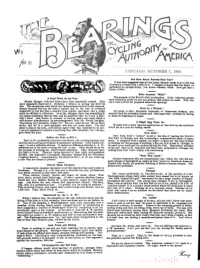
Articles in this issue
- The editor defends professionals Morgan, Eck, and Prince against habitual criticism, arguing that the skepticism surrounding Johnson's Independence mile record—set under the watch of a wealthy Iowa lumber merchant and a judge—is ridiculous, and that Jack Prince's alleged race-selling, however plausible, does not excuse blanket condemnation.
- The L.A.W. is charged with maintaining two farces: the sham amateur rule and the unenforced requirement to publish applicants' full addresses, with President Burdett, the Executive Committee, Secretary Bassett, and the Wheelman Company all knowingly violating a rule they are bound to uphold.
- A satirical account fills in an omission from reports of the previous year's Rochester meet: a farcical professional race whose three starters—Canary, Barber, and Appel—were presided over by referee Bull, who nearly protested Canary for being an amateur before Appel won by a full core.
- The editor dismisses the argument that offering cash prizes at amateur meets will increase betting, noting that pool-selling is already prohibited on the baseball grounds proposed for racing and that the connection between cash prizes and professionalism is overstated.
- Boston ladies' cycling clubs, whose members including Margaret Kirkwood, her sister, and Miss Beers have been regularly reeling off centuries, are praised for their riding but criticized for a rivalry so fierce it has degenerated into what is described as a 'monkey-and-parrot time.'
- A humorous first-person narrative recounts John S. Johnson's reception at the Peoria, Ill., state fair, where twenty thousand spectators cheered him and trainer Tom Eck despite the undulating, hill-riddled horse track causing Johnson to lose the piano race; the correspondent wanders through the livestock and agricultural departments in comic asides.
- Miscellaneous news briefs include Frank Lenz's arrival at Walla Walla, Wash.; the new Elks Cycling Club in Buffalo (president H. Hartmetz, secretary J. Britz); the Colorado Springs Wheelmen's thirty-five-member debut; the Century Wheelmen of Philadelphia expending $2,100 on club-house refurnishment; and a soldier of Co. H, Fourth Regiment, Iowa National Guard, using a wheel in lieu of a horse during the Sioux City encampment.
- Chicago Cycling Club's two-day tournament at Washington Park, October 21–22, expects 50,000 spectators on the first day; N.H. Van Sicklen certifies the track will be in record-breaking condition, Zimmerman and Tyler have promised to compete, a wheel-vs.-horse mile race with Nancy Hanks is planned, and a flying-start triplet mile between Cleveland and Chicago teams may be added.
- Sporting Life's Frank A. Egan has arranged a special palace car, complete with cooks, servants, baths, and wheel storage, to take America's greatest racing men on a southern and California winter tour, giving regions that have never seen top riders a chance to support the sport and trade.
- A Philadelphia report based on conversations with Dando, Richter, Dayton, and cycling editor Frank A. Egan of Sporting Life reveals plans for a professional racing association with cement tracks in Chicago, New York, and Philadelphia modelled on the Paris track, a minimum prize fund of $36,000, revocable racing licenses, and exclusion of riders of the 'Jack Prince stripe.'
- The editor argues that no L.A.W. convention has ever made good roads a bold public issue despite the League originating the movement, and urges the next National Assembly to add a roads session anchored by Isaac B. Potter's illustrated lectures and to adopt resolutions for Congress supporting the national road-improvement bill, noting that bad roads cost Illinois farmers alone $16,000,000 annually.
- The editor attacks President Burdett's confidential letters supporting a plan that would perpetuate the 'amateur' sham through continued non-cash prizes, argues that George F. Taylor and others intend to race for cash next season, and calls for the sham to die, to be replaced by a prize limit forcing men to turn professional when they want real value; Tyler may also quit the L.A.W.
- After an unfortunately long delay caused by a contractor's financial failure and broken dies at a second firm, bronze souvenirs the size of a quarter-dollar—inscribed 'Animo et fide' and '1000 miles—109 hours'—are at last ready for the riders who carried the message in The Bearings' Chicago-to-New York relay ride of May 18–21, 1892.
- Chief consul H.L. Perkins of Massachusetts is circulating a call for a constitutional convention of the L.A.W. on the stated ground of the 'color line,' but insiders whisper the racial issue is a subterfuge and that once sufficient signatures are secured the real call will sweep it aside in favour of broader constitutional reform.
- A gigantic good-roads convention is to be held in Chicago during World's Fair dedication week, organized by L.A.W.'s Frank W. Gerould, S.T.K. Prime, and General Roy Stone; the published call is signed by a distinguished roll including senators Shelby M. Cullom and Charles F. Manderson, Isaac B. Potter, and Chicago publishers H.H. Kohlsaat, Victor F. Lawson, and James W. Scott.
- The Columbus bicycle parade committee, meeting at the Astor House with chairman Morgan and grand marshal G. Minturn Worden, expects over two thousand wheelmen from Eastern and Western clubs—each preceded by a band—to form one of the greatest cycle parades in history, starting from the New York post office on October 12.
- London correspondent reports Johnson's 1:56 3-5 is the talk of the cycling world and may accelerate adoption of cement tracks in Britain; at Herne Hill, A.W. Harris lowered the safety mile record to 2:12 3-5, the Wass-Newland tandem broke all records from two to twenty-five miles (23 miles 1,725 yards in the hour), Lewis Stroud broke the flying quarter tricycle record in 33 seconds, and professional E. Oxborrow of Coventry set a new two-mile safety record of 4:55 3-5.
- The veterans' association for cyclists of ten or more years' experience draws letters from E.H. Wilcox of Stover Bicycle Mfg. Co. of Freeport, Ill., C.L. Stevens of Vineland, N.J. (twelve-year L.A.W. member), Albert C. Stevens of New York (who rode a Wood velocipede in 1870–71), and W.D. Cloyes of H.A. Lozier & Co., who recalls an abortive veterans' group proposed among forty velocipede riders in central New York before the ordinary bicycle existed.
- At Evansville, Ind., Oct. 6, J.S. Johnson won the one-mile piano race in 2:23 3-5 beating Munger by two feet; Lumsden then shattered the five-mile world competition record held by Taylor at 13:39, finishing in 12:36 3-5 and also breaking Taylor's three- and four-mile records of 8:07 2-5 and 10:52.
- Two-day report from the Lockwood Cycling Club's first annual tournament at Jacksonville, Ill., Oct. 3–4: Lumsden rode the fastest competitive mile in the West at 2:18 2-5 (three seconds above Taylor's record), Johnson set a new Illinois state flying-start mile of 2:13 paced by Rhodes, Bliss, Githens, and Lumsden, and Lumsden won the $800 piano in the five-mile open; the Green brothers of Chicago took seven prizes worth $400.
- A Boston rider at the recent Baltimore piano race refused to honour a pre-arranged finish order agreed among a trio—orchestrated by inducer Troy after referee Luscombs imposed a severe half-mile limit—and rode to win instead, causing the other men to shun him entirely and leaving the meeting in a worse temper than before.
- Paris correspondent Albert G. Roux reports that Jules Dubois, over thirty and a former French champion, reclaimed the 100-kilometre record from Reboul in 2:41:56—cutting twelve minutes off Reboul's recent mark—and simultaneously set a world 50-mile record of 2:11:08, riding a wheel of his own make and finishing fresh despite close and sultry weather with a hot southwest breeze.
- A sympathizer argues that Johnson's apparent decline after his 1:56 4-5 Independence record—managing only 2:13 at Jacksonville—is the natural let-down following intensive special training for a single great effort, not evidence against the original achievement; Johnson had less than a month's actual preparation before Independence and may not have realized the relaxation overtaking him.
- At Hampden Park, Springfield, Mass., Sept. 30, Windle set a new world flying-start mile record of 2:04 4-5, beating Zimmerman's mark and lowering Tyler's three-quarter record to 1:32 3-5; he also broke Zimmerman's two-mile world record from 4:37 2-5 to 4:28 3-5, and stated his intention to bring the mile under 2:00 before leaving Hampden Park.
- Louisville Cycle Club's two-night indoor meet at the Auditorium bicycle track drew large enthusiastic crowds: Birdie Munger won the $600 Vose piano in the five-mile open from a field that included Lumsden, Bliss, Rhodes, Githens, Baker of Columbus, and Guyol of Louisville; Chicago men captured nineteen of forty prizes; J.P. Bliss won the Auditorium time cup with the meet's best mile at 2:38 2-5.
- Post-tournament colour notes: R. Philip Gormully postponed a Mammoth Cave visit to attend the second night's racing; T.E. Jefferis, who won a full-dress suit in the invitation race, is to be married the following Tuesday and will race no more; H.A. Lozier of Cleveland, impressed by electric-light racing on the small banked track, announced plans to build a similar facility at his home.
- The Crescent Wheelmen's inaugural tournament at their Cincinnati track, five miles from the city, drew over 2,000 spectators; Lumsden won the flying-start mile open in 2:28 4-5 and the half-mile open in 1:20; Munger and Githens filled the other open places; an exhibition mile on a triplet safety by Bliss, Munger, and Lumsden—Githens riding alongside to pace—clocked 2:19 3-5 to the crowd's delight.
- Boston Athletic Club's 25-mile road race from Boylston and Exeter Streets to Wellesley and return was won by F.B. Emerson of the P.C.C. in 1:22:07 from an 8:00 handicap; P.J. McDuffie from scratch broke the course record by 1:06 despite strong wind; 95 men started and 56 finished within twenty minutes of Emerson to earn bronze souvenirs.
- Zimmerman and W.W. Taxis headlined the joint tournament of the Wilmington W.C. and the Warren A.C. at Wilmington, Del., with Zimmerman winning every event he entered; M.K. Lancaster of the Wilmington Wheel Club won the 25-mile road race with a ten-minute handicap, and Frank Marriott of Philadelphia captured the time prize in 1:20:30 from scratch.
- Arthur A. Zimmerman describes his methods in detail: complete winter rest (he mounted a wheel only once between October 16 and mid-March), gradual spring road work, ten miles morning and afternoon on the track, thorough bare-hands massage and tea with lemon after races, and the importance of training specifically for one's distance; he recounts how racing fifty miles in England after training only for short distances left his legs numb and his heart strained for three weeks.
- Comic fiction: Harry Richardson, an Englishman, bluffs his way into a bicycle-assembly job at the Chicago Best Wheel on Earth Company, twice botches the assembly—hiding the first wrecked machine in a closet—and when the boss bets $10 that no worse-assembled bicycle exists in the world, produces the hidden first attempt to win the wager.
- French inventors have developed a cycle elastic-suspension system to rival the pneumatic, in which independent upper and lower forks are insulated from shocks by spiral springs; a rider equipped with it finished fourth in the Paris-to-Trauville race organized by Le Matin, beating several pneumatic-tired competitors in his first race.
- Column of trade notes: Morgan & Wright pneumatic tires were fitted to Nancy Hanks for her world-record 2:04 trotting mile; Pope Mfg. Co.'s Philadelphia agent Pioneer Hart sold over 1,000 Century Columbias this season; New York pawnbrokers' legal immunity on stolen goods frustrates recovery by Pope's New York representative Elliott Mason; James Josephi leaves McIntosh-Huntington Co., succeeded by Arthur Holmes of London.
- U.S. Circuit Court judge Townsend sustained claims 4 and 5 of A. Featherstone's Dunlop tire re-issue patent against George R. Bidwell Cycle Co. and Thomas Inflatable Tire Co., granting an injunction and order for accounting; Bidwell's Chicago manager disputes the scope; inventor Amos W. Thomas simultaneously filed a separate equity suit alleging $40,000 in unpaid royalties, claiming the defendants exploited his weak-mindedness.
- The Coventry Machinists' Co. Ltd. announces it will build an American factory at Richmond, Indiana, with 80,000 square feet of floor space, the finest modern machinery, and goods identical in quality and design to its English factory, aiming to reach the market in time for the 1893 season.
- Trade notes: Bretz & Curtis Mfg. Co.'s Solid Comfort saddle, pushed by traveller Perrett, is now fitted on Raleigh and New Howe wheels; Airtite Pneumatic Tire Co. confirms Tyler's 2:08 4-5 standing-start mile was made on their tire all season; John J. Fecitt introduces the Airtite to Chicago for use on Union wheels with a special rim; F. Howard Tuttle will travel west for E.C. Sterns Mfg. Co. of Syracuse; the 1893 Garford saddle line of 22 varieties is now ready for cycle manufacturers.
- End-of-season trade survey finds the predicted wave of failures has not materialised; English firms' neglect of American retailers—who were left with demand and expenses but no supply while English makers shipped everything to France ahead of tariff increases—is driving retailers toward home products; at least two strong English companies will assemble goods in the U.S. for 1893; the only alarming rumour is a projected new cycling journal and cycle-trade review in New York.
- The Sercombe-Bolte Mfg. Co. of Milwaukee presents its new removable pneumatic tire, held in place by the rim when inflated and capable of having its inner tube removed and replaced in one minute; the company will also continue making the Bolte Indestructible tire for riders who want puncture resistance, with fall 1893 trade announcements due in three weeks.