The Bearings, Vol 6, No 15
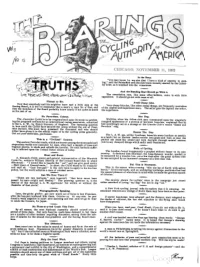
Articles in this issue
- Phoenix's front-page editorial column of short squibs covering the Racing Board, L.A.W. President Burdett's favoritism over the American Cyclist scoop, Colonel Pope's road-department petition to Congress, the consolation race and flying start, shamateurs at Washington Park, and election-season politicians courting cyclists.
- Humorous column by Villinen Twinkli built around a satirical letter from a cycle manufacturer secretly offering to subsidize a rider on the upcoming southern racing circuit while demanding silence and buying groceries at the rider's store; includes commentary on the loafing race and the Washington Park half-mile open.
- Profile of William A. Fletcher at 43 East Van Buren Street, Chicago, whose news-stand holds the unique distinction of stocking every cycling publication of note, including English papers such as Cycling, Wheeling, The Cyclist, British Sport, and the Irish Cyclist.
- Reprinted from Wheeling, this brief piece notes that at Herne Hill and other venues, racing cyclists almost never acknowledge spectators' applause by bowing or raising their caps, in stark contrast to cricketers, and calls for a reformation.
- Satirical piece by Juggins K. Juggins, reprinted from Cycling, parodying the recently published physical examination of Zimmerman; fictional Dr. Hezekiah Strumthorpe examines amateur Josiah Snodgrass and discovers his missing two ounces of brain are wedged uselessly into a greatly developed 'pure amateur' bump.
- An English court has ruled in favor of a cyclist whose wheel was stolen from a country inn yard after the hostler directed him to leave it there, ordering the hotel keeper to pay the full value of the stolen machine.
- Secretary J. B. Ferguson of the Bridgeport, Conn., Y.M.C.A. reports that 35 of the 50 miles from Chamonix to Geneva are downhill, French roads along the Seine allow 75 miles a day, and Scottish Highland touring with companion Samuel Beardsley was comfortable.
- Brief editorial contrasting the current L.A.W. constitution and by-laws ('as it is') against an implied reformed state ('as it should be'), calling for structural overhaul of the organization.
- Editorial defending The Bearings against the Bicycling World's rebuttal, accusing the rival paper of using lawyer-style word-tricks and evading main issues—such as the confusion and postal losses caused by the Wheelman Company's mislabeled member addresses—rather than confronting justified criticism.
- Major editorial on shamateurism including a letter from 'An L.A.W. Member' who condemns officers for knowingly sheltering racing men who openly sell prize bicycles for $100 each on the day they win them; The Bearings suggests the League might best remedy the situation by devoting itself wholly to road work under a genuine amateur rule.
- Report on politicians newly solicitous of cyclists' votes ahead of the Illinois election: a Democratic candidate visited The Bearings office, and Congressman Durborow circularized known cyclists; Republican opponent Thomas C. MacMillan also gave a press interview on roads and cycling interests.
- Department covering the National League for Good Roads executive meeting (Col. Pope, General Roy Stone, Chauncey Ripley and others); N. H. Van Sicklen's L.A.W. membership records back to 1883; the Brooklyn B.C.'s plans for a country house at Bay Ridge or Sheepshead Bay; the Chicago Cycling Club's seventeen-man 'ordinary' bicycle run to Pullman; the new Telegram Cycle Club in Milwaukee with Walter Sanger among its members; Century Road Club organizing at the Grand Pacific Hotel; and Pacific Coast cycling politics.
- Profile of 'Dead Broke' Harry Hilliard Wylie, who rode his Eagle bicycle from New York to Chicago over three weeks without spending a cent, averaging 50 miles daily and covering 103 miles in a single day from New Lebanon to Indianapolis, despite fighting dogs, falling into a canal, and nearly being arrested for vagrancy in Wheeling, W.Va.
- Racing department: Bay City Wheelmen of San Francisco plan an outdoor board track; Joe Goodman of the American Cyclist condemns alleged dirty riding by Chicago men on the western circuit; Milwaukee Exposition Building indoor track tournament closes entries November 19; W. C. Sanger and Fenton Fox confirmed going South; Racing Board fully exonerates Tyler; A. C. Edwards suspended in England for failing to send his entry fee; Cleveland's A. I. Brown, Johnson brothers and Fred Brown reviewed; Kansas City races ruined by mud; Sandy Sellers now a practicing doctor; and various records from Scotland, Kansas and England.
- London, Oct. 29: detailed report on a Catford C.C. debate on 'Amateurism' chaired by Percy Low, at which Francis Glynn proposed dividing riders into licensed trophy and cash classes, with views from C. P. Sisley (Cycling), S. T. Brown (N.C.U. handicapper), G. H. Smith (Cycle Record) and C. W. Hartung (Cyclist); also covers Schofield's new flying-quarter record of 29 2-5 seconds and Wass and Newland's fifty-mile tandem safety world records on the Putney cement track.
- Department of short items: Chicago cyclists' rash election bets (Lumsden loses silk hats and cigars, Nicolet and Lennie must shave mustaches, Murphy and White to push Walters and Werner in wheelbarrows on Cycle Row); W. E. Schenck of Greensboro completes the first century run in North Carolina (107 miles, 11:13:00); Utah Sub-Division approaching 100 members; Chicago C.C. opening dance at Rosalie Hall; and miscellaneous news from Peoria, Baltimore, Springfield, Detroit and Boston.
- Gormully & Jeffery Mfg. Co. files suit in U.S. circuit court against the Kenwood Mfg. Co. of Chicago for infringing their 1893 pneumatic tire patent; Mr. Jeffery states Sercombe & Bolte have already acknowledged copying their tire and will stop production, while at least one other major manufacturer remains 'under suspicion.'
- The World's Fair authorities are placing the cycle trade press in a room adjacent to the chief of transportation exhibits, Willard A. Smith; The Bearings' bound files are already held in Smith's office and will be on continuous display throughout the Fair.
- Reprinted from the Irish Cyclist: two bad seasons, reckless price-cutting and tire-pattern changes have financially devastated English cycle agents, with many large firms pivoting to continental markets; The Bearings suggests recruiting solvent ironmongers as agents, and notes that Ireland's trade remains comparatively healthy.
- Arthur A. Taylor of the Taylor Cycle Co., Chicago, returns from England with a new Psycho bicycle of about 28 pounds featuring hollow continuous drop-forged connections with no welding, resembling the Rover in line; six models are planned for 1893, including a 31-pound ladies' wheel, with the Taylor Cycle Co. holding sole American control.
- Extended interview by 'Itinerant' (reprinted from Sport and Play) with a veteran British cycle trader identified only as 'Mr. John Smith,' who argues the current depression is temporary: fraudulent makers are being cleared out, pneumatic tires will outlast solid and cushion types, and front-drivers will dominate in 1893, with the Dunlop firm credited for the biggest revolution in the trade.
- Two-page trade section covering: the new Fowler bicycle from the Hill Cycle Mfg. Co. (general manager Frank T. Fowler); George Hendee touring the West promoting the Majestic for J. C. Speirs & Co.; the Ariel Cycle Co.'s new Chicago headquarters at Van Buren and Wabash under C. H. Plumb; the Sercombe-Bolte Mfg. Co.'s 10% dividend and six new 1893 models including the 25-pound Sanger Racer; the George H. Bell No. 99 saddle (under one pound, single-clip fastening, sold at Taylor Cycle Co.); the Philadelphia Bourse show (140 spaces, 326x132 ft); and Sundries trade notes including Liberty cycle shipments to Mexico and the Yost Mfg. Co.'s new Falcon models.