The Bearings, Vol 7, No 10
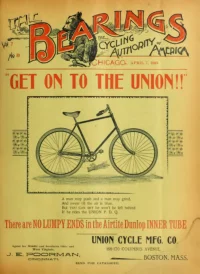
Articles in this issue
- The National Cyclists' Union of England adopts Dr. Turner's amateur licensing scheme by a two-thirds majority (69 to 27) at a London Tavern council meeting, dividing racing men into Class A (no trade connection) and Class B (trade employees not paid to race); correspondent C. W. Hartung covers the full debate including speeches by Turner and Hillier and Grace's failed amendment, with brief notes on Chairman Raymond's decision awarding a Baltimore racing sanction to the Maryland Bicycle Club and St. Louis wheelmen electing twelve of nineteen endorsed municipal candidates.
- Chicago cycling news covers railroads' attempt to charge for transporting bicycles to the World's Fair (led by the Northwestern), the Illinois Central's capacity to handle 1,000 people every two minutes for the Pullman road race finish, J. O. Blake's LAW transportation work, Joliet gravel favored for the Chicago track surface, a Bicycle Accident Insurance Co. organized by Frank P. Wright, and the press committee preparing weekly syndicated articles on the August international meet.
- Investigation of the four-day delay in mailing the L.A.W. Bulletin of March 24: a Hartford dispatch says the Wheelman Company withheld the edition demanding 25 cents per member (up from 12½ cents), while Secretary Bassett claims only a one-day voluntary delay to avoid postal-law violations; globe-girdlers Allen and Sachtleben are escorted by St. Louis riders to Forest Park on return from their round-the-world journey, and the third annual St. Louis Forest Park road race (17½ miles, May 20) seeks Chicago riders.
- Racing Board member Lewis A. Miller of Meriden refuses to sanction the Massachusetts division spring races at Waltham (May 30), seen as Connecticut retaliation in the Worcester-Boston L.A.W. controversy; President Burdett threatens removal but denies it in a Hartford interview, Chief Consul Perkins travels to New York in vain, and Baltimore's Clifton Wheelmen five-mile handicap is won by Edward C. Wollman of the Chesapeake Wheelmen in 16:23¾.
- Tom Roe prepares intensively in Boston for his transcontinental bicycle ride from New York to San Francisco, regularly covering the 4½ miles from the Boston Reservoir to Providence Depot in 14 to 16 minutes; F. Ed Spooner plans to start simultaneously from San Francisco to attempt to beat Roe's time.
- The Bearings announces a subscription price increase from $2 to $3 per year (six months $1.75, three months $1.00) effective with the May 5 issue, arguing the paper's production cost exceeds that of any other American cycling paper and the current price unfairly advantages subscribers over publishers and advertisers.
- Pointed editorial rebuttal of L.A.W. Secretary Abbot Bassett's announcement in the official Bulletin defending the Wheelman Company, identifying five specific misstatements — including the false claim that cycling papers wish to deprive members of a free weekly — and advising Bassett to stop acting as spokesman for the Wheelman Company and return to his assigned secretarial duties.
- Feature in four chapters: D. E. Avery of Jacksonville, a Remington typewriter and Edison phonograph salesman, uses his phonograph to play a Springfield Journal editorial exposing a Sangamon County farmer's illogical objections to road improvement to audiences across Illinois, spreading the pro-good-roads message by recorded voice.
- Editorial urges prominent wheelmen in each town with state troops to organize cycle corps of eight to fifty men and apply for enrollment as infantry with special cyclist duty assignment, arguing this is the surest method to gain military recognition for the bicycle and secure officers' commissions for the organizers.
- Editorial commends contributor "Bolav's" reply to a Brooklyn minister who preached against Sunday cycling, calling it the ablest arraignment of anti-Sunday-cycling zealots ever produced by a cyclist and pledging to circulate it beyond the cycling press.
- Editorial responds to L.A.W. President Burdett's plea for fair press treatment, acknowledging his self-sacrificing energy and the promise of a prompt statement on Good Roads' finances, while noting that his Philadelphia Assembly tactics created an impression of partiality to a Boston publisher that the paper now regards as past.
- Regular editorial column covers English rider P. J. Osmond's upcoming American visit, arguments against opening L.A.W. championships to foreigners, F. T. Bidlake's two-speed gear experiments over 120 miles of bad English roads, the true nature of the Florence Italy cycling mayor's street privileges (clarified by Baltimore's Arthur H. Baxter), the French $2 cyclist tax bill stalled in the Senate, and San Francisco's controversial division meet capture through 386 disputed new members.
- New York correspondence reports that W. S. Campbell refuses to return the L.A.W. state and national championship medals he won while not a League member, with rumors they have been given to friends including Asa Windle and Willis B. Troy; also covers concern that college athletic associations may offer board and tuition to speedy cyclists in shamateurish fashion, dissatisfaction over early international championship dates, and Zimmerman receiving his Racing Board amateur credentials while Walter Sanger has not yet replied to questions.
- Avignon correspondent A. G. Roux reports on the upcoming Bordeaux-Paris road race (572 km, May 27-28) with Stephane, Cottereau, and Dubois as favorites, a successful cycling theatrical revue "Paris Fin-de-Cycle" by Lafitte, Minart, and Davin de Champelos, and L. Bandry de Sannier's plan for a central Paris cycling club house; Philadelphia notes cover the Century Wheelmen's new "Carr Cup" trophy for most club runs (worth $225); San Francisco's San Jose Road Club five-mile handicap is won by J. C. Smith (scratch) in 15:48 4-5.
- Profile of Archie C. Willison, president of the Cumberland (Md.) Hardware Co. and leading wheelman advocate of western Maryland, praising his parliamentary skill, devotion to cycling, and his famous 174-mile solo overnight ride from Frostburg toward Baltimore that ended when his tire punctured eight miles short and he slept under a straw stack.
- Long essay signed "Bolav" rebutts a Brooklyn minister's sermon against Sunday cycling by tracing Sabbath observance from ancient Jewish practice through Christianity, arguing that civil law requires only that one not disturb others by riotous conduct, and that cyclists who escape to the country to worship "under every green tree" are among the least likely to go astray.
- Dr. Gordon Stables advises via a Chicago paper that children must be medically examined before cycling, no one should attempt long-distance riding before age 22, and club rides are particularly dangerous for young riders since emulation leads to spurting and hill-climbing that can permanently stretch and damage a weak heart.
- The editor's nostalgic feature contrasts the loving care given to ordinary high-wheel bicycles — recalling Cola Stone, described as the greatest road rider who ever mounted a wheel, fixing his 60-inch machine by midnight in a St. Louis basement — with modern impatience toward safety machines, and discusses elliptical sprockets, Chicago's flat terrain compared to St. Louis hills, and old cycling companions now in Chicago including Edward Stettinius and "Deacon" Cranz of the Diamond Match Co.
- Table reprinted from Cycling magazine listing world records for one mile by 25 modes of travel: a Midland Railway train at 49 4-5 seconds, safety bicycle J. S. Johnson (flying start) at 1:56 3-5, W. W. Windle (standing start) at 2:04 3-5, trotting horse Nancy Hanks at 2:08 3-4, then ordinary bicycle, tricycles, ice skater, runner, rower, snow-shoe walker, canoe paddler, and swimmer.
- Letter from "President Bates" argues the county road taxation system is fair because it levies heaviest cost on cities and villages rather than farmers, citing official records from an orange district where property values more than quadrupled in eight years after road improvements, with former farming opponents becoming the strongest supporters once roads were built.
- Brief items column: 2,218 volunteer cyclists in England; Thomas Burns of Binghamton N.Y. wagers he can ride 700 miles to Chicago in eight days; France adopts a standard 37-pound cushion-tired military safety at about $80; a Denver cyclist overhauled a horse thief on behalf of Justice Barnes; Eastman Kodak Co. cyclists in Rochester arrange a six-mile handicap road race; L. B. Zuner of Mobile defeats Frank Mehlig of New Orleans for $500 and "championship of the South"; and Phillip Young of Montclair N.J. has ridden 32,617 miles since 1882.
- Major analytical article by S. W. Merrihew examines whether the $150 price for a first-class bicycle is justified, exploring manufacturers' genuine costs — severe testing guarantees, year-ahead production risk in a volatile two-to-three-month selling season, and selling costs that can exceed building costs — while predicting that growing competition and supply will force prices toward $100-$125 within one to two years.
- Chicago trade news: the Quadrant Cycle Co. ships seven patterns from England, Warwick & Hazlewood prepares twenty machines photographed at the factory, and Swift's thirty London National Show machines are redirected to the Chicago Coventry store; John O. Blake of Gormully & Jeffery is secretly tracing stolen wheels including a Columbia No. 23910 and a ladies' Victoria; Theodore Smith's James road racer (geared to 80, No. 3,651) is stolen by a would-be purchaser who rode away from Smith's Indiana Avenue home.
- Essay by "Bolav" challenges elliptical sprocket advocates, recounting personal experiments with a friend showing power loss due to chain slap and uneven pedal motion, and illustrating the psychological element with the story of a young bookkeeper who praised his wheel's ease after a repairman secretly did nothing but wash it, leaving his 64-inch gear unchanged.
- New Orleans correspondent finds cycling trade at a standstill despite forty miles of good asphalt streets: most of the six retail stores carry old 1891 models nobody wants, E. C. Fenner & Co. (Rambler, Raleigh, Victor agents) have cornered the little business available, and the Southern Cycle Co. cannot sell even deeply discounted high-grade machines because buyers insist on the latest 1893 patterns.
- Trade reports across the South and West: Ott & Treiller of Dallas open a large riding school and place the biggest tire order ever from Texas (100 pairs of Morgan & Wright tires); Fort Worth's installment-credit business is in unhealthy condition; W. A. Parker of Waco opens a model exclusive cycle agency; San Francisco trade brightens with Osborn & Alexander reporting satisfactory Columbia and Hickory sales and builder Mohrig constructing five custom machines.
- A traveling salesman's rumor that the Overman Wheel Company was organizing a manufacturers' price-maintenance trust through its Denver branch is investigated and deflated: Col. A. A. Pope emphatically denies any syndicate plan, saying he controls thirteen companies and is a syndicate in himself, while William C. Overman calls it nonsense; the truth is that Overman's Denver agency merely asked to join a local dealers' association to maintain prices on second-hand wheels.
- A Riverside Press reporter describes a three-day bicycle tour from Riverside through the fog-shrouded Temescal mountains, the green Chino ranch hills, Pomona, and rough roads near Puente to Los Angeles, then on to San Gabriel Mission and the peacock and deer park at Lucky Baldwin's ranch, with an encounter with a wagon-driving Chinaman who said the bicycle bell sounded "allee samee like telephone."