The Bearings, Vol 7, No 12
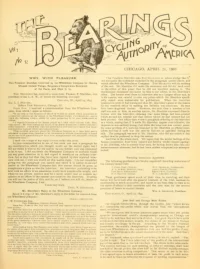
Articles in this issue
- L.A.W. Vice President Thomas Sheridan submits letters to The Bearings and to the Wheelman Company disputing the accuracy of a previous Bearings interview attributed to him; the paper stands by its report and denies misquoting or misrepresenting him.
- A.A. Zimmerman departs for England via Bordeaux, and The Bearings dismisses predictions that Walter Sanger will beat him early in the season; includes a detailed description of the July 1892 N.C.U. one-mile championship photo from Leeds featuring Zimmerman, Schofield, and Edwards.
- Hartford correspondent reports that Connecticut L.A.W. members are dissatisfied with President Burdett's prolonged delay in publishing Good Roads financial accounts, his full payment of $5,000 to editor I.B. Potter before the statement was rendered, and his alleged use of two cycling papers as personal press organs.
- Milwaukee manufacturer P.H. Sercombe cannot accompany Walter Sanger to England due to business obligations; Sanger and trainer Culver will sail on the Teutonic May 3, with Sanger's camp planning he will defeat Zimmerman in the first four or five races they meet.
- The Bearings editorial backs the Hartford correspondent's criticisms of President Burdett, urging him to follow Chairman Raymond's example of candid public statements rather than communicating through inspired articles in personal organs, and calling the delayed Good Roads financial statement 'indicative of an autocratic policy.'
- The paper reprints an editorial from the Louisiana (Mo.) Press condemning the annual St. Louis wheelmen's pike county tour as Sabbath-breaking and indecent, then rebuts both charges, noting The Bearings itself recently published a photograph from the tour showing riders who were plainly not half-dressed.
- Editorial urges cyclists to shake off winter isolation, seek the company of active healthy riders rather than sluggish ones, and embrace the coming season of road and track riding before summer passes and the office claims them again.
- Editorial defends The Bearings' practice of promoting cycling in cities such as St. Louis, citing Chicago's thriving clubs and cycle stores as proof of what 'judicious booming' achieves, and invites live correspondents from western cities where cycling is only beginning to grow.
- Miscellaneous column featuring a profile of Wheeler editor W.S. Holding, comments on the Pullman color-bar vote and expected shamateur suspensions, the St. Louis election placing cyclist-allied William F. Saunders as mayor's private secretary, the story of globe-girdler Allen's father reading travel books to follow his son's world bicycle tour, and a critique of a Revue des Sports satire mocking American cyclists.
- A humorous three-chapter sketch follows a Chicago cyclist who resolves before his first spring ride to cure his hunched-back position, only to succumb to the 'abominable hump' when riding home into a stiff sou'west headwind — because 'the machine was built that way.'
- Bradstreet's financial journal is gathering answers from prominent L.A.W. members to nine questions measuring the direct and indirect economic cost of poor country roads, including effects on farm produce prices, merchant collections, interest rates, and land values.
- Correspondent debate on F.J.J. Glynn's Wheeling article: one writer argues tire flection wastes power and corrugated tires act like lumps raising the centre of gravity; an expert road rider using a longitudinally corrugated light pneumatic reports it increases speed and reduces mud-throwing by cutting the area of road contact.
- A Des Moines real estate man proposes a 300-cyclist road race from Des Moines to Chicago with $900 in prizes self-funded by $15 entry fees; The Bearings points out that cash prizes would make all entrants professionals under L.A.W. rules and doubts 75 Iowans would pay $15 each to enter.
- The editors introduce a response letter from professional cyclist John S. Prince of Mobile, who faces vague charges of luring southern amateurs into professionalism, noting that Prince is a genuine factor in cycling's southern growth and that the evidence against him is not conclusive.
- At the Associated Cycling Clubs of Chicago's April 12 meeting, only two delegates — Gardiner of the Lake Views and Root of the Chicagos — voted to allow Black riders in the Pullman road race; the prize list is expected to reach $4,000 in value including about twenty bicycles, with L.A.W. Vice President Thomas Sheridan as referee.
- The Chicago cycle track at the 35th Street Base Ball Park will be built by Dolese & Shepard for $7,350 using Joliet gravel on fine macadam, with one-in-five banking on the turns; contractors face a $100-per-day penalty if the track is not finished by May 15.
- J.M. 'Jack' White, 24, is described as the fastest track man in Baltimore after defeating both safety champion William Holland and multiple Baltimore News Cup opponents; employed by the Speedwell Company, he commutes four miles daily from Arlington and has been invincible locally since his debut on Thanksgiving 1892.
- London correspondent C.W. Hartung reports on Easter racing: Schofield and Harris traded victories at Liverpool, Belle Vue, and the Aston meeting, with Schofield winning the half-mile scratch at 1:14 1-5; Don Lacaille competed at Brighton on his new Crypto F.D. front-driver without success; G.L. Hillier plans a series of front-driver handicaps and crushed H.H. Griffin's objection to blind handicaps at the Union Council.
- Philadelphia correspondent reports that Reading and the Penn City Wheelmen are quietly working to secure the 1893 Pennsylvania division meet; the South Ends and Quaker City Wheelmen have already announced race dates for June 24 and August 26, while cycling club dances have fallen out of fashion after nearly all clubs lost money on their 1892 receptions.
- New York correspondent reports overtures for a 25-mile team road race between the Kings County Wheelmen of Brooklyn and the Chicago Cycling Club; the Irvington-Milburn road race has set a 1:28:00 bronze-medal time limit, with Harry Hall Jr., Charles Kluge, and William F. Murphy all planning to ride, while W.W. Windle invites George C. Smith to train together at Westmill bury.
- Boston correspondent reports Massachusetts wheelmen are frustrated waiting for the L.A.W. Executive Committee sanction, with both Vice President Sheridan and Dr. Brown indicating they will vote to sustain the appeal; Worcester's attempt to send Windle to sabotage the Waltham track project was flatly rebuffed by the capitalist building it.
- Nearly 200 members form the Rochester Cyclists' Association to lobby for better roads and a city bike path; Herald bicycle popularity voting-contest candidate Charles Struble was caught submitting thousands of counterfeit coupons, costing him both second place and his newspaper position.
- Professional cyclist John S. Prince writes from Mobile, Ala., defending himself against charges of corrupting amateurs, stating that the two St. Augustine riders who paced him in his horse race knew the rules and freely chose to turn professional, and asking The Bearings to publish his letter as a fair reply.
- St. Louis correspondent describes how H.G. Anderson's Post-Dispatch interview accusing the Wheelman's Political Association of being a Republican tool led to L.A.W. expulsion charges and a $6,000 lawsuit against six league members; all charges were dropped after Anderson withdrew the suit.
- The New Orleans Bicycle Club, after thirteen years of activity, merges with the Louisiana Cycling Club to form the Pelican Cyclists, who begin with a modern clubhouse featuring bowling alleys and baths and plan to build a cycle track before the end of the 1893 season.
- Denver correspondent reports that two Black riders seen at a Brighton club run will not be permitted to enter the coming road race despite being described as intelligent and riding high-grade machines; organizers expect conditions may produce a record 25-mile time, with a $700 piano among the prizes.
- The Baltimore Club has secured a Racing Board sanction for a July 4 meet at the Maryland Division track, now accessible by a new electric railway; the club will also hold a five-mile road race on Pimlico May 30, possibly extended to ten miles, while F. Howard Harvey and club president M.F. Thomas recently completed centuries.
- Kansas City clubs enjoyed large spring turnouts to Raytown and Merriam Park as five more miles of the Raytown road were macadamized; Captain Warren has prohibited scorching on club runs, and several members are training for the St. Louis Forest Park road race on May 20.
- L.M. Wainwright of the Central Cycle Mfg. Co. writes from Asheville describing smooth red clay mountain roads at altitudes of 2,500–6,000 feet as ideal for cycling, with only about twenty local riders but visitors regularly bringing their wheels for the grand scenery.
- Miscellaneous items include Sanger's departure for Springfield, the Milwaukee Wheelmen's June 8 meet at National Park, the death of Comte Alain de Coetlogon while cycling in Paris, Kaufmann's trick-riding wager against German rider Marschner, receptions for globe-cyclists Allen and Sachtleben in St. Louis, the marriage of retired racer Colie Bell in Minneapolis, and Brooklyn Bicycle Club election results with I.B. Potter as president.
- The Cyclist editor Henry Sturmey reports after experiment that elliptical sprocket wheels are a genuine gain for hill-climbing and steady road 'plugging' but interfere with sprint rhythm; most manufacturers have misunderstood the correct crank position relative to the rider's hip-joint, and using a higher gear with the elliptical immediately cancels the advantage it confers.
- A.G. Spalding & Bros. obtained receivers for Baltimore's Sportsman's Supply Co. by enforcing a $1,500 chattel mortgage; company president R.H. Chapman disputes the action, contending the account was paid in full eleven months earlier and the company was in good condition, resulting in a cross-bill and appointment of joint receivers.
- A bill before the British Parliament would extend the definition of 'bill of sale' to cover all time-payment cycle agreements, requiring costly registration and voiding any deal under $150 — a threshold below the price of many wheels sold on instalment, threatening to make time-payment cycle sales legally uncollectable.
- Dealer complaints about heavy, over-engineered bicycle shipping crates prompt an editorial; one western dealer reports a 31-pound wheel arrived from Boston with $16.80 in express charges, its crate 'looking more like the cage of some ferocious beast,' and The Bearings calls on manufacturers to improve packaging.
- Department column covering cycle row: Featherstone & Co. claim to be first to fit pneumatic tires to bicycles in America; the Pope Mfg. Co. sells a record 39 Columbias in one day; manager R.D. Garden signs three red-headed Columbia riders including Herbert Githens and George Thorne; pick-ups include Fowlers arriving on Cycle Row, the sale of a 55-inch pneumatic Humber ordinary for $40, and extraordinary demand for Eagles and Pullmans at Woodrough & Hanchett.
- Reprinted from the Cycle Trade Journal, this analysis of the English bicycle trade argues that lower prices driven by competition will expand demand to record levels in 1893, but warns against over-production and overstocking, noting that the pneumatic tire revolution made solid-tire inventory nearly worthless overnight.
- Houston correspondent reports that C.G. Field, representative of the Stokes Mfg. Co., is finding strong demand for Union and Sterling wheels across Texas, making warm friends among dealers and expected to spend thirty to forty more days in the state visiting the larger Texas cities.