The Bearings, Vol 7, No 13
Articles in this issue
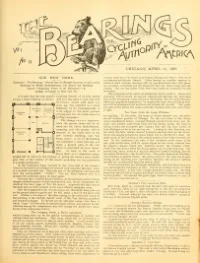
- The Bearings announces its move tomorrow to the ninth floor of the new Isabella Building at 46–48 East Van Buren Street, Chicago, describing the editorial rooms, compositing room, and a novel lounging room open to all riders and tradesmen, with views of Lake Michigan and the distant World's Fair dome.
- English champion F.J. Osmond arrives unannounced in Chicago late Wednesday night and registers at the Wellington; he discusses Schofield as England's fastest man up to ten miles, expresses hope of beating Zimmerman at the international meet, and is disappointed that the new Chicago track will not be ready for two weeks.
- New York city letter reporting the banquet at Wallace's on Fifth Avenue to welcome F.J. Osmond and bid farewell to Arthur Zimmerman before his European trip, with Kennedy-Child as toastmaster; Osmond promised to race only if he could do himself justice, and Zimmerman's overseas expenses will be paid by the New York Athletic Club.
- The Associated Cycling Clubs are forced to reroute the Pullman road race via South Chicago and 92nd Street after new electric railway tracks on Stony Island Avenue make the old course impassable; the course is now two and one-eighth miles longer, and the prize committee expects to assemble a $4,000 list of twenty bicycles and thirty other prizes.
- L.A.W. Vice President Sheridan reports the delayed Good Roads financial statement will appear in the Bulletin next week; the New York Executive Committee meeting settled the Massachusetts division's Waltham sanction appeal, the Wheelman Company withdrew its per-capita subscription demand, and President Burdett is empowered to incorporate the League in New Jersey or Connecticut.
- W.C. Sanger, in excellent condition with upper body training but no leg miles yet, visits The Bearings with trainer C.R. Culver on his way to Springfield, Mass., before sailing May 3 for England, where Culver plans to enter him in all prominent races including the N.C.U. championships June 17, before sailing home June 21 for the Sarnia meet July 2–4.
- Chief Consul Holm of Missouri announces the Clarksville fifty-mile road race scheduled for May 8 is abandoned for lack of prize pledges despite a fixed turnpike course and strong entries; the Pike County tour on May 7 proceeds, with over 250 riders expected from St. Louis, Jacksonville, Springfield, Quincy, and other towns steaming down the Mississippi on the Gem City.
- Editorial clarifying last week's "See that Hump!" piece, arguing that modern bicycle frames force riders into an unhealthy crouching posture and the fault lies with builders rather than riders; quotes the Medical Press and Circular warning that cycling's "physical debt" is a rounded back that may in time become an inherited characteristic of the race.
- Editorial commending President Burdett of the L.A.W. for his early protest against Connecticut's new anti-pool law, now vindicated as the Charter Oak Park Driving Association has canceled all Hartford cycling dates for July 4 and September; petitions for repeal are to be circulated at once.
- Editorial dismissing New York electrical engineers' proposal to substitute an electric railway network for the $10,000 hard-roads bill, citing impracticality for farms and side roads, and ridiculing the Scientific American for assuming the Good Roads movement is funded only by "young fellows" of the League.
- Department column including: the surprise marriage of Bearings artist Charles A. Cox, whose "landlady" was revealed to be his new wife; commentary on faked interviews in Sporting Life; a critical response to a Cleveland minister's qualified endorsement of Sunday cycling; and a portrait of John T. Huntington of Cleveland, new Ohio member of the L.A.W. Racing Board.
- Boston city letter revealing that baseball men Jacob C. Morse (Boston Herald cycling editor) and William McGunnigle—who managed Brooklyn's 1891 national championship team—have secured an N.C.A. franchise for Boston; McGunnigle is leaning toward a track at Brockton, 30 miles from the city, and has engaged an inducer who has already obtained race promises from Taylor and Berlo.
- New York city letter accusing the L.A.W. of favoritism for sanctioning three bicycle events at the Seventh Regiment games despite the regiment's bad standing with the A.A.U., contrasting its earlier refusal to sanction Buffalo events under identical circumstances; also reports Casper Whitney's Harper's Weekly view that the maker's amateur is everywhere and cycling is in an unhealthy state.
- London correspondent C.W. Hartung reports on the N.C.U. licensing committee elections and argues against "Wheeling" magazine's call to revive professional racing, noting too few professionals are willing to organize and control it; also reports the resignation of R.L. Philpot as general manager of the New Howe Co. in Glasgow and upcoming Hospital races at Herne Hill on May 27 with the Lord Mayor in attendance.
- Minneapolis, on the international circuit for August 19, is building a three-lap board track on 15th Street at a cost of $10,000, backed by a $100,000 guarantee fund from the Minneapolis Carnival Association, with the opening meet set for Decoration Day.
- George P. Mills, the intrepid long-distance road rider, describes his forthcoming 1,000-mile ride from the tip of England to Scotland on a light tricycle as merely "a trial spin" to test the strength of his bad ankle.
- Peoria city letter reports a ten-mile relay race being organized between the Y.M.C.A., Peoria High School, and Peoria Bicycle Clubs with five riders each carrying club colors two miles apiece, set for the second week in May; several Peoria riders are also joining the Springfield-to-Madison relay at the end of May.
- At the recent Santa Barbara, California carnival, George W. Gourley and W.M. Jenkins rode tandem decorated as a sloop yacht "Flora" with fish-netting sails and floral anchors, taking first prize; Maurice C. Kittredge won second riding as Cupid on a white-flannel costume with a wheel trimmed in marguerites and yellow mustard.
- William Van Wagoner, training since December at Springfield, Mass., recently rode 125 miles in 8:45 over a hilly road despite rain and wind; he will ride the Boston-Chicago relay, Forest Park race in St. Louis on May 17, and Decoration Day at Buffalo, aboard a 20-pound Warwick wheel geared to 71 under Springfield B.C. colors.
- Editorial advice on diet for racing men, recommending beef, mutton, fowl, fish, soups, bread, fruit, and milk puddings while cautioning against excess tea, coffee, potatoes, and spirits, noting that a glass of beer at meals is acceptable for some men.
- Chicago department covering Julian P. Bliss's anxiety over seven medals dropped into Lake Geneva by a sister that may threaten his amateur standing; hotel price-gouging for World's Fair visitors; the loss of First Regiment Cycle Corps arms in an armory fire; and brief notes on Osmond, Lumsden, the new Clarendon Wheelmen, and a proposed Elgin-Aurora 100-mile road race.
- Miscellany including H.C. Tyler entering training for Boston on Decoration Day; 5,539 cyclists leaving Paris on a recent Sunday morning; John Cochrane of Maiden planning a record ride to the World's Fair; Robert Bruce riding New York to Chicago writing "The Wheelman's Ideal Route to the Fair"; and Jules T. Hancock breaking the Pacific Coast ten-mile road record at 32:11 on a No. 5 Rambler at San Leandro.
- Trade column by "Bolav" arguing that Chicago cycle dealers show unusual fraternal good will and warning salesmen never to disparage rival machines because informed modern buyers will instantly distrust such claims; notes that the main point of superiority between top makes lies only in tire selection.
- A.L. Garford, president of the Garford Mfg. Co. of Elyria, Ohio, publicly corrects cycling papers that published Bretz & Curtis Mfg. Co.'s false circular claiming Judge Dallas ruled the Solid Comfort saddle did not infringe Garford patents, quoting the actual U.S. Circuit Court decision showing Dallas merely declined to issue a preliminary injunction pending full hearing on pleadings and proofs.
- Profile of E.H. Wilcox, a fourteen-year cycle trade veteran who was the first regularly appointed traveling man for a U.S. cycle firm (Gormully & Jeffery) and carried the first bicycle trunk in the country, now leaving the Stover Bicycle Mfg. Co. of Freeport, Ill., for the Ariel Cycle Mfg. Co. of Goshen, Ind., as secretary; Robert C. Lennie is expected to take over Stover's Chicago store.
- Memorial note on Freeman Lillibridge, recently deceased in Illinois after a long illness in Texas, who helped popularize the hammock saddle and invented the detachable handle-bar used by George Hendee and other prominent riders; the bar once saved editor Van Sicklen from a fractured skull when he struck a telegraph pole near Indianapolis.
- Two Bearings staff report on the cycle exhibits in the Transportation Building, finding the Overman Wheel Co.'s mahogany and gilt booth nearly complete, Pope Mfg. Co.'s ornate brass pavilion rising, and English exhibitors Premier Cycle Co. and Whitworth with booths that have seen service in Britain; the article also describes the building's broader transport exhibits from a full ship's cross-section and Mexican cart to locomotives ranging from old Samson to a 90-mph C.M.&St.P. engine.
- New Orleans correspondent corrects a previous Bearings article, noting dealers do carry 1893 wheels but the market is hampered by a whimsical population that resists buying; the Southern (Taylor) Cycle Co. has left town, repair business is steadier than wheel sales, and trade travelers D.J. Canary, L.W. Conkling, and R.W. Slusser recently visited the Crescent City.
- Felton Parker of Hartford delivers a detailed rebuttal to Kenwood Mfg. Co.'s Douglas in the ongoing elliptical-sprocket debate, reproducing a letter from Trinity College professor F.S. Luther proving by integration that the mean lever arm of an ellipse equals that of a circle of equal circumference, and concluding that the sprocket's advantage is purely physical—better distribution of the rider's muscular force—not a mathematical gain.