The Bearings, Vol 7, No 14
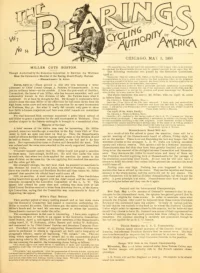
Articles in this issue
- Connecticut Racing Board member Lewis A. Miller defies the L.A.W. Executive Committee by refusing to grant a sanction for Massachusetts division's May 30 Waltham meet; the full correspondence is reproduced and Massachusetts wheelmen openly discuss secession and calling a National Assembly.
- Michigan voters adopt a constitutional amendment for county and township road maintenance by nearly 20,000 votes; President Bates explains that the tax structure places the heaviest cost on cities and villages rather than farmers, and that free labor—not convict labor—was the key to winning working-class support.
- The Associated Cycling Clubs of Chicago decline to reconsider their vote barring Black riders from the Pullman meet; the meeting also debates grandstand and rope arrangements at Pullman, a proposed 25-mile inter-city road race against Buffalo, and plans to banquet F.J. Osmond.
- Report on the Boston–New York–Chicago message relay: Van Wagoner gains 1 hour 27 minutes on the Springfield leg, but two hours are lost between Port Chester and New Rochelle when riders fail to appear; at press time the dispatch is 14 hours behind schedule at Buffalo after passing through Syracuse before a crowd of 5,000.
- Editorial statement explaining that The Bearings serves as a medium between manufacturer, dealer, and rider—a broader field than a purely trade journal—and that faithful adherence to this policy has placed its circulation above any other independent cycling paper.
- Around June 1, L.J. Berger will be succeeded as editor of The Bearings by George K. Barrett, the paper's first editor; Berger will take an editorial position on the new Chicago cycling paper Cycling Life, in which he will hold an interest.
- The Bearings defends its Hartford correspondent against 'X.C.C.' of the American Cyclist, who privately admitted he was 'only writing to fill space' when he accused the paper of faking its Good Roads reporting from Hartford; the editors call out his mercenary duplicity at length.
- Editorial rebuttal to competing cycling journals' promises of enlargement and improved printing, arguing their claimed circulations make the economics of enlargement impossible and that their spread-eagle promises are desperate responses to the crusade for full postal addresses that The Bearings started.
- Essay observing that English bricklayers and painters ride solid-tired machines to work, and that Chicago's early-morning boulevards are filled with working-class cyclists carrying tools and lunch boxes—riders who extract the last bit of pleasure from cycling without gaudy kit or scorching.
- Colonel Albert A. Pope calls on the nation's 18,000 newspapers to support his proposal for a Senate Agriculture and Forestry sub-committee tour to investigate road conditions and their agricultural impact; The Bearings endorses the campaign and lists the nine committee members.
- Miscellany column covering: a St. Louis bicycle thief whose case prompts Judge Claiborne to declare bicycles more important than horses; Canada's childish complaint about exclusion from the international circuit; Secretary Bassett praising Kentucky division bookkeeping; criticism of conspicuous medal-wearing; professionalism in Australia; and cycling prospects for the 1894 Denver L.A.W. meet.
- C.W. Hartung reports from London on the completion of the new pine-batten wood track at Herne Hill, measuring exactly 502.857 yards (3.5 laps to the mile), built by Messrs. Peacock Bros. of Brixton; racers including Lacaille and Bates praise the smooth, fast going, and experiments show wood grips rubber better than cement.
- Zimmerman denies being party to any scheme to prevent Walter Sanger from racing in England, recounts their prior race at Sarnia, Ontario where Sanger had a 20-yard handicap and won, and says he expects faster men in England this year and looks forward to a fair meeting with Sanger to settle who is quicker.
- George Hendee considers returning to the track after shedding surplus weight; Sanger departs Springfield for New York after a week's training on the local path, praising it as the best he has seen; road crack Van Wagoner and youngster E.A. Nelson are in fine form for the coming season.
- Globe-circling cyclists Allen and Sachtleben depart St. Louis escorted by local riders, having snapped 4,000 photographs during their journey; they expect to reach New York in three weeks, completing a trip begun three years ago, with a full journal to form the basis of a published narrative.
- C.W. Hartung's London dispatch covers Mr. Schofield Sr.'s letter defending son J.W. Schofield's amateur status at the Whitworth Works; the Surrey Cup race at Kennington Oval drew 20,000 spectators and was won by A.W. Harris in the 10-mile scratch over Fowler and Lambley; also covers a new corrugated cement surface at the Kensal Rise track and a newly asphalted path at High Beech.
- The Century Wheelmen of Philadelphia conclude their social season with three nights of minstrel performances on April 27–29 in their gymnasium, with manager E.H. Collins, new scenery by scenic artist Oscar Ryhter, and all effects produced by club members.
- Humorous essay by 'Bi. News' satirizing the novice racer who ignores advice, buys successive machines (the 'Suspense' by Smashem & Co., then a 'Rumtum'), eats tomatoes to thin his blood, fails in every handicap by cracking after one lap, and never grasps that method—not equipment—is the key to path success.
- Brief items column: English debate on whether club runs are failing; J.S. Johnson and H.C. Wheeler to race at Worcester on Decoration Day; LAW sprinkle committee secures dry streets until 9 a.m. in St. Louis; new Ganymede Wheel Club formed at Council Bluffs, Iowa; Dayton Wheel Club's minstrel show to play at Cleveland on Decoration Day.
- Profiles the newly elected officers of the Southern California L.A.W. division, formed April 15: Chief Consul J.S. Thayer of Los Angeles, Vice Consul E.A. Hornbeck of San Diego, and Secretary-Treasurer B.C. Jordan of Riverside; includes an enthusiastic letter from Dr. S.A. Defoe describing cycling conditions on a 1,200-mile tour, noting George Faulkner's new coast record of 1:19:04 at the San Leandro 25-mile road race.
- Union Cycle Mfg. Co. of Highlandville writes to The Bearings and to Sporting Life protesting the Philadelphia paper's coercive practice of 'roasting' non-advertisers; full text of both letters is published, the Union Company pointing to Sporting Life's own failed Cash Prize Car scheme and demanding to be left alone.
- Editorial on the practical advantages of two-speed gear devices as a complement to—or substitute for—the contested elliptical sprocket, citing R.J. Mecredy's Fortnightly Review article on a Coventry gear weighing under three pounds that shifts from 58 to 72 inches while riding, operated by a brake-style lever.
- Report on the chaotic state of cycle exhibits in the Transportation Building gallery at the World's Fair two days before opening: the English section (Whitworth, Premier, Warman & Hazlewood) is nearly complete while most American firms are still unpacking; describes Pope's relic boneshakers, Hickory's wooden ordinary, and German booths of Adam Opel and Henrick Kleyer, including a 15-pound German racer and a 28-pound tandem.
- C.L. Berg of Lemars, Iowa argues the elliptical sprocket deserves a fair comparative trial, contending dissatisfied users are gearing too high, and urges readers to report their own experience in The Bearings rather than rely on makers' or dealers' interested opinions.
- A Portland bicycle dealer recounts convincing an ambitious young rider—fresh from admiring the dealer's own racing credentials—to buy a machine and racing suit by vouching that the maker's wheels 'breed champions': the first sale of the dealer's week, completed on a Monday.
- 'Bolav' deplores Chicago cycle dealers' price-cutting, auction sales of obsolete machines, and scalpers who sell doctored stock at apparent discounts, and calls on the Cycle Board of Trade to act before the season ends in the usual 'bustedness'; contrasts Chicago's chaos with strong, orderly trade everywhere else.
- Step-by-step guide (reprinted from Cycling) on deflating, dismounting, patching, and refitting the Dunlop wired-edge tire, describing its pine-rim ledge, binding wires of torpedo-net steel, and canvas jacket; notes a simple repair takes 5–10 minutes and suggests replacing the inadequate milled valve nut with a winged nut.
- Letter from an Englishman in the United States noting that American amateur racers openly negotiate cash for riding machines and club colors, that American bicycle manufacture already surpasses English in design and finish, and that the day of bicycle importation to America is 'on its last legs.'
- Technical explanation from the India Rubber World on how air permeates rubber under 40-pound inflation pressure, how poorly vulcanized cotton duck allows air to migrate along the tire wall after a first puncture, and why skilled repair of that first puncture is critical to the tire's long-term serviceability.
- Article on the growing acceptance of cycling among American women, arguing the bicycle's pleasurable appeal overcomes old prejudices; describes the Kenwood ladies' bicycle as a model of combined lightness and strength, lighter and stronger than the previous season's model.
- Editorial from the Cycle Trade Journal defending impartial show reporting by explaining that stands showing nothing novel received no notice; condemns the cycling press's pay-to-play 'trade notice' system as 'rotten at the core' and urges the trade to value independent judgment over self-interested puffery.
- 'Bolav' column about a cycle trade salesman who nearly lost a large contract by absent-mindedly lighting a cigarette in a New England merchant's office; the merchant hands him a fine imported cigar instead, the deal is saved, and the moral is that cigarette-smoking is 'mighty poor taste' for traveling salesmen.
- A French scientific journal calculates that the energy Terront expended in his 1,000-kilometer race with Corre would have allowed a man to climb Mont Blanc seven times, scale Notre Dame 600 times, or run a steam engine consuming nine kilogrammes of coal.