The Bearings, Vol 7, No 24
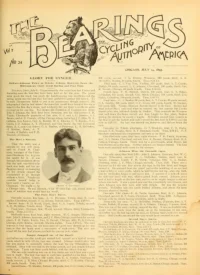
Articles in this issue
- Detailed account of the two-day Toledo, Ohio race meet (July 7–8, 1893) where W.C. Sanger of Milwaukee won the half-mile open and set the fastest mile in the meet at 2:20 2-5, while John S. Johnson of Syracuse won the one-mile open in 2:23; includes full heat summaries, notes on track manager Frank H. Chapman, and behind-the-scenes color on the competitors.
- Baltimore: sixty-year-old J. Frank Brown sues the B&O Railroad for $25,000 damages, arguing that because the cyclist who ran him down on Lombard Street was a company messenger, the railroad is liable for his dislocated hip and broken ribs.
- Milwaukee Wheelmen's annual race meet at National Park on July 8: Chicago's Cy Davis sprinted away from the field in the last hundred yards to win both open events; heat summaries for the novice, 3-minute class, two-mile handicap, five-mile handicap, and 2:30 class races are given.
- Feature on the Winton Cycle Co. of Cleveland's unique quadruplet bicycle—the only one in existence, costing over $1,000 and weighing 105 pounds—which has already made a mile in 2:03 and been demonstrated at the Sandusky meet with George Collister, R.C. Lennie, Dan Canary, and others aboard.
- Boston correspondent reports George Taylor's record-breaking one-mile win of 2:21 2-5 at the Waltham meet attended by his mother and sweetheart from Philadelphia, and makes a bold prediction that rising star Guy Gary—not yet twenty, with no bad habits and a devoted trainer—will cut the mile below two minutes before season's end.
- Melbourne: representatives of the Victoria Racing Men's Association and Melbourne Bicycle Club agree to form a new League of Victoria Wheelmen to resolve the long-running governance dispute between the two rival bodies; the Pneumatic Tire Co. is reported to be opening a factory in Australia.
- Editorial arguing that handicap starts should be capped at 100–125 yards per mile: inexperienced riders inflate entry lists, force excessive preliminary heats, obstruct top competitors, and make racing dangerous, while contributing nothing to the quality of competition.
- Two-part editorial: the editors correct Albert Mott's claim that D.J. Post writes unsigned articles for The Bearings, asserting complete editorial independence from league politics; they also rebut Mott's assertion that the L.A.W.'s Good Roads publication is paying, and conclude by arguing that prizes should be given for trial heats rather than finals alone.
- Editor's miscellany noting The Bearings was the only cycling paper on sale at Toledo on the day of the races; Jack Prince is en route to Chicago for the International meet claiming he will race any man for up to $10,000; and English cycling clubs have raised a total of $100 to send their men to the World's Fair meet.
- Profile of John S. Johnson (Century Cycling Club, Syracuse), who rode a mile in 1:56 3-5 after Tom Eck took him in hand at the Chicago–Parkside meet; though uneven in 1892, he has swept the boards in 1893 and is expected to push Zimmerman and Sanger hard at the International Tournament, riding the Stearns.
- A Bearings reporter corrals D.J. Post at Detroit and obtains a detailed account of Connecticut's fight against L.A.W. president Burdett: Post charges Burdett with twice misstating Potter's contract terms to Colonel Pope, working as paid attorney for the horsemen during the anti-pool bill fight, and reading Attorney Gross's legal opinion selectively to deceive the division board.
- Washington, D.C. correspondent reports that the Arlington Wheelmen and Washington Road Club traveled to Baltimore's Pimlico on July 4 for the Baltimore Club races and returned with prizes; military cyclists of the N.G. are on a nearly 500-mile two-week field tour; and weekly club runs around the capital are now poorly attended.
- St. Cloud, Minn.: Dahle wins the 140-mile round-trip road race to Minneapolis and back in 16:24:00 among ten starters; pre-race favorite Adley broke down in the lead just seven miles from home and finished third in 17:30:00.
- Paris correspondent Albert G. Roux reports Stephane's failed attempt on June 24–25 to break his own 24-hour record of 673.816 km at the Velodrome du Parc in Bordeaux, covering only 620.303 km; fatigue from a high gear, lack of rest after Bordeaux–Paris, and alcohol given in his milk all contributed, and detailed hour-by-hour distance tables compare 1892 and 1893 performances.
- Milwaukee: Governor Peck of Wisconsin plans to welcome W.C. Sanger back to his native pavements with a speech to the wheelmen; the Telegram Cycling Club will stage a double line of red fire from the railroad station to the clubhouse, and hold a race meet at National Park the next day where Sanger will attempt to lower his mile record of 2:10 2-5.
- Baltimore: officers and cycle soldiers of the Second Battalion, 4th Maryland Regiment N.G., plan to demonstrate military cycling by signaling a message by flag across Chesapeake Bay to North Point and relaying it twelve miles by bicycle back to the commanding officer, watched closely by the state's entire national guard.
- London, July 1: C.W. Hartung reports friction between the Scottish contingent and the trade licensing committee at Newcastle; South African L.S. Meintjes lowers Sanger's mile record to 2:09 3-5 at Herne Hill using Palmer tires on a 72-inch gear; strong entries including two French distance men are confirmed for the London County Club's Cuca 24-hour path race on July 21–22.
- One hundred and seventeen riders from German, Austrian, and Hungarian clubs start the Vienna-to-Berlin race over the route of the recent military horse ride; Herr Fischer of Munich wins, arriving in Berlin at 1:11 p.m. Friday having started at 6:10 a.m. Thursday.
- Melbourne, June 9: Arthur Turner issues a formal £100-a-side challenge to any Australian but withdraws his deposit when no one accepts; the Austral wheel race is rescheduled from November to December 2 and 9 due to difficulty securing the Melbourne cricket ground; negotiations for an Australian Wheelmen's League are advancing despite many difficulties.
- Con. Fredericks of Chicago, costumed as Mephistopheles with flaming red torches, performs nightly at Captain Boyton's Earl's Court Water Show in London—riding a safety bicycle down a sixty-foot chute at a one-in-four gradient, plunging into the lake, then riding twice around the track in dripping garments to the crowd's applause.
- Notice of A.A. Zimmerman's training manual, just published in America after its English debut: he advocates a month of road riding to open the season, hard morning track miles and afternoon sprinting, toe-clips over blocks, moderate diet without potatoes, no cold baths, and complete winter rest; the book also contains portraits of prominent riders worldwide and an article by Frank Bowden of the Raleigh Cycle Co.
- E.J. Heffelman of Canton, Ohio, protests that Sandusky race judges denied John Shimp the second place in the novice heat he had rightfully earned, refusing to change their decision even when Shimp produced witnesses; Heffelman warns that such conduct will drive members away from Ohio division races.
- Detroit, July 4–5: a two-day meet marred by poor management, a near-unridable track, and late programmes, but redeemed by outstanding individual rides—J.P. Bliss wins the one-mile handicap in 2:17 flat (setting Michigan state records for the quarter, half, and three-quarters as well), and Guy Gary takes the two-mile 6:10 class in 5:21 2-5; full first- and second-day summaries included.
- Standing listing of the Century Road Club's executive officers, committee chairmen, and state centurions for each U.S. state and several foreign countries including England and France, with mailing addresses.
- H.T. Strother departs Chicago on July 2 for Lexington, Ky., on a Union P.D.Q., completing the journey in five days over rough roads carrying only a wrench, with overnight stops at Laporte, Henpeck, Indianapolis, Corinth, Ohio, and Williamstown, Ky.
- Harry Leeming is engaged as trainer for the Springfield Bicycle Club and promises to have the 229-pound Hendee racing at 2:10 within a month; in private trials Sanger has done a quarter in 26 4-5 seconds while Zimmerman has gone 26 flat.
- J.W. Stocks, something of a dark horse, wins the English 25-mile championship by setting most of the pace himself; Green finishes second, A.W. Harris third, and Meintjes finishes with the bunch.
- M.A. Holbein and F.T. Bidlake break the 24-hour tandem tricycle record previously held by G.P. Mills and R. Tingey at 298½ miles, covering 333 miles on the North Road in England.
- Elyria, Ohio, July 12: J.P. Bliss defeats John S. Johnson and Roy Keator in the two-mile invitation race in 5:57 2-5 to claim a $150 saddle horse; Johnson had earlier won the one-mile handicap from scratch in 2:19 3-5, setting a new Ohio state record that itself broke Sanger's 2:20 at Toledo just the previous week.
- Edward H. Elwell, Jr.'s second dispatch describes cycling at twelve and a half miles an hour through the dead-straight forest road to Compiègne, touring Napoleon's palace and the restored Château de Pierrefonds, and a comic encounter with the genteel cliff-dwelling residents of Crépy-en-Valois who assumed the American cyclists were invalids needing medicinal milk.
- Savannah, Ga. column covering Harry Wheeler's disputed dual-club prize-money arrangement with the Savannah Wheelmen; a humorous inventory of mismatched race prizes at a recent southern meet (a shaving ticket won by a beardless boy, cigars won by a non-smoker); Governor Northen of Georgia endorsing good roads; and Jacksonville riders barred from Atlanta club races after handicaps were converted to open events.
- [Letter from Frank A. Egan, Secretary, National Cycling Association of America] (opens in a new tab)N.C.A. Secretary Egan withdraws the Association's advertisement but writes to The Bearings noting that replies the ad generated in this paper outnumbered those from the Bi-World and The Wheel combined in a ratio of not less than ten to one.
- Trade editorial: the bicycle price-cutting flurry of recent weeks has subsided; the next season will bring lower list prices, smaller dealer discounts, fewer jobbers, and the contraction of undercapitalized factories—a necessary shakeout for a comparatively new trade, with Pope, Overman, and G.&J. expected to set the tone.
- Prof. J.B. Johnson of Washington University (St. Louis) reports to the St. L.R. & W.G. Co. on comparative load tests of steel and cast aluminum bicycle frames: aluminum frames (Warman & Hazlewood's Coventry Cross pattern) carried greater loads before failure, recovered fully from eccentric loading, and showed twice the elastic resilience of steel, leading the professor to predict 'a great future' for aluminum frames.
- Ariel Cycle Mfg. Co. of Goshen, Ind., issues a public statement that 1893 Ariel bicycles will remain at $150 with no agent permitted to sell below that price—contrasting their stance of adequate capital and honest pricing with overstocked rivals resorting to auction-room methods.
- St. Louis has seen bicycle auctions every Saturday for three weeks, with two scheduled this week; the Wednesday lot of 150 new machines labeled 'Continental Bicycle Co.' bears a remarkable resemblance to a well-known brand and is to be sold without reserve, with the auctioneer expecting dealers to attend in force.
- Race calendar for July through September 1893, covering the Cuca 24-hour race at Herne Hill (July 21–22), Indiana division meet at Fort Wayne, Michigan division and international circuit races at Detroit (August 1–2), the major Illinois division and National L.A.W. meet with international races in Chicago (August 7–12), and the Springfield, Mass. annual meet (September 12–13).
- Standing tables of American cycling records in track competition and best times against time—quarter-mile to 25-mile—held by Zimmerman, Taylor, Sanger, Johnson, Windle, and Hoyland Smith, plus road records set at Louisville and Detroit in 1893 by Knisley, Hurlburt, and Murphy.