The Bearings, Vol 8, No 13
Articles in this issue
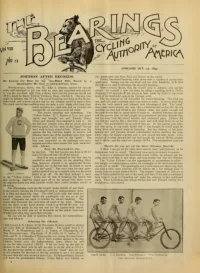
- John S. Johnson sets a new one-third-mile flying-start record of :37 1-5 at Minnehaha, Minneapolis, paced by E. C. Stearns & Co.'s "Yellow Fellow" quadruplet, then four days later breaks the standing-start third-mile record at :39 3-5; the party departs for Independence, Iowa, to attempt Johnson's mile record of 1:56 3-5.
- Zimmerman arrives in Hartford with W. B. Troy and a squad of tandems, triplets, and a quadruplet to contest all records up to the hour on Charter Oak track; Tyler meanwhile lowers the three-quarter standing-start record to 1:28 1-2 at Springfield, finishing the mile in 2:01 1-5.
- Boston correspondent covers the Massachusetts L. A. W. division contest between incumbent chief consul Perkins and challenger Dean, with Sterling Elliott's partisan letter—backing Dean and attacking Perkins's stewardship at the Buffalo convention—becoming the central controversy.
- The Savannah Wheelmen's two-day fall meet sees Banker dominate across eight events per day, lowering the quarter-mile track record to :29 4-5, while Murphy consistently finishes second; Banker afterwards heads to Springfield to pace Zimmerman.
- Maryland division unanimously renominates its incumbent officers; a rival from the eastern section who challenged Chief Consul Mott quietly withdrew; the division launches membership drives offering full track-association tickets for recruiting ten new members.
- J. W. Linneman of the Press Cycling Club rides 100 miles from Erie to Buffalo in 5:39:15, chopping 9 minutes 20 seconds off the American century road record; meanwhile Buffalo's city auditor begins collecting the new 50-cent bicycle tax.
- A charity meet at Sportsman's Park's quarter-mile cement track raises roughly $125 for the St. Louis Republic's school lunch fund; H. A. Githens of Chicago C. O. P. wins the mile open in 2:44, with Steele and Levy also collecting prizes against local riders.
- Victor Cycle Club holds its first annual meet at the Y. M. C. A. track before 1,200 spectators; W. T. Robertson wins the District of Columbia mile championship in 3:35, but a protest is filed after roughly half the entrants are barred for not knowing the event required L. A. W. membership.
- Philadelphia correspondent surveys the three local cycling papers—The Athlete, Cycling, and Cycle Guide—and their editorial feuds over the N. C. A. and editor Kain's advocacy; notes the planned Syracuse-to-Utica century run and a five-mile handicap at the Los Angeles fair won by L. W. Fox.
- Willis B. Troy will represent The Bearings in New York and the east from November 1, with offices at Room 3, 21 Park Row; the notice praises Troy as a veteran newspaper man with thorough knowledge of cycling.
- Editorial urges cyclists who have packed away their wheels after summer mud and heat to reclaim the crisp autumn roads, calling the present season the most glorious of the year for the true cyclist.
- Editorial reports that The Bearings' months-long campaign for racing men to register and wear distinctive colors has succeeded, with most prominent path riders now in colors; the Racing Board should codify the rule for 1894 entry forms and score cards.
- Editorial urges all Chicago cyclists, regardless of party, to vote November 7 for Henry V. Freeman for Superior Court judge—an enthusiastic daily bicycle commuter—citing the success of wheelman political action in securing good streets in St. Louis and Philadelphia.
- Column of short notes: mocks a rival paper for placing Zimmerman in Savannah when The Bearings correctly had him in Springfield; reports Percy Harris made $25,000 on the New York Stock Exchange; relays gossip that Zimmerman is engaged to a Savannah young lady.
- A. D. Kennedy Jr. of the Illinois Cycling Club lies gravely ill with typhoid fever at his West Side home and is not expected to survive; he had a strong season of handicap-race victories.
- G. A. Wahlgreen, business manager of Cycling West, explains Denver's renewed bid for the 1894 L. A. W. national meet, citing five clubhouses, more wheel riders per capita than any city, and the attraction of Pike's Peak excursions for eastern visitors.
- Peoria Bicycle Club members tour Jubilee and host the Bloomington club; W. J. Robinson's Century Columbia No. 2,512 is stolen from outside the freight office; the thrice-postponed century run to Bureau is rescheduled; the club plans a grand ball November 9.
- Letter from Nelson A. Bradt, 65 Twenty-fourth Street, Chicago, challenges H. H. Wylie—who has ignored his September challenge—to race for the New York–Chicago road record (10 days 3 hours, held by Bradt since 1891), and invites any long-distance rider to a 100- to 5,000-mile match for $500.
- Traveling salesman Jay Ross recounts a hot sprint through Brunswick, Ga., streets in which he led Zimmerman all the way to the hotel—then reveals the punchline that they were riding a tandem together and he occupied the front seat.
- Poem by Tommy Dod contrasting the record-and-prize-chasing racing man with the slow leisure cyclist who rides through violets in spring, shaded dales in summer, and browning fields in autumn, concluding that road memories are worth more than twenty score of records or prizes.
- Comic fiction in which frugal banker Banker storms at his spendthrift son George, demanding to know where last week's $500 went, then instantly reverses and begs a $50,000 loan when he learns his son has won 150 first prizes on the bicycle circuit.
- Reflective prose meditation on a battered second-hand tandem displayed outside a West Side cycle shop, imagining its history from a young man's purchase and roadside proposal to a settled married couple who now ride two gleaming solo machines.
- Anecdote about a cycling club man whose wife, tired of his nightly smokers and stags, takes up the wheel and acquires handsome knickerbockered escorts, prompting her husband to give up the club entirely and stay home every night—the homeopathic cure in action.
- A young theology student silences a room of gray-bearded Methodist preachers who condemn his Sunday cycling by opening Isaiah to "he shall ride in high places," whereupon the entire assembly flees the bookstore.
- Humorous regular column: replies cover Windle's mile record on a Union wheel, a ruined tire in Oil Stop City Pa., a Hardened Crank's speed-gear invention, a recommended lamp-oil recipe, H. C. Tyler's marriage and racing future, and the Massachusetts delegation's behavior at the Buffalo convention.
- International miscellany: Russia's Novoie Vremja begins covering cycling; Corre and Lumsden agree to three Paris races of 12, 24, and 48 hours for a 2,000-franc wager; U. V. F. forbids the tricolored sweater of the late Cassignard; Terront receives a two-hour horseback challenge from Buffalo Bill Cody; New York cyclists protest lamp-arrest policy to Superintendent Byrnes.
- American Dunlop Tire Co. purchases the Comet Cycle Co.'s patents, plant, and stock for $11,000 and plans a Toronto factory; road champion Carman defeats blacksmith Hensel by twenty yards in 1:04:23 over the Athenaeum course to retain his title as champion road rider of Canada.
- A fatal bicycle–pedestrian collision on Cleveland's central viaduct kills Charles Beader after cyclist Charles Bard's front fork broke; C. G. Merrills of the Cleveland Wheel Club completes 220 miles before cramps end his attempt at 300 miles in 24 hours.
- London correspondent covers A. W. Harris's new two-mile path record of 4:20 and Bowen's tricycle hour record of 22 miles 304 yards at Herne Hill; Watford Club's 120-member lantern-and-costume carnival; Terront's enthusiastic Paris reception after St. Petersburg; and the rapid advance of rational knickerbocker dress for lady cyclists, backed by R. L. Jefferson and Gamage's affordable pricing.
- Two brief English items: a man who makes his living on the road but has never seen a bicycle; and the story of how cycling journalist Lacy Hillier's name was garbled in a telegram to "Lucy Hillier," requiring much explaining when the undergraduate returned home.
- A circular signed by twelve St. Louis cycling clubs—including the Pastime, Y. M. C. A., and Wanderers' Bicycle Club—calls for electing Albert C. Davis as Missouri L. A. W. chief consul over incumbent Robert Holm, promising reform and economical administration.
- Directory of Century Road Club officers and state centurions for 1893, listing president W. A. Skinkle (Cleveland), secretary John E. Templeton (Chicago), representatives across every U.S. state plus England, France, and New Brunswick, with membership applications from Indiana, New York, and Ohio.
- Miss Lizzie Hegerty of Chicago completes her fifteenth century ride solo, pedaling via Geneva, Aurora, and Naperville—35 miles of it in darkness—to return home at 9:30 p.m., intending next time to beat the course record of nine and a half hours.
- The Century Road Club's first milestone—a Stover Co. conical stone labeled "2 miles"—is quietly planted at Lincoln Park's Lake Shore Drive entrance after years of delayed dedication plans involving Mayor Harrison's speech and the Lincoln Cycling Club cornet band.
- A new St. Petersburg cycling club is organized by upper-society representatives under the presidency of Grand Duke Serge Michaelowitch and vice-presidency of Captain Prince Gagarine, with titled ladies including the Princess Gagarine among its members.
- Misses Hegerty and Porter, each holding twelve or more century bars and riding centuries weekly, plan a 1,200-mile wheel tour from Chicago to the Atlantic coast next season, intending to supply daily accounts to the cycling and daily press.
- Frank G. Lenz writes from Mandalay that he has crossed China completely despite universal discouragement in Shanghai, covering 2,884 miles from Shanghai to the Chinese frontier and 3,149 miles to Mandalay, spending the last three months largely walking due to road conditions.
- Trade editorial warns that next season will bring at least twice as many tire makes as 1893, many of poor quality, and urges cycle makers to stay with proven tires rather than jeopardize their machines' reputations by contracting with experimental new concerns.
- Secretary C. W. Dickerson of the Stokes Mfg. Co. reports $100,000 above-plan Sterling sales by July 1 and favors a 1894 price scale of $125–$150; notes that fifty of seventy-nine starters in the North Side Cycling Club's Milwaukee road race rode Sterlings, the first three home among them.
- Description of a new English attachment by O. Poole & Co. (204A Blackstone Road, Highbury) that converts any rear-driving safety into a tandem by replacing the rear wheel and clamping an auxiliary crank-hanger and brace to the seat-post lug and down tube.
- W. H. Ennsworth at Lozier's World's Fair exhibit predicts 1894 Cleveland road wheels will list at $150 or match the market leader, weigh under thirty pounds, and be guaranteed to carry 200 pounds; reports over 8,000 Clevelands manufactured and sold in 1893.
- Newton Rubber Works (278 Devonshire Street, Boston) introduces the Heustis' Detachable Pneumatic Tire, featuring edge protuberances that lock into rim recesses when inflated but allow easy removal when deflated, eliminating creep without requiring violent effort to change.
- The Lu-mi-num company proposes two alternative test arrangements to E. C. Stearns & Co. for settling the aluminum-vs.-steel frame controversy, leaving Stearns to choose which side bears the judges' costs and asking him to submit articles of agreement.
- Detailed technical description of the redesigned P. D. tire, which replaces spike fasteners with a flexible stranded wire rope (tested to 4 cwt.) tensioned by rim turrets, making the cover as secure as the original Dunlop, lighter than the previous model, and removable in under a minute.
- Mr. Richardson of Monarch reports quadrupled business in 1893 and plans 6,000–10,000 machines for 1894 at a maintained price list, criticizing the season's universal price-cutting; the company's retail store will carry sewing machines through winter.
- Trade note about a now-defunct Chicago dealer who tricked a customer's wife into surrendering her wheel "to show as a sample" while pressing her husband for payment on a $75 note, coming close to a theft warrant before the customer was talked out of pressing charges.
- Twenty-three firms have confirmed their intention to exhibit at the Philadelphia cycle show, including Pope Mfg. Co., H. A. Lozier & Co., Gormully & Jeffery, E. C. Stearns & Co., the Hartford Cycle Co., and the American Dunlop Tire Co.
- Profile of George Chapman, bicycle department manager of Chapman Hardware Co. of Toledo, one of the largest jobbing firms in America, handling Columbia, Sunol, Hartford, Hickory, and Western Wheel Works lines, and credited with his brother Frank for popularizing cycling in Toledo.
- Prince Wells visits Chicago to secure more Ramblers for Louisville, where copper rims are a firm requirement and about 500 wheels were auctioned without materially hurting regular trade; he plans a 1894 race meet at the Louisville jockey club track.
- Brief trade notes: tire manufacturers must file anti-trust affidavits; the Winton Cycle Co. will build its 1894 line on the lines of its racer; the St. Louis Refrigerator & Wooden Gutter Co. faces such Lu-mi-num demand that no traveling men may be needed; the Gendron Iron & Wheel Co. will list at $135 for 1894.
- Two anecdotes from the World's Fair cycle exhibit: Bob Lennie plays a convincing country rube to trick Sam White of Monarch into explaining his medals, and P. O. Rudy and General Dorr pose as Indiana grangers to extract an unwitting $130 price cut from Monarch salesman C. C. Meade.
- World's Fair cycling exhibit roundup: Sam White labels a 35-pound Monarch as eighteen pounds to draw crowds; a British exhibitor praises The Bearings for arriving promptly each Friday; German tandems by Adam Spel and Kleyer Hemrich are admired and marked "for sale, no reasonable offer refused."
- Toronto correspondent imagines future water and air cycling, then notes two new Canadian machines: the Lochrie pacer (lever-driven, chainless, adaptable to any safety) and a chainless safety, both attracting interest though no records have been broken with either.
- Comprehensive tabulation of current American track and road cycling records in competition and against time, covering distances from one-third mile to 50 miles, with holders including Zimmerman, Tyler, Windle, Johnson, and Meintjes, plus road records through Linneman's new 5:39:15 century mark.
- Raleigh Cycle Co. moves to new New York premises at 2,081 Seventh Avenue and secures U.S. rights to Middlemore Lampaugh & Co., D. Mason & Sons, and J. B. Brooks & Co. accessories, with M. G. Peoli and A. Flavell as road representatives under factory director James Cawlwood.
- Ralph Temple reports his best-ever season in wholesale trade and predicts 1894 Halladay-Temple Scorchers will list at $125–$135 rather than $150, arguing a lower maintained price beats a higher price that manufacturers will inevitably cut.
- A. Kennedy-Child purchases three-quarters of Bretz & Curtis Mfg. Co. stock and is elected president of the reorganized Philadelphia firm, now renamed Curtis-Child Mfg. Co.; long-serving road representative W. M. Perrett, who had declined rival offers on assurances of permanence, is displaced.
- Letter from treasurer Edward A. Godding of the Providence Cycle Co. warning dealers that a young man with a scar on his chin, using aliases James S. Why and H. S. Folsom, has forged the company's letterhead to borrow bicycles, then pawned them and left town.
- J. R. Nisbet, editor of the Scottish Cyclist, after visiting the Pope Mfg. Co. plant, predicts British cycle makers can no longer compete in the American market, warns that trade failures are of daily occurrence in the U.S., and praises the Snell Co.'s timing in entering the tubing business.
- Editorial reprinted from The Cyclist argues that cycle shows do not prevent "fixity of pattern" but instead drive "universality of pattern," as seen when fifteen or twenty makers simultaneously copied the Humber design after one show, devastating makers who had stocked other patterns.