The Bearings, Vol 8, No 16
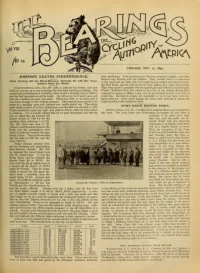
Articles in this issue
- John S. Johnson completes a tour at Independence, Iowa, breaking world records from 100 yards to the standing mile (1:58 1/5), paced by a quadruplet team; Medicine Bear, reputed son of Sitting Bull, was induced to ride a seat on the quadruplet while visiting the track.
- Boston correspondent reports that L.A.C. Kelley won the Press Club's ten-mile handicap road race but was disqualified for riding a different wheel than declared; E.C. Yateman of Washington breaks the American 24-hour road record with 311 miles on a Rambler.
- London correspondent reports a Rochdale syndicate with £300,000 is building an athletic ground to promote professional cycling with $500 first prizes; covers English road records, women's rational cycling costumes at Ditton, and M.A. Holbein's injury and engagement.
- Brief on the Rambler racing teams' 1893 season: the first team of Bliss, Taylor, Githens, and Dirnberger covered over 20,000 miles attending 35 meets, while the second team of younger riders scored heavily in the east.
- R.E. Carpenter and W.H. Chubb arrange for a Cleveland restaurant and hotel to give L.A.W. members meal and room discounts on presentation of a current membership ticket; the Broadway Wheel Club, which started the spring with bright prospects, is about to disband.
- G.E. Bicker of the South Side Cycling Club outrode Italian challenger J. Perino in a 100-mile road race on the Elgin-Aurora course; the challenge was secretly arranged by a romantic rival hoping to discredit Bicker in a young lady's eyes.
- Satirical item reprinting a New Rochelle paper's fanciful diagnosis of 'bicycle jaw,' a malady producing incessant jaw-wagging and simian regression allegedly afflicting cyclists of all ages and sexes.
- Denver correspondent describes how a Chinese laundry cart driver ran into Miss May Colagman on her bicycle on Eighteenth Avenue and dragged her a block before stopping; the driver's Sunday-school teacher advised him not to pay the doctor's bills.
- Milwaukee correspondent covers the mysterious collapse of the Telegram Club after Sanger's expulsion and the Sercombe-Bolte Co. failure, with unresolved questions about what became of the furniture sale proceeds; also covers the Mercury Club smoker, Milwaukee Wheelmen's dancing party, and Wisconsin L.A.W. elections.
- Philadelphia's cycling clubs—Century Wheelmen and Park Avenue Wheelmen—prepare for their football rematch with even betting and fever-pitch excitement, after last year's game ended in a scoreless tie.
- The Savannah Wheelman voted unanimously at a packed meeting to deny colored cyclists access to the cement track, on the grounds that permitting it would cause club dissension.
- The L.A.W. Racing Board unanimously dismisses all four charges brought by the N.C.U. against A.A. Zimmerman; the article publishes Zimmerman's full sworn replies to charges concerning Raleigh company shares, book profits, diamond gifts from Frank Bowden, and alleged race-stipulation in Ireland.
- Editorial urging wheelmen to lobby for special legislation making bicycle theft punishable as severely as horse theft, noting that a bicycle is even easier to steal and harder to recover than a horse, and that organized political pressure can achieve this reform.
- Regular department covering: a French physician's recommendation of small arsenic doses to improve athletes' wind; Racing Board member J.M. Erwin's comments on whether Johnson's horse-paced mile records should be accepted; a fistfight between French racers Medinger and Charron at a Paris tricycle race; and two Parisian romantic vignettes involving bicycles.
- Profile of trainer 'Dad' Moulton, who held the American sprint championship for six years, trained volunteer fire-department hose teams and professional women bicycle riders, and currently coaches the University of Michigan football team; expected to manage amateur wheelmen next season.
- Regular humorous column including a complaint about cycling know-nothings, a wishlist of cycling improvements ('Doesn't Want Much'), a poem tribute to John S. Johnson, a satirical piece on critic G. Lacy Hillier belatedly endorsing the pneumatic tire, and a comic courtship story ending with a man fleeing his fiancée's request to mend her punctured tire.
- Report on the farewell dinner at the Grand Pacific Hotel for R.D. Garden, Pope Mfg. Co. store manager and originator of the Pullman road race, departing Chicago for Hartford; C.E. Randall presented him with a gold watch and lounge chair from Chicago cyclists.
- At West Side Park in Nashville, Dirnberger rode 100 yards flying start in :05 flat and Bliss broke records for 100 yards standing start (:08 4/5) and one-eighth mile standing (:16 4/5), all bettering Johnson's recent figures.
- W.C. Sanger met with a severe accident exploring an old mill near Waukesha, falling from a platform onto a projecting nail that tore into his groin; he is expected to be confined to bed for some time.
- Detroit correspondent reports both cyclist-friendly candidates won the recent election, including Republican Mayor Pingree by 6,000 votes; a contentious three-way L.A.W. Michigan division election is complicated by a dispute over whether candidate A.H. Griffith held League membership before voting opened.
- Cycling is flourishing in Vienna among court officials, lawyers, and manufacturers; a women's 2,000-meter race at Langendois was won by Mlle. Schrieber in 7:11, and the mayor of Vienna and Doctor Richter are among the latest converts.
- L.S. Meintjes has sailed from England for South Africa, announcing retirement from racing to preserve his amateur status, noting his tour cost $3,500 and that first-rate racing demands a millionaire's resources.
- Fournier and Giradin set a new world tandem record of 2:03 1-5, bettering the Osmond and Merry mark by 2 2/5 seconds; Fournier later tied the same time with German racer Verheyen.
- Several leading Chicago riders are quietly gathering names and researching expenses for a party to attend the proposed 1894 international championships in England.
- The Union Velocipedique de France refuses to accept Lesna's claimed 24-hour record of 433 miles, ruling the attempt was not properly made.
- Essay combining a Boston newspaper report on cyclists replacing livery patrons with French writer Francisque Sarcey's prophecy—from the Cosmopolitan Magazine—that the bicycle will revive the country inn tradition destroyed when railways absorbed all road travelers.
- The Baltimore Club has given its racing board autocratic power over its cycling team following disputes between the social and racing factions; Robert Bright and William Osborne (alias Reed) were arrested for possessing bicycles stolen from Washington riders.
- Humorous anecdote in which a boy who prays faithfully for a bicycle receives a tricycle on his birthday and appeals heavenward: 'O Lord, don't you know the difference between a bicycle and a tricycle.'
- Hartford: Zimmerman declined to race the horse Directum for less than $500; state champion A.W. Warren raced the pacer Flying Jib instead but was beaten by 5 1/2 seconds, with the horse finishing in 2:10.
- An unnamed Canadian club member recounts outwitting a gang of thirty hostile townsmen at Woodstock, Ontario, by waving his calliope whistle in the moonlight to simulate a revolver and backing away forty paces to safety.
- Brief note observing that Parisian ladies slip off their long skirts, hand them to male escorts to strap on the bicycle, then mount and ride freely; short cycling dresses in this style now appear in Paris shop windows.
- Regular notes department covering G.P. Mills' marriage, a proposed monument to pedal inventor Michaux, F. Pope's new English records, a postponed Niles meet, the Cody horse-race challenge to French cyclists, and U.S. items including a newborn son announced by Nelson Bradt and the N.C.U.'s December 1 deadline for Zimmerman's amateur-status reply.
- Review of the new bicycle-themed theatrical piece at the Paris Gaietie, summarizing its plot about a legacy conditional on marital fidelity tested by cyclist-sleuth Clodonier, with praise for the cycling costumes, the ballet divertissement featuring girl cyclists in flower-decorated machines, and a closing acrobatic unicyclist.
- Essay by H.H. Lambton arguing that mental temperament and tactical judgment are as important as physical training; advises riders to pace themselves precisely, shelter from wind, nurse strength for the final sprint, and practice estimating speed in training—a method Lambton refined during trials in Australia.
- Editorial noting growing support for a cycle trade association that could maintain blacklists of unreliable dealers, address 'blackmail' by race-promoting clubs soliciting prizes, organize an annual trade cycle show, and coordinate stolen wheel recovery on the model of the Chicago Cycle Board of Trade.
- Fred Patee reports that the defunct Nebraska Cycle Co. is reorganized as Patee, Oliver & Co. with a $200,000 credit rating; despite strong sales the old firm's entire capital was lost through gross mismanagement.
- The Palmer Tire Co. introduces a road version of its racing tire with a simplified puncture repair system: Mr. Palmer demonstrated repairing six punctures in fifteen minutes using rubber plugs and threaded inserts, a process unique to the single-tube Palmer design.
- Marble Cycle Co. of Plymouth, Ind. sold its entire 1893 Smalley output of 3,500 wheels on a strictly cash basis; the 1894 model will feature a higher rear frame, a double-straight ladies' frame, and an English dust-proof crank box.
- Philadelphia's January cycle show is assured of success through strong support from the city's two-dozen bicycle clubs and the well-connected Associated Cycling Club, whose representatives wield genuine influence in the community.
- Profile of William Herrick, founder of the Century Road Club and salesman for Morgan & Wright tires, who is taking orders so rapidly he says selling the tires needs no samples—'it would be like showing samples of dollar bills.'
- J.L. Yost of Toledo describes a new deal with Kingman & Co. to distribute Falcon wheels across six states, announces 1894 prices ($115 men's, $100 ladies'), and traces to a rival jobber's employee the false rumor of the Yost company's failure.
- J.O. Blake's detection bureau is recovering stolen wheels for the Chicago Cycle Board of Trade; Blake publishes an extensive list of stolen bicycle serial numbers by make, covering hundreds of machines from Columbia and Victor to Rover and Humber.
- A.G. Spalding & Bros. is expanding its Chicopee Falls plant to manufacture juvenile wheels alongside the Credenda, of which over 6,000 were sold this season; manager Frank Fanning advocates a $150 list price and notes that instalment sales have been strong but collections slow.
- Technical critique of 1893 racing bicycle design faults: back stays too small in diameter causing rear sprocket binding and frame misalignment detectable by straight-edge test, and solid seat-rods of only half-inch diameter that inevitably bend under normal use.
- Practical cycling advice from the Irish Cyclist: makers of ladies' bicycles should fit longer heads to accommodate shorter-armed, upright-seated riders, and lady cyclists should carry a dark cloth splash-guard to pin over the rear mud-guard on dirty autumn roads.
- Thieves stole two Monarch Cycle Co. wheels; one brazenly returned to offer to reveal where the wheels were hidden, then tried to sell them using forged documents; detective Radell has recovered over 20 wheels and jailed four men, with 500 thefts reported to him.
- Profile of O.G. Formhals, advertising manager of Gormully & Jeffery Mfg. Co., credited with making every Rambler advertisement worth reading and attributed with much of the firm's commercial success through skilled, breezy copy.
- The Boston Woven Hose & Rubber Co. introduces their 1894 N.G.L. tire with a turned-edge clamping band that engages the tire bead below the rim edge, reducing friction and preventing nipping when stones are struck, applicable to steel, wood, or aluminium rims.
- The Sterling Cycle Works has been separated from the Stokes Mfg. Co. and transferred to a new company under C.W. Dickerson as president, B.W. Lord as secretary, and Charles Timm as superintendent, all men long identified with the Sterling wheel.
- The F.F. Ide Mfg. Co. of Peoria, Ill., which previously built bicycles on contract, will manufacture its own 1894 line in three models: a 22-23-lb. special light roadster, a 26-lb. light roadster, and a 30-lb. full roadster, all embodying proprietary features.
- Regular trade department with brief notes on industry personnel, orders, and new models: Stover keeping its Chicago store open for winter, Gendron Iron Wheel Co. improvements including a cement-free tire, 1894 Rambler plans with a new 19-lb. racer, Grand Rapids Cycle Co.'s broad guarantee, and Snell Cycle Fittings breaking ground for a new factory.
- Listing of recent U.S. patents for velocipedes, bicycles, pneumatic tire inflating devices, drive-chains, saddles, umbrella supports, and bell mechanisms, granted to inventors in Toronto, Worcester, Minneapolis, Carbondale, New Brighton, New Britain, Birmingham, and London.