The Bearings, Vol 8, No 21
Articles in this issue
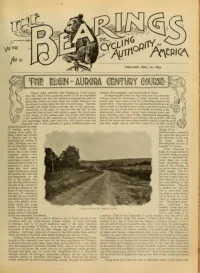
- Feature on the Chicago area's hundred-mile cycling route through Elgin and Aurora, describing the Century Road Club and notable members including J.W.E. Kinkead.
- Brief editorial meditation comparing the passing cycling year to a milestone on the great road race of life, written as an introduction to the Christmas number.
- Proposes a fraternal order for cyclists modeled on existing secret societies, tentatively named the 'Ancient Order of Mystic Wheelmen' or 'Knights of the Golden Wheel.'
- Regular department column with items on the southern Negro cyclist, upholding the licensing scheme, record breakers versus champions, and the disbanding of the Rambler team.
- Humorous Christmas serial set in the fictional western town of Sockdolager City, featuring two cycling characters Charley Horse and Bloat Face Bill in a slapstick holiday adventure.
- Comprehensive annual review of the 1893 racing season, opening with Arthur Zimmerman's 101 first-place finishes and profiling Sanger, Windle, Tyler, Johnson, Bliss, Dirnberger, Taylor, Githens, Meintjes, Osmond, Bald, Crooks, Banker, and Rhodes.
- Signed 'Brakespeare'; defends American treatment of visiting English rider Schofield and American race-timing methods against British criticism.
- By 'Wheeler B.'; first-person account of a harrowing brakeless descent near St. Louis with a broken crank, ending in a wild uncontrolled plunge down the hill.
- Signed 'The Prophet'; argues that time-trial world records are less meaningful than championship victories in open competition.
- By C.G.S. Andy Magnus; Christmas memoir-story featuring anecdotes about professional cycling managers Tom Eck and Billy Rhodes.
- Profile of Judge Lewis E. Reed of Ripon, Wisconsin, a cycling enthusiast whose sons won at the Wisconsin state meet.
- Multi-page illustrated ballad about Dorothy Maguire and two rival Rambler tandem riders competing for her attention at a cycling club ball.
- First-person touring narrative of riding from Oregon's Willamette Valley over the Coast Range to Tillamook by bicycle.
- Review of Washington D.C. cycling including the Capitol Bicycle Club (founded January 31, 1879, worth $80,000), the Arlington Wheelmen, and the growing number of lady riders.
- By Isaac B. Potter; argues that bicycle manufacturers should financially support road improvement advocacy rather than leaving the burden to individual riders.
- Brief practical note on methods for securing pneumatic tires to wooden rims using cement, heat, or rubber solution.
- By S. Wallis Merrihew; reviews the NCA's first professional season using cash prizes, assessing winners and controversies of the new system.
- By George L. Sullivan; reviews the 1893 Boston cycling season including the Waltham track and key local riders.
- By Henry E. Harris; reviews the 1893 cycling season in Duluth and Superior, Wisconsin, covering club activities and road conditions.
- By E.W. Ballard; reviews California cycling in 1893 including the Bay City Wheelmen's cement track and Frank Waller's 24-hour world road record.
- Short illustrated verse celebrating the graceful riding style of a young woman cyclist named Margery on her golden wheel.
- By P.E. Dalpin; history of the Canadian Wheel Association (founded September 22, 1882), champion Will Hyslop, and a table of championship records from 1883 to 1893.
- By 'Tommy Dod'; satirical story about an honest bicycle salesman who refuses to recommend a wheel he would not ride himself.
- By A.D. Smith; argues that cyclists possess ideal physiology for speed skating and offers winter training advice for wheelmen.
- Travel essay comparing road quality in France, Spain, Italy, and England, arguing that French roads are ideal for touring cyclists while English roads are the worst.
- Translated French cycling anecdote about Marius, a Provençal man who races his cousins by bicycle to reach a dying relative's bedside, winning the race by a nose.
- By 'Barry Hecla'; optimistic prediction essay forecasting the continued growth and professionalization of cycle racing in America and Europe.
- Travel narrative 'Through Aztec Land with a Bicycle' describing cycling on the Paseo de la Reforma and up to Chapultepec Castle in Mexico City.
- By H.H. Lambton; Australian cycling feature covering racing in Melbourne, Adelaide, and Sydney, the Austral Wheel Race ($1,000 prize), and track racing under electric lights.
- By Tommy Don; satirical story about 'Simon Pure,' a supposed amateur cyclist who accumulates $19,438.65 in prizes over his career while professing strict amateurism.
- Untitled fiction about Pet Demar, daughter of French-Canadian mill watchman 'Cranky Pete,' who saves a young woman from runaway horses but dies of her injuries; bicycle serves as a key plot element.
- Short affectionate sketch of Sadie Schaffner, a waitress beloved by Chicago cyclists at Winter's restaurant on the waterfront.
- Untitled fiction about Mrs. Gordon, an 87-year-old anti-cycling grandmother converted to the wheel after her great-grandson Harry is saved when Jennie Gordon fetches Doctor Tom Hudson by bicycle in an emergency.
- By Edward H. Elwell Jr.; traces the 1878 arrival of Maine's first bicycle, a 48-inch Excelsior from Coventry ridden by C.H. Lamson, who later designed the LAW badge.
- Brief item noting that the tandem safety bicycle, now adopted by English riders for pacemaking, was originally an American invention.
- By Edward H. Elwell Jr.; account of a 50-day, 1,000-mile bicycle tour of France by 25 American cyclists, starting at Boulogne and riding through Amiens, Peronne, and St. Quentin on superior French roads.
- History of The Bearings' founding in January 1890 by N.H. Van Sicklen and Geo. K. Barrett, its growth into the 'cycling authority of America,' and a tour of its Isabella Building offices and composing room.
- By Brudder Stainforth; humorous dialect piece about a rustic cycling club meeting in Farmer Jobson's barn, featuring a delinquent treasurer, a disputed poem, and an interrupting rooster.
- By Harold Quill; three-part English cycling story in which a journalist meets tramp Will Watkins on Farningham hill and is later warmly welcomed into the Watkins family home in Rotherhithe.
- Short profile of H. Kanaska, a 16-year-old Milwaukee NCA professional racer who had a notable 1893 season.
- Obituary tribute for H.H. Lambton, the Australian cycling journalist who wrote 'Ten Thousand Miles Away' for this issue and died in Chicago before it was printed.
- Editorial forecast for the 1894 bicycle market, predicting conservative manufacturing practices, price reductions across many lines, diamond frame dominance, and lighter average wheel weights.
- By John F. Palmer; reviews five years of pneumatic tire development, covering detachable fastening systems, puncture-closing devices, and Palmer's own patented self-closing fabric tire.
- Multi-page history of the Rambler bicycle manufacturer from Thomas B. Jeffery's 1879 Chicago start through international expansion and R. Philip Gormully's Supreme Court patent victory over the bicycle trust.
- Profile of Charles F. Stokes, Chicago bicycle dealer who sold 8,500 wheels for $650,000 in 1893, also president of Union Cycle Mfg. Co.
- Profile of the Stearns bicycle manufacturer of Syracuse, N.Y., known for expert manufacturing; W.C. Johnson rode a Stearns to a mile record of 1:55 3/5.
- Feature on cycling development in Texas, profiling dealers in Sherman (E.W. Hope), Houston (H.D. Spore & Co.), Waco (W.A. Parker), San Antonio (W.E. Roach, France & Theile), and Dallas (Ott & Trieller, Dallas Cycle Co.).
- Profile of Col. Pope's Hartford Columbia bicycle factory, covering the popular Model 30 and Model 32 for 1893, the 19-pound racer, and the trade's anxious anticipation of the unannounced 1894 list price.
- Profile of Victor bicycle maker Overman Wheel Co. of Chicopee Falls, Mass., noting globe-trotters Lenz, Allen, and Sachtleben all rode Victors, and the company's 1894 list price announcement of $125 ahead of other big makers.
- Extensive two-page factory tour of the Cleveland bicycle plant capable of 100 machines per day with 1,000 workers; profiles all six 1894 Cleveland models (Nos. 7-12) from 32-pound roadster to 20-pound racer with removable-tube Cleveland thread tire.
- Detailed profile of the Union bicycle's 1894 improvements—44-inch wheelbase, 27-28 pound stripped weight, crimson enameled rims—plus biographical sketches of staff including superintendent George Wood and salesmen Alfred Stainforth, L.A. 'Airtite' Howell, W.J. Greer, O.W. Temple, F.L. Warner, and J.J. Fecitt.
- By T.I.L. Forbid; two-page editorial on effective bicycle advertising, arguing for frequent copy changes, simplicity of diction, avoidance of scripture-quoting or competitor-baiting, and concentration of spend in high-quality paid-circulation cycling papers.
- Profile of Holmes Co. of Boston (Edwin and John Holmes), manufacturers of Union underwear and bicycle athletic garments since 1885, now capitalized at $200,000 and supplying the U.S. military.
- By W.C. Smith of Ariel Cycle Mfg. Co.; editorial arguing that bicycle manufacturers should maintain quality and resist jobber pressure to cut prices, as skilled labor and proper capital investment cannot be eliminated without sacrificing the product.
- Profile of Ariel Cycle Mfg. Co. of Goshen, Ind., covering W.C. Smith's design philosophy and key staff including secretary E.H. Wilcox and Chicago store manager C.H. Plumb, a veteran since the Indianapolis Bicycle Club days.
- Factory tour of Rich & Sager Co.'s saddle plant in Rochester, N.Y., a five-story, 15,000-square-foot facility producing 400 saddles per day under superintendent J. Harry Sager, inventor of the Beauty child's bicycle seat.
- By Charles E. Duryea; engineering article comparing longitudinal, diagonal, and transverse-thread pneumatic tire fabrics, concluding that transverse-thread construction offers superior resiliency and speed by allowing each thread to flex independently.