The Bearings, Vol 8, No 5
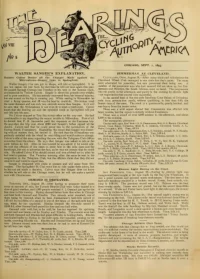
Articles in this issue
- Trainer Culver stops at The Bearings office to rebut the Milwaukee charges: Sanger's father paid the $800 European trip (not Sercombe), Sanger is ten pounds overweight with a hip wound still running, and Culver denies all rumors about a contract with an eastern firm.
- At the Toronto Bicycle Club meet Hyslop beats Osmond and Rhodes and lowers the five-mile record to 13:03 3-5, while Osmond—not yet recovered his sprint—still breaks Zimmerman's half-mile heat record of 1:07 4-5 in a heat he did not win.
- The Cleveland Wheel Club runs races in the afternoon and under electric light in the evening; Zimmerman wins the quarter-mile, one-mile, half-mile, and three-mile lap with South African Meintjes second in most events, before crowds totalling over 2,500.
- The Bay City Wheelmen inaugurate electric light racing in San Francisco on August 22 to great success; H.F. Terrill lowers the quarter-mile record to :32 flat over two evenings, and a mile race is staged against a bronco.
- Indianapolis's first big meet draws 8,400 paying spectators; Zimmerman wins the $1,000 diamond-studded gold cup one-mile open in a record 2:12 4-5—fastest scratch race ever ridden—from George Taylor, J.P. Bliss, and Windle; the Springfield boys' plan to tire Zimmerman with pace-making fails.
- Multiple Chicago clubs race simultaneously on August 26; Charles Hagaman wins the Illinois C.C. ten-mile handicap in a blanket finish of five men, G.W. Robinson takes the Englewood C.C. seven-mile road race, and Arthur Carr wins the Sporting Review five-mile.
- Columnist 'Bolav' surveys the season: Zimmerman remains king with no equal yet shown, Sanger's behavior at Milwaukee damages his credibility, Osmond is a wonder who should have faced the champion, and Bliss alone can make Zimmerman ride for his life.
- The editor argues the current amateur rules are unenforceable because bicycle makers pay riders regardless, and calls for a liberal rule allowing riders to accept expenses and sell prizes, administered by an elected Racing Board with power to frame its own amateur definition.
- Editorial urging cyclists to carry lamps at night, pointing out that the rider's own safety—not just that of pedestrians—is reason enough to light up before venturing into traffic.
- Editorial citing the Indianapolis five-mile handicap fiasco—where most riders missed the false-start recall bell because no flag man was posted ahead of the limit mark—as proof that race officials must study the specific handicap recall provisions.
- Short items column: H. Crowther of Ariel blushes crimson after being caught flirting in the press stand at the international races and misses the next start; cyclists in the Lake Front unemployed riot scatter expertly; the Chicago Herald's anti-cyclist screed is rebuked; Wheeling attacks the N.C.U.'s arrogant claim of authority over foreign riders.
- M. Allais writes a satirical letter to a French cycling paper claiming the millimeter record (1/7000th of a second on track, made on an 1864 velocipede with a drunk pacemaker in the rain) to mock French cyclists' obsession with records without handlebars, without pacers, and in every other absurd variation.
- C. Faruffini, representative of an Italian cycling paper visiting Chicago, proposes Milan as the site of the 1894 international meet, citing four tracks including a fast wooden one and a concurrent International Sport Exposition.
- Circuit diary: Dan Canary's trick riding improves at Indianapolis; 300 riders join the lantern parade; Harry Tyler and trainer Leeming split; J.S. Johnson vows to face Zimmerman at Columbus; racing men adopt vivid racing suits in yellow-and-black stripes, lavender, and baby blue; Springfield set for extensive record attempts in October with Meintjes going for the hour record.
- Despite a rain-soaked Chester Park track, the Cincinnati Century Cycle Club's international meet proceeds; Zimmerman wins the half-mile open, the one-mile international, and the one-mile open, Bliss takes the one-mile handicap in 2:21, and Rhodes wins the two-mile handicap; Meintjes' tire punctures before he can race.
- The Quaker City Wheelmen's third annual meet at the Tioga track in Philadelphia draws 1,000 spectators but no national stars; D.F. Maynes is disqualified in the 25-mile road race for cutting three miles off the course, with the award going to J.B. Pierson.
- Wild reports that the Indianapolis Bachelors' Hall was raided by sheriffs are explained: a butcher owed for meat filed a false affidavit claiming the occupants fled the state to defraud creditors while they attended the Chicago meet; back home the Hall's denizens furnished bonds and are now pursuing the butcher for perjury.
- Essay by 'Buckeye' arguing that the bicycle liberates city workers—clerks, salesmen, mechanics—to discover sunrise, country roads, and rural life otherwise unknown to those raised behind brick walls and crowded tenements.
- A cycling party of architects tours Anjou and Brittany: limestone cliff-dwelling communities along the Loire, an epidemic of twenty punctures from shoe-tacks dropped by peasants lasting a full week, a frantic scramble for dinner for 23 riders at a tiny hamlet near l'Ile-Bouchard, and a near-arrest on French cavalry grounds at Saumur.
- London correspondent C.W. Hartung reports Osmond breaks Meintjes' two-mile record with 4:24 2-5 at Herne Hill (mile en route in 2:10); the North Road hundred-mile disappoints as Edge, Bidlake, and James all retire; Paris-Brussels (253 miles) goes to unheralded Belgian Andre of Liege; W.J. Britten resigns from the N.C.U. licensing committee.
- Veloce Sport's Maurice Martin sends a scathing, elaborately sarcastic open letter to English judge G. Lacy Hillier for publicly ridiculing French records and timekeeping during Shorland's record ride at Herne Hill, citing Dubois's 1887 world 50-mile championship as evidence of French cycling honour.
- A.I. Brown draws on Arthur Young's 1787 'Travels in France' to argue that French road-building—maintained in perfect condition for over a century—puts everything American road science currently constructs to shame.
- Short profile of Dr. A.I. Brown of the Lakeside Cycling Club, Cleveland—a curly-haired, brown-suited medical graduate who has been track racing since August 1892 and is noted as a strong finisher with a sprint always in reserve.
- Full directory of the Century Road Club's officers, committee chairs, and state centurions from Alabama to France and England, along with dues payment notice (the year ends May 1, 1894) and the secretary's request that Chicago members transact all business by mail.
- Boston common council's special committee hears prominent cyclists including J.S. Dean and C.H. Griffin protest proposed speed ordinances; Dean favors arresting scorchers outright while the lamp clause draws the most objection; the matter is held over for legislative action.
- A.J. Nicolet and C.H. Peck of Chicago dominate the Champaign IL race meet, winning the mile open, two-mile open, and two-mile handicap; a disputed 2:45 time-limit ruling in the first mile open leads to a run-over that Miner wins after Nicolet's front wheel is buckled in a collision.
- Following three days of horse racing at the Leavenworth County Breeders' Association in Kansas, a Kansas division bicycle meet sees M.H. Burt of Wichita win the one-mile open in 2:27 1-2 and R.W. Farrell take the novice half-mile and county half-mile championship.
- The Racing Board adopts a new rule allowing it to bar any trainer or manager who extorts money from race promoters or engages in blackmail from appearing on any track, a direct response to Tom Eck's demand for money from the Albany Wheelmen.
- At a Waverly NJ cash-prize meet sandwiched around a Chicago-Brooklyn baseball game, H.C. Wheeler of Orange rides the five-mile handicap from scratch in 12:04 1-5, lowering Lumsden's amateur five-mile competition record.
- The Von Der Ahe Colored Bicycle Club's electric light meet in St. Louis draws a fair attendance but poor track lighting means riders can only be seen as they cross the tape in front of the grandstand.
- Miscellaneous news: Michigan Century Riders' Club adopts a gold-and-frosted-silver pin; Metropolitan Cycling Clubs of New York plan a September 16 meet at Waverly; professional Shock finally beats Heuman in Freeport IL; German champion August Lehr rides a mile in 2:06 2-5 breaking all European records; Italian tourist Masetti arrives in New York.
- Milwaukee bicycle manufacturer Sercombe-Bolte is placed in receivership amid a stockholder dispute: Parker Sercombe and F.H. Bolte face off against John S. George and C.M. Sanger's faction, with the split linked to C.M. Mortimer's role in the Telegram Club's feud with Walter Sanger over his refusal to race.
- Pope, Overman, Kenwood, and Lozier had refused to enter the World's Fair cycle competition while Irving Miller served as judge; with Miller agreeing to recuse himself from judging the Gormully & Jeffery exhibit and Professor Thurston added to the committee, the major makers are now likely to participate and awards should be announced in about two weeks.
- Milwaukee dealer George C. Cribb, who handles agricultural implements, carriages, and bicycles at Nos. 133-139 West Water Street, makes an assignment to William Mariner with bonds of $800,000; assets are expected to cover all liabilities.
- R.P. Gormully of Gormully & Jeffery inquires about Governor Altgeld's reported scheme to employ the unemployed on road improvement; the governor's secretary replies that the last General Assembly already rejected road legislation and cannot be recalled for the same purpose.
- Reprinted from Pacific Medical Journal: a physician argues that the racing crouch—bent back, head depressed—prevents free chest movement, displaces the heart forward, strains arterial connections, and interferes with gastric digestion after meals, making high-speed cycling in this position a pernicious exercise especially for immature riders.
- 'Nick O'Demus,' writing in Cycling, humorously describes how a genteel club run inevitably becomes a scorch: all riders claim to be off form and mean only to crawl, until one bolts from the rear and the whole cluster digs after him, hills and tire failures thinning the field.
- S.F. Edge, writing in Cycle Record, advises against high gearing on pneumatic-tired machines, recommending no more than 57 inches for touring, 60 for hilly scorching, and 63-64 for the fastest North Road courses, arguing that the extra pace of pneumatics does not require higher gears.
- Reprinted from The Cyclist: at modern track speeds a final with seven or eight men invites a crash; experienced promoters already limit finals to five or six competitors, and the article urges all race managers to adopt this standard for competitors' safety.
- Reprinted from the English Umpire: the current generation of English champions—Watson, Harris—are smaller than great predecessors like Sellars, Furnival, and Osmond, and this physical disadvantage explains why Zimmerman and Sanger so thoroughly dominated the international meet.
- Calendar of upcoming race meets for September and October 1893, from Norristown PA and Kansas City on September 1 through the Syracuse Athletic Association's eighth annual meet, the Chicago A.A.U. championships on September 14-16, and the Savannah Wheelmen's fall tournament on October 17-18.
- Column collecting humorous cycling items from small-town newspapers: an Iowa novice demolishes a borrowed bicycle on his very first ride; Jacksonville cyclists wisely choose soda-water over beer; a Canadian woman petitions for soft tinkling silver bells on bicycles instead of horrid gongs.