The Bearings, Vol 9, No 1
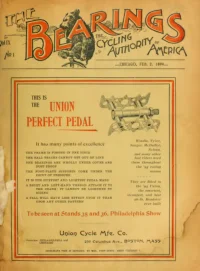
Articles in this issue
- Boston correspondent reports on Massachusetts division's sudden apathy toward the L.A.W. negro-membership question, tracing it to two social dances where Black couples appeared; explores Mr. Perkins's suspected deal to pledge Massachusetts votes for Asbury Park in exchange for support as second vice-president of the League.
- The Lake View Cycling Club has petitioned the Lincoln Park board for a quarter-mile track after park commissioners shut down the club's road-race course on the Lake View boulevard, leaving them without a venue while West Side and South Side clubs retain theirs.
- Paris correspondent A. G. Roux provides a detailed account of the Dubois-Linton 100-mile match race before 20,000 spectators at the Paris winter track—won by Linton after two falls apiece—and reports on the first Paris cycle show at the Salle Wagram, plus news of visiting racers Wheeler, Edwards, Barden, Verheyen, and Linton's trainer Warburton.
- Milwaukee dateline reports that Chief Consul A. Cressy Morrison, whose anticipated long stay in Antwerp had prompted resignation rumors, is returning home; the Wisconsin division annual meeting will settle the location of the next state meet, with Ripon, Oshkosh, and Eau Claire the main candidates.
- Boston correspondent ridicules a Massachusetts legislative bill that would cap bicycle speed at eight miles per hour in towns over 1,000 inhabitants and require riders to sound a bell or whistle at least six times when within twenty feet of a vehicle, horse, or pedestrian; also notes Boston's campaign for the 1894 national L.A.W. meet.
- London correspondent C. W. Hartung reports on the N.C.U.'s proposed three-tier licensing scheme for amateur, tradamateur, and cash-prize (lucramateur) riders, to be voted on at a special Leeds council meeting; also covers the inaugural meeting of the Mowbray House Lady Cyclists' Association, with Lady Henry Somerset as president and Frances Willard as vice-president.
- New York correspondent contrasts metropolitan clubs' tight membership vetting with Chicago clubs' practice of suing delinquent members for dues; reports on the Metropolitan Association of Cycling Clubs bowling tournament—Atlanta Wheelmen and Brooklyn Bicycle Club tied for first—and the new pool tournament, with an anecdote about Riverside Wheelmen racer Titus's cunning plan to abolish the bugler office by getting himself elected to it.
- The Pennsylvania division meeting voted to uphold admission of Black members, endorsed the entire Luscomb ticket, chose Asbury Park for the next L.A.W. meet, and appropriated $300 for the state meet while voting $500 to Chief Consul Boyle; the treasury stands at $2,224.57 with membership up 931 to 3,645.
- The Bearings describes how an attempt to form a cycle press association at the New York Cycle Show dissolved after members broke a secrecy pledge before the meeting ended; The Bearings withdrew at a follow-up meeting in Philadelphia when it became clear the other papers—The Wheel, The Referee, American Wheelman, American Cyclist, Cycling Life, Bicycling World, and Sporting Life—had acted in bad faith, and Cycling Life then also withdrew.
- Editorial argues that riders Bliss, Dirnberger, and Bald—having beaten Tyler, Sanger, and Johnson and set a record quarter-mile—are well-prepared to repeat the American dominance of Zimmerman and Sanger over English amateurs, whose best men have all turned professional and left the N.C.U. unable to protect its championships.
- Weekly department column covering: Boston's lukewarm desire for the 1894 national meet; Dai Lewis's prank on tire man Frank Eppele with a building demolition chute on State Street; personalities of English long-distance riders Mills, Bidlake, Holbein, Edge, Carlisle, James, and Shorland; French professional Fournier's $600 lawsuit loss for racing a rival maker's machine on holiday during military service; O. S. Bunnell's anger at N.C.A. riders who raced unsanctioned at Madison Square Garden; Bliss's ambition to sprint a mile behind a locomotive; Waltham track management's plans for monthly meets; the Overman tariff threat; and a letter from W. C. Harris Jr. of Birmingham correcting the claim that a wooden-framed Alabama bicycle was built by a Black man.
- H. A. Huff recounts a moonlight thirty-five-mile bicycle excursion by three Denver wheelmen—Herrick, Peoples, and himself—through Turkey Creek Canon near Morrison, Colorado, including a precipice-edge road above a 1,000-foot drop, a campfire overnight with roasted potatoes and cow's milk for breakfast, and a thrilling brakeless downhill coast home.
- John S. Johnson lowers his own half-mile skating record to 1:16 4-5 on the Ohio canal in Cleveland on January 30, beating the previous world record of 1:22 he set at Minneapolis; ninety-two Cleveland Wheel Club members accompanied Johnson and Tom Eck to the Grays' Midway Plaisance that evening, and new Cleveland Wheel Club officer elections are scheduled.
- At the Philadelphia show Tom Eck emphatically denies rumors of a split with John S. Johnson, predicts Johnson will ride faster than ever with better race-generalship this season, credits himself with developing both Johnson and Dirnberger, and advocates a one-class amateur rule opposing the six-month prize-selling allowance.
- Humorous editorial response to a letter from 'Would-be Scorcher' seeking advice on winter cycling; the editor offers mock tips including sealskin sweaters lined with dog's hair, liberal doses of brandy and Bass ale through a funnel, snowballs eaten raw, pressing cold feet against a warm back, and carrying one's League ticket for identification when found frozen—concluding that the chief objection to winter riding is the winter.
- Comic anecdote in which Colonel Burdett, president of the League of American Wheelmen, reveals his identity to an anti-cyclist curmudgeon on a train to New York, only for the man to shrug and continue his tirade against 'the most ornary, flat-pated, asinine ijots' who ride wheels.
- Satirical fiction piece in which the dashing Clarence de Stuyvesant Van Ham loses his beloved Evangeline O'Rafferty because she refuses to marry a man who needed a horse to pace him to break a record—lampooning the N.C.A. controversy over paced record attempts, with a coda that a French manufacturer plans to brand his racers' costumes so the public knows they are paid riders.
- Reporter surveys Chicago's Cycle Row dealers ahead of the 1894 season, finding brisk early sales and optimism at Quadrant, Stokes, Pope, Raleigh, Ariel, Security, Gormully & Jeffery, and Spalding; profiles Louisville dealer R. C. Whayne's expanding regional jobbing business, and notes Zimmerman's first experience as a traveling salesman for Burtis & Zimmerman selling Raleighs in New Jersey.
- Comprehensive opening-night report on the fourth annual Philadelphia cycle show in the First Regiment Armory—described as a close second only to New York's Madison Square Garden show—covering decorations, trick riding by Sid Black and Kilpatrick, and detailed exhibit descriptions for Gormully & Jeffery, Union Cycle, W. H. Wilhelm, New York Tire Co., Derby Cycle, Palmer Tire, Raleigh, Keating, Stearns, Spalding/Lamb, Cleveland, Lovell Arms, and over two dozen other wheel and accessory manufacturers.
- Profile of J. L. Townsley of the Derby Cycle Co. as an unsung but prolific salesman who sold most of his firm's 1893 output; he has just placed the entire state of New Jersey—mostly through Burtis & Zimmerman at Freehold—and exposes a competitor who received glowing press notices after placing only one wheel on an entire Pennsylvania trip.
- John F. Palmer closes a deal with the Western Wheel Works for 5,000 sets of Palmer tires to equip the new Crescent at $90 list price, undercutting the G. & J.–Pope–Indiana Bicycle–Western Wheel Works tire alliance; R. Philip Gormully and Secretary Edward W. Pope give conflicting accounts of whether a contract was actually signed.
- H. C. Martin & Co. of Buffalo will stage a week-long local cycle show at 'Martin's Church' from February 19, featuring eleven stands including Columbia, Rambler, Warwick, Buffalo, Syracuse, Envoy, Fleetwing, Falcon, and sundries, with nightly music, trick riding, and free admission.
- At the Madison Square Garden show, 128 of 427 exhibition wheels carried Sager saddles exclusively—more than double the nearest rival's forty-nine—while thirteen manufacturers specified Sager saddles; the 1894 line features a new button nose attachment replacing the unsatisfactory hook and new direct seat-posts.
- C. E. Duryea of the Rouse-Duryea Cycle Co. has built a practicable gasoline motor carriage in which a single-cylinder engine mounted on the rear axle drives the wheels by chain as on a safety bicycle; a lever controls speed and direction, and Duryea claims operating costs of three cents per hour.
- Technical article translated from a French cycling exchange, with diagrams, demonstrating mathematically that large-diameter thin-walled tubing resists bending, buckling, and torsion better than small-diameter thick-walled tubing of equal weight—vindicating modern lightweight bicycle frame design using oversize tubes.
- The Wheelmen's Registration Co. of Boston, led by president F. R. Wright and with E. M. Thayer as agency superintendent, registers bicycles for $2 the first year and $1 annually thereafter, guaranteeing replacement of any stolen wheel within thirty days and employing private detectives in major wheel centers to trace stolen machines.
- A Bearings correspondent visits the Simonds Rolling Machine Co. in Fitchburg, Massachusetts—the world's largest ball manufacturer—and describes how bar steel is heated, rolled into rough spheres at up to 35,000 per day, ground on emery disks, tempered to glass hardness, steam-inspected by girls for flaws, and gauged to 1/1,500 of an inch before shipment; some 140 balls enter each bicycle.
- Boston trade correspondent reports on brisk cycle-row activity: Rich & Sager traveling man C. J. Iven is booking saddle orders with ease; Fred F. Dudley expands into three Union Cycle Co. storefronts at 116–120 Columbus Avenue to handle Premier, Triangle, and Imperial wheels; B. B. Emery & Co. have booked seventy-five Fowler orders since taking the New England agency on January 12.
- The new Fluke mud-guard made by Colton & Hickox of Toledo uses rubber construction to stop all mud and water from both wheels; it is extremely light and retails through the Stokes Mfg. Co. in Chicago at $1 per pair, as scorchers increasingly appreciate mud protection.
- Reviews of 1894 bicycle manufacturer catalogues: Sterling's innovative dialogue-format booklet; F. F. Ide of Peoria offering four weights from 23 to 30 pounds at $100–$140 with interchangeable tool-steel sprockets; Premier's half-tone illustrated catalogue highlighting new steering-head ball races and tangent spokes; Hickory Wheel Co.'s catalogue showing weight reduced to 30 lbs with new spoke-fitting and mud-guard methods; and League Cycle Co.'s explanation of how its chainless bevel-gear system eliminates chain stretch, climbing, and wear.
- New York trade notes: Wilson-Myers Co. incorporates with $100,000 capital to continue Liberty cycle production amid rumors of financial strain; Bidwell-Tinkham Cycle Co. secures the New York E. C. Stearns agency; Rudge bicycles attempt a comeback through Bronson Supply Co.; Ira Perego's Sons reopen on Park Row as cycling haberdashers after a fire; a new central-draft kerosene bicycle lantern called the Searchlight enters the market; Stephen Golder and George Hendee depart for England.
- George S. Webb of Aurora, Illinois exhibited at the New York show a wire-attached pneumatic tire using a skate-key principle to tighten or loosen wires holding the tire to a specially designed Parkhurst & Wilkinson wood rim; once fastened the tire never loosens.
- The New York Tire Co. introduces a 1894 road tire weighing only 2.5 pounds per pair, using patented fabric that withstands 250 pounds of air pressure, saving riders two to three pounds per pair compared to competitors while maintaining strength and resiliency.
- The Overman Wheel Co. has patented a device that automatically records the number and relative height of a tire's rebounds when dropped one foot, tracing a graph on paper for direct comparison; the company distributes cards showing the Victor pneumatic road tire outperforming all competitors on the same machine.