The Bearings, Vol 9, No 11
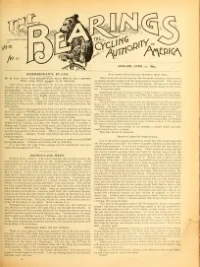
Articles in this issue
- W. B. Troy, arriving on the steamer Majestic, reveals the terms of Zimmerman's professional contract with the Union Velocipedique Society of France: a $5,000 deposit, $250 per race started, thirty per cent of gross receipts, and a $20,000 city-prize debut race in Paris on June 17 with sixteen meets to follow across Europe.
- The Massachusetts division plans its largest spring meet for May 30 at Waltham's new metalithic track, praised by trainer Dirnberger as the fastest surface he has ever ridden, with a grand concert smoker the night before and a parade projected to exceed the world-record turnout of the previous year.
- Two Stearns racing teams depart for Savannah—Charlie Murphy leading one squad, Tom Eck and John S. Johnson another—while Charlie Schwalbach holds his third annual cycling reception in Flatbush and the Brooklyn Bicycle Club election ends peacefully when regular-ticket nominee Stebbins steps aside for incumbent vice-president Walter L. Sinn.
- New York cycling press men form the 'Chinatown Push,' a club that takes visiting wheelmen on Wednesday night tours of Mott Street—including Wing Wo Hing's merchant house, fan-tan parlors, opium dens, a Chinese joss house, and the Doyer Street theater where the party's laughter at the wrong moment nearly starts a riot among 800 Chinese patrons.
- Louisville, Ky., correspondent covers E. H. Croninger's appointment as southern member of the LAW Racing Board, an April Fool forged-check fraud on Pope and Sargent & Ham dealers, the Owensboro meet program with thirty-seven distilleries in the county, and Chicago's Associated Cycling Clubs' May 6 union run with $50 in prizes for the largest club turnouts.
- Editorial notes that the LAW Bulletin's experiment in eliminating trade puff items may prove misguided for other papers, but The Bearings long since resolved the problem by confining all trade matter to a classified back section, leaving the editorial pages free for sport and pastime.
- Rival good-roads publications are now in prospect: Sterling Elliott has the League's backing while Isaac B. Potter, though supplanted as the movement's champion, will publish independently from sheer enthusiasm—and The Bearings expects the two organs to coexist rather than clash.
- Regular department discusses who will claim the amateur championship now that Zimmerman has turned professional (naming Sanger, Tyler, Johnson, Bliss, and Dirnberger as contenders), ridicules daily newspaper artists' anatomically improbable bicycle illustrations, and offers humorous items including cycling arithmetic from the French Le Cycle, the three-class Paris-Bordeaux race rules, and an April Fool cake-tin prank on Utah captain C. A. Emise.
- Feature explains how the Syracuse Athletic Association—$75,000 clubhouse, twelve pool tables, gymnasium and café—charges 750 members only $12 per year through tight board management; a row erupts when Chairman Raymond grants Decoration Day meet sanctions to Auburn, Utica, and Rome simultaneously despite all three lying within the fifty-mile exclusion limit.
- English exchanges report that retired champion Fred J. Osmond has returned to competition, winning his heat in the mile open in 2:32 1-5 at a recent British meet, though Stroud and Fisher beat him in the ten-mile final (26:50) while he finished a good third.
- During Terront's Paris-to-St. Petersburg journey a Belgian prankster in Huy wrapped himself in a waterproof and rode into town posing as the great cyclist, drawing cannon fire and cries of 'Vive Terront!' from a thousand rain-soaked spectators, while the real Terront slipped through unrecognised, black and muddy, a few minutes later.
- Official LAW department lists newly-granted sanctions (Philadelphia, Waltham, Asbury Park, Fresno, Elmira, and others), the five National Racing Board members and their district assignments from Maine to California, and the full roster of official handicappers for all thirteen districts.
- Milwaukee correspondent reports that Sanger's friends believe he would have beaten Zimmerman had the latter stayed amateur, while Chairman Raymond formally denies reinstatement to cash-prize rider Henry Kanaska; also notes the Milwaukee Wheelmen's July 4 Waukesha road race and their tenth-anniversary celebration at Germania hall on April 28.
- Denver correspondent refutes a sensational newspaper story claiming League officials were conspiring to ruin the city's 1894 national meet, explaining the August 27-September 1 dates were cooperatively agreed, and reports that the Denver Wheel Club has leased Martine's dancing academy for a new clubhouse to open May 15.
- The season's first southern meet, held in Charleston, S. C., April 3-4, draws large crowds; Fitzsimons of Greensboro, N. C., wins the Columbia cup race with the last quarter in :29 and also takes the mile handicap and three-minute class, with W. W. Hamilton of Pueblo announcing he will move to Denver.
- Houston capitalist Wilson is completing a $50,000 track three miles from the city center—surpassing San Antonio's facility—and plans a likely Decoration Day meet with diamond prizes, eight events per day in class A and class B, and free training quarters for visiting racing men.
- The third annual Linscott twenty-five mile handicap road race, set for May 5 in Massachusetts, offers prizes including a horse and team for first place with aggregate value of $2,000-$2,500; promoter J. M. Linscott is revising the course to cut turns, and James Clark, E. A. McDuffee, and other local cracks have already entered.
- Editorial rebutting the Irish Athlete's condemnation of the LAW's exclusion of Black cyclists, arguing that Irish immigrants in America show particularly intense racial prejudice—citing a laborer who preferred being thrown back into a suffocating sewer to being saved by a Black man—and questioning the paper editor's nationalist credentials given his apparent Unionist sympathies.
- Correspondent surveys Cincinnati's flourishing cycle trade: General Poorman sold 700 high-grade and 1,000 medium-grade wheels in 1893 and projects double that this season; the four Hanauer brothers run two stores including the only cycle house in Covington, Ky.; and local manufacturer H. E. Schluter is producing the new Norwood wheel at $125, twenty-four pounds, with 'Teddy' Alsop in charge of building.
- New York's busiest trade week of the year: Wilson-Myers manager Bretz converts the fifty-seven-member Economy Bicycle Club of Binghamton entirely to Liberty wheels in one day; Colonel Pope makes a one-hour flying visit; Western Wheel Works receives four carloads of Crescent scorchers per week and sells them almost immediately; Ira Perigo's League chainless bicycle draws daily crowds.
- London, March 31 dispatch covers American riders' neglect of gear cases, Seddon's forthcoming low-price pneumatic tire of pure Para rubber, Singer & Co.'s Modele de Luxe ladies' safety and tandem, the Quadrant Cycle Co.'s new tricycle meeting strong demand, Seddon company consolidation reducing capital from £160,000 to £100,000, and a complaint about manufacturers who cannot fill orders placed four months in advance.
- Late news item reports Mark W. Hill of the Hill Cycle Mfg. Co., Chicago, is dangerously ill and not expected to survive more than a few hours; his son-in-law and daughter Mr. and Mrs. Frank T. Fowler are attending him while his wife and son are summoned from Florida.
- A Bearings representative tours the Eclipse Bicycle Co.'s factory in Beaver Falls, Pa.—reportedly the fourth largest in the United States—finding a 150-wheel-per-day spoke room, ten large nickel-plating baths, twin dynamos powering 450 incandescent lights for overtime work, and a 10,000-gallon fire tank atop a derrick seventy-five feet high.
- Editorial, drawing on the Sporting Goods Gazette, warns that dry-goods syndicates now entering the bicycle trade will face a 'reflex action' when warranty customers return for spokes, saddle posts, and repairs that a dry-goods counter cannot supply.
- Description of the Clymer two-speed bicycle from Berlin Machine Works of Beloit, Wis., which uses two independent chains on 45- and 60-inch sprockets switchable at the steering head via a center-clutch that permits coasting before engaging either gear, allowing riders to climb hills through sand and mud while others walk.
- Editorial traces the cycling industry's history of fashion-driven material changes and questions whether the current craze for wood rims—adopted by manufacturers against their own judgment to satisfy public demand—will survive once Eagle company's aluminum rims receive wider trial.
- Regular column listing incorporations, dissolutions, assignments, and ownership changes among hardware-and-bicycle dealers across more than twenty cities, including the new Beebee Tire Mfg. Co. of Portland, Maine with $100,000 capital, and numerous hardware firms in Iowa, Illinois, Indiana, Colorado, and the Pacific Northwest that have sold out or dissolved.
- Short trade department: burglars back a wagon into Jordan & Saunders in St. Louis and steal two new wheels; Avery Planter Co. of Kansas City sells thirty-five Road King and Duke bicycles to mail carriers; the Royal Flush Cycle Co. moves from Elyria to Toledo with thirty men; fire on Chicago's Cycle Row damages Sieg & Walpole's store at 271 Wabash avenue.
- Title of what appears to be a feature, travel narrative, or fiction piece; the body text is too damaged by the scan to read.