The Bicycling World, Vol 1, No 1
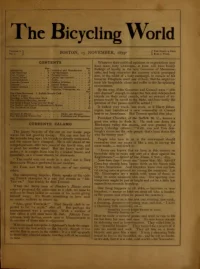
Articles in this issue
- The editor's witty opening column for the inaugural issue, commenting on the visiting French racing champion Terront, rival cycling journalists, and the spread of bicycling clubs across America.
- A detailed profile of the Suffolk Bicycle Club of Boston — the largest American club in 1879 — covering its founding, constitution, club-room at 36 Charles Street, and full membership roll.
- An election-day excursion signed 'Mercury': nine riders of the Philadelphia and Germantown clubs cross to Gloucester, N.J. and ride via Woodbury to Salem and back through a snow-squall, the writer covering sixty-eight miles.
- Club news including the Boston Bi. Club's protest against recognising Will R. Pitman as an amateur, and notes on the newly founded Brockton, Chicago, Harvard, Lynn and Massachusetts bicycle clubs.
- Report of the four-days' race in the tent at Huntington Avenue and West Newton Street, Boston, where Charles Terront (660 miles) and William Cann (628) held the track against Thomas and George Harrison, Prof. Rollinson, Murphy and Lowder.
- Summary of the 60-hour race between Harry Etherington's Anglo-Franco team and five American professionals, won by Terront on a 52-inch D.H.F. Premier ahead of Cann and George Harrison; none reached the 800-, 750- or 700-mile prize distances.
- John Keen, on a 56-inch Eclipse, beat David Stanton in a fifty-mile race at Bicycle Park on Huntington Avenue, Stanton retiring in his 33rd mile despite a two-and-a-half-lap start.
- Notes on individuals: acting Captain Edward C. Hodges of the Boston Bi. C. revealed as one of the publishing 'Co.', John C. Sharp, Jr.'s 2.59 mile ridden in England, and mentions of President Longstreth, Captain Johnson and Willie Wright.
- Letters welcoming the new paper: a Pittsburg rider, a Detroit correspondent ('Go as I Please') reporting Captain N. B. Conger's seventy-mile Windsor-to-Leamington run and deploring gambling in the sport, and Philadelphia Bi. Club president Thomas K. Longstreth.
- A listing of American bicycle clubs with their officers and contact information, compiled to help riders connect with organised clubs across the country.
- The inaugural editorial greeting from editor Charles E. Pratt, introducing the mission and scope of The Bicycling World as America's premier cycling journal.
- Editorial assessment of Boston's first protracted professional race: hampered by a too-narrow track, an unready tent and bitter November weather, with the riders loafing on the final day, the paper judges it 'almost a farce' despite Terront's 3.10 mile.
- F. W. Weston's farewell to the American Bicycling Journal, founded December 1877, which after eighteen numbers is merged into The Bicycling World, with Weston continuing as an associate editor.
- The five Brockton Bi. Club members fined $10 for Sunday riding were acquitted on appeal before Justice Wilkinson in the Superior Court at Plymouth, Mass. — the first criminal prosecution of a bicycler in America.
- Fixtures including the Suffolk and Harvard club races at Clyde Park, Brookline, the joint Boston and Massachusetts clubs' run to South Framingham, and the Manhattan A. C.'s open mile handicap on Thanksgiving Day.
- A column of jokes and squibs, trading quips with London's Bicycling Times and Cycling, needling Harry Etherington, and exposing a two-mile 'best American record' of 6:52 that was run 352 yards short.
- Readers' questions on choosing between a 52-inch and 54-inch wheel, Prof. Rollinson's best record before the sixty-hour race, and a loose-clasped 'Pope' cyclometer and clicking Aeolus ball bearings.
- Lists fourteen U.S. velocipede patents granted in 1879, as reported by patent solicitor C. E. Pratt of Boston, including E. C. F. Otto's tricycle, A. A. Smith's ice velocipede, and a hammock-seat arrangement by J. Shire.
- Notes from other sports: a Reno roller-skater's claimed 154 miles in ten hours, the California trotter St. Julien's 2.12 mile, and the All England Eleven's cricket victories over the Young Americas and Merions.
- On the four or five tricycles in America as forerunners of a machine suited to ladies, the pace of English patenting, and boys' velocipedes as training for future bicyclers.
- Reprints including J. Wilcox in November Lippincott's on why ladies should ride, and the Brockton Advance's account of the Brockton Bicycle Club members' acquittal over Sunday riding in the suit brought by Fitzgibbons.
- Foreign news clipped from The Bicycling Times of London: John Keen beat David Stanton in a 100-mile race for a belt and money at Agricultural Hall, Stanton retiring at 76 miles, with record times tabulated.