The Bicycling World, Vol 1, No 3
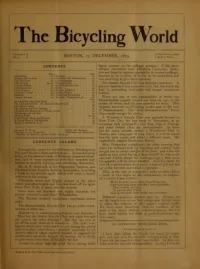
Articles in this issue
- Editorial notes for the December 1879 issue, including observations on Thanksgiving Day cycling around Boston's suburbs, commentary on archery, and light political humour.
- The conclusion of the John Keen interview, detailing his championship race record from 1872 to 1879, advice on track conditions, coaching methods, and training principles for racing cyclists.
- A profile of the Harvard Bicycle Club, covering its organisation, membership, and activities in the Cambridge area.
- Continuation of a Brooklyn correspondent's New Jersey ride through Orange and the Valley Road to Montclair, returning over Bloomfield Avenue's macadam to Newark and Jersey City — thirty-four miles in all, signed E. J. A.
- Letters from South Bend, Ind.; from Pittsburg on its new tracks and the boys' Challenge Bicycle Club (Leydon Bard, Jr.); from Capital Bi. C. member James P. Stabler of Washington; from Jno. M. Fairfield of Chicago on archery; and from Llewellyn H. Johnson of Orange, N.J., answering Harry Etherington's race challenge.
- No. 2 of the column: archery's future compared with bicycling, an English roadside anecdote of archers escorting a wagonette by bicycle, what a "good track" means (with advice for St. Louis), and progress on Boston's Granite Bridge track project.
- Organisation reports from the Challenge Bi. C. of Pittsburg, Princeton College Bi. C., the new Waltham Bicycle Club (captain Henry B. Colby) and the Yonkers Bi. C., with notes from the Cleveland and Chauncy Hall clubs.
- Directory of club secretaries and their addresses, covering the Boston, Brockton, Brooklyn, Buffalo, Capital, Challenge, Chauncy Hall, Chicago, Cleveland, Detroit, Essex and other bicycle clubs.
- Leader on the bicycle's legal status as a carriage: Boston collector W. A. Simmons's adverse customs ruling was overturned by Treasury Secretary John Sherman in 1877, and the English case of Taylor v. Goodwin now confirms bicyclers' right to the roadway.
- Unheaded editorial notes on the paper's aims and friendly press notices, its circulation rise from three thousand to thirty-five hundred copies, and the prospect of weekly publication.
- How the Suffolk Bicycle Club's May 1879 races at the Chestnut-Hill Reservoir, with gold medals offered by Amos A. Lawrence, led Boston's Water Commissioners to withhold approval for the October races, and why the club gave up racing at the reservoir.
- An argument for long-range shooting at the double York Round and for heavier bows, citing Will H. Thompson, George A. Hansard's "Book of Archery", and the Highland Park Archers' rule against ranges under sixty yards.
- The New York Archery Club's Thanksgiving shoot at Mount Morris Square, the Toledo Archery Club's prize dinner and 1879 winners, a new indoor range on State Street, Chicago, and Double York Round scores by the Wabash Merry Bowmen, led by Will H. and Maurice Thompson.
- The Philadelphia and Germantown clubs' Thanksgiving meet as seen by the Evening Bulletin, a thirty-mile Capital Bi. C. country run from Washington, a Sunday ride from New York up to Tarrytown and Nyack, and the Boston Bi. C.'s nineteenth meeting and club dinner.
- About sixty riders of the Philadelphia and Germantown clubs gathered in Fairmount Park on Thanksgiving morning — the largest meet yet seen in America — posing for a photograph at Memorial Hall and giving a fancy-riding display in the Permanent Exhibition building; signed "Mercury".
- A Tariffville, Ct., reader asks after second-hand 44- or 46-inch machines, and Prof. Rollinson's record before the sixty-hour race is answered from the Philadelphia Sunday Press.
- The West Newton Archery Club's coffee party at Newton City Hall on 16 December, and a two-mile amateur bicycle race at the Columbia College Boat Club games, Madison Square Garden, 2 and 3 January 1880.
- The Six-Day Exhibition Contest at Chicago's Exposition Building, won by the English team of Keen, Stanton, Terront and Cann; L. H. Johnson's one-mile handicap win at the Manhattan Athletic Club games; Terront's sixty-mile victory in Chicago; and a seventy-two-hour tournament at the Mechanics' Pavilion, San Francisco.
- A report on the English court case Taylor v. Goodwin in the Queen's Bench, which established that the bicycle is a carriage entitled to use public highways.
- A. W. Drake of Scribner's Monthly is elected an honorary member of the Boston Bicycle Club; A. J. Philbrick of the Salem Bi. C. rides to Haverhill and back; the Pope Manufacturing Company presents a Columbia to the Old South Fair; and J. C. Thompson builds a riding hall behind the Peabody Museum.
- Press notices of the Bicycling World from the Chicago Field, Turf Field and Farm, the Boston Post, the Commonwealth and the Congregationalist, noting its succession of the American Bicycling Journal under editor Charles E. Pratt.