The Bicycling World, Vol 1, No 4
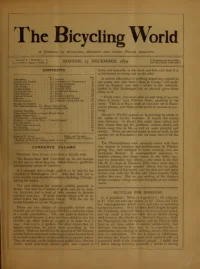
Articles in this issue
- End-of-year editorial notes discussing proposed bicycle tracks in Washington DC and Chicago, club news, and remarks on the growth of cycling as a sport and utility.
- A substantial essay arguing that the bicycle has enormous practical value for professional men — physicians, bank messengers, lawyers, and collectors — as a swift and economical vehicle for business travel.
- Profile of the Boston Bicycle Club, the oldest in America, tracing its origins and noting its senior role in establishing the local cycling movement.
- A brief review of the Brockton Bicycle Club, covering its formation and membership.
- Four Brooklyn Bicycle Club members ride 21 miles from Brooklyn Heights through Prospect Park to Brighton Beach, Coney Island, and back by moonlight; and 'Hoosier' recounts a 70-mile ride from Indianapolis through Greenfield, Charlotteville and Raysville to Richmond, Indiana, revolver at the ready against two tramps.
- A Worcester correspondent details the Worcester Bicycle Club's claims to the most practical use of the wheel: Mr. John A. Dean carried a twelve-foot timber half a mile, and covered over 3,000 miles in a five-month business trip through New England on a sixty-pound home-made machine, gaining twenty pounds in the process.
- E. W. Pope corrects 'Mercury's' claim that Philadelphia saw the largest gathering of bicyclers in America, citing the seventy-five riders present at the Boston Bicycle Club's 20-mile road race at Chestnut Hill Reservoir on 27 November 1878.
- Race results from the Knickerbocker Athletic Club's winter meeting at Madison Square Garden (won by J. Faley over J. Rolfe of the Zephyr B.C., London), the New Jersey Athletic Club at Hoboken, the Columbia College Athletic Association (W. T. Lawson first), and the Twenty-Second Regiment armory games in New York.
- Full report of the first three days' professional bicycle race in California, held at the San Francisco Pavilion: H. C. Eggers won with 543 miles and a $500 prize over F. T. Merrill (512 miles) and A. A. Bennett (480 miles), while the injured W. A. M. Dunbar pluckily completed 400 miles to save his entrance money.
- The novel ladies' competitions at the San Francisco three-day meeting: Miss Lizzie Baymer beat Miss Addie Lee and Mrs. Martin in all four timed races on 50-inch and 42-inch English wheels, and afterwards rode a mile against time in 4m. 52s.
- Club news including the Chauncy Hall run to Lynn, the formation of the Columbia College, Keystone (Pittsburg), New York, and Tivoli bicycle clubs with their officers, and the Waltham Bicycle Club's election of Walter D. Hatch as president.
- Foreign notes: the Bicycle Touring Club reaches 923 members; reports from Trinidad, Australia, the Geneva Bicycle Club, Scotland, and New Zealand's Pioneer Bi. C.; Chas. Hommey wins the professional championship of Paris at Neuilly; and G. T. Edmund and J. C. Mercer contest the championship of Wales at Llanelly.
- Personal items: the English professional team returns home; the N.A.A.A.A. again refuses to reinstate W. R. Pitman as an amateur; William Cann and Terront visit Boston; H. B. Thompson enlarges his Pittsburg riding school; and the Boston Bicycle Club's president is re-elected to the Boston City Council.
- Notes and anecdotes from the English cycling press, covering races, new machines, and club activities across Britain.
- Directory of American bicycle club secretaries and addresses, from the Boston, Brockton and Brooklyn clubs to Chicago, Cleveland, Montreal, and San Francisco.
- Leader columns wishing readers the compliments of the season, reviewing 1879's growth to thirty-four American clubs and some 2,500 riders, appealing for records of the year's amateur races, and urging support for the proposed Granite Bridge racing grounds.
- Archery department with the Manhattan Archery Club's Thanksgiving score at Mount Morris Square, the Highland Park (Illinois) shoot for a Spalding bow won by Mr. Gray, and the West Newton Archery Club's successful coffee party.
- An essay signed 'Toxy' on the fascination and difficulty of archery, describing how a small New York State town's club — whose seventy-year-old representative took two prizes at the Eastern Archery Association meeting in Boston — fitted up a twenty-yard winter shooting range in a militia armory.
- Answers to readers, advising an Independence, Iowa correspondent on Columbia wheel sizing for sandy roads, and explaining to a Racine, Wis. reader why ball bearings run easier than plain ones, contra Sturmey's Handbook.
- A column of puns and quips — Boston as 'urbs bicyclica', circulars of 'his Wheeliness the Pope (Mfg. Co.)' — followed by the Punch parody poem 'To a Fair Archeress'.
- Reviews of the enlarged Atlantic Monthly for 1880 with Howells's serial 'The Undiscovered Country', the Christmas number of The Spirit of the Times with a story by Wilkie Collins, Turf, Field and Farm, The Chicago Field, and Scribner's Monthly.
- Illustrated description of a new automatic alarm perfected by Hill & Tolman of Worcester, Mass., in which the driving-wheel tire spins a roll that hammers the gong; notes the alarm bells already marketed by Cunningham & Co. and the Pope Manufacturing Co.
- An article on ice yachting as a winter sport related to the wheeling community, reflecting the journal's broader coverage of outdoor recreation.
- Clippings from other journals, including the January Atlantic's observations on English walking styles, New Haven notes on Frank Bigelow and George Fiske's ride to Saratoga, and flattering notices of the Bicycling World from the Philadelphia Sunday Press and The Pilot.
- Preliminary prospectus for a $10,000 company — with Albert A. Pope as chairman and Charles E. Pratt among the managers — to purchase twenty acres at Granite Bridge, Dorchester, on the Neponset river and build a three-lap bicycle track and grounds for archery, lacrosse, cricket, and other amateur athletics.