The Bicycling World, Vol 10, No 1
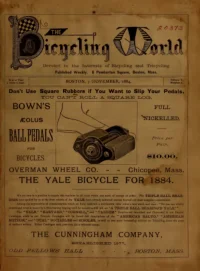
Articles in this issue
- Leader on the interchangeable system of manufacture as an American peculiarity in bicycle and tricycle making: machine-made parts guarantee uniformity and easy repair, but the enormous cost of the plant discourages the rapid model changes that English hand-work makers use to imitate popular machines.
- The judges award the $15 first prize in the World's writing competition to Charles E. Duryea of Wyoming, Ill., for 'A Tough Tour', and split the second prize between F. W. Blacker of Worcester ('Practical Road Riding') and L. H. Porter of East Orange, N.J. ('The First Season'); James Cockburn and Dr. George E. Blackham receive complimentary subscriptions.
- Unheaded editorial notes: betting as the price of public interest in bicycle racing, the professional Young's offer to race Neilson for the gate receipts, a retort to the Wheel over 'Cyclos', G. L. Hillier's 'one way round' argument corrected (American races run left-hand inside), tricycle stabling as a business opening, saddle design and the perineum question, prospects for an American cycle show, and the ingratitude of Sellers and Howell after their American tour.
- Readers' letters addressing a range of topics including road access disputes, experiences with particular machines, and suggestions for the League's governance.
- 'Rochester' urges the League to hold its 1885 meet in Buffalo, citing Music Hall's capacity for the banquet, business meeting and wheel storage, asphalt-paved parade routes past Fort Porter, the Genesee, Mansion, Stafford and Tifft hotels, and the twenty-two-mile road to Niagara Falls, calling on the Buffalo Bicycle Club to issue the invitation.
- W. V. Gilman of Nashua, N.H., continues his acrimonious dispute over the League's former corresponding secretary's administration, calling it the most expensive in League history; the editor closes the exchange with '[This correspondence must now cease.]'.
- 'Veteran' reports endless trouble with breaking laced spokes and argues for direct butt-ended spokes, asking why they cannot be used with hollow rims of the Warwick pattern.
- 'H. T.' endorses the editor's recommendation of larger rear tires, arguing that an inch rubber would cushion the small wheel that pounds into every hole on long rough-road rides.
- W. G. Kendall's jesting letter claims cycling originated in the East, citing Tennyson's 'Locksley Hall' line 'Better one year of England / Than a cycle of Cathay', with the editor's interjections.
- C. E. Duryea, replying to 'Eph', teases the St. Louis 'toughs' whose muddy streets and hilly roads make hard riders of necessity, recounting his own attempts to ride there and their wheel-punishing climbs of Corey Hill.
- Frank W. Weston, U.S. chief consul of the Cyclists' Touring Club, corrects the suggestion that new applicants are unaware the club year ends 31 December, noting the application blanks state it plainly and crediting the club's nearly twenty thousand members to true 'cycling spirit.
- Maine notes: the Pine Tree Wheel Club of Bangor's successful tournament, the Portland Wheel Club's grand ball at City Hall on 18 December, Capt. J. C. Stevens's stable of machines, the liberal treatment of wheelmen by F. E. Boothby's Maine Central Railroad, and plans for a State L. A. W. division and a tour taking in Moosehead Lake, Bangor and Mt. Desert.
- Prospectus for a wheelmen's tour to Bermuda leaving New York on 22 January aboard the Quebec Steamship Company's Orinoco, stopping at the Hamilton hotel; F. A. Elwell of Portland, Me., takes names, and Charles F. Joy of the Massachusetts Bicycle Club 'generously offers to be seasick for the entire party'.
- George Lacy Hillier, reprinted from the Tricyclist, catalogues the sins of makers' lamp fittings — absent, flimsy or badly placed brackets that shake loose and cause accidents — and proposes tapered, double-holed holders and grip-screws, urging attention before the next Stanley Show.
- 'Skinny' visits Bull & Haynes's new Buffalo emporium in Hersee Hall, with its wheelmen's reading room, riding school and repair shop, and reports a club run to Batavia featuring the 'tanbi' tandem ridden by Haynes and H. L. Drullard, plus champion long-distance man R. H. James laid up with a broken knee-cap.
- 'Faed' explains to the 'Cyclist his arrangement of horizontal sockets, split lugs and sliding tubes giving tricycle handles and steering spindle full lateral adjustment while keeping the spindle vertical.
- On Prof. Jaeger of London's 'system' of all-wool dress — outer garments, bedding and furniture as well as underwear — endorsed by the Lancet and the Times, with sixty thousand continental adherents and some three hundred in New York; wheelmen are told the movement appeals directly to their necessities.
- The paragraph department opens with 'Dalt Wheelman's' Safety-bicycle verses 'Extraordinary', then ranges over the Massachusetts Club's new house, Rudge & Co.'s safety-bicycle challenge, the proposed 'Big Four' Buffalo-to-New York tour under B. B. Ayers, Bull & Haynes's American Saddle, the Delaware (Ohio) Rovers' twenty-four-hour club-run claim against Cleveland's 112 5-8 miles, and twenty-five torch-bearing tricyclers led by W. W. Stall in Boston's Republican procession.
- R. A. Neilson beats C. J. Young by inches in the deciding heat of their $200-a-side mile match at Boston's Union Grounds; the Patterson–Johnson $500 match at Omaha is declared off after Johnson's fall; J. S. Smith and W. Brown and Cripps–Wilson break English tandem tricycle records at the Crystal Palace; and T. W. Eck backs Morgan and Armaindo against Woodside and Brooks.
- The Aeolus Club of Chicago elects W. G. Wanjer president; the New Jersey Wheelmen's roller-skating and fancy-riding entertainment at Oraton Hall, Newark, draws fashionable audiences; and the Washington 'Cycle Club fits up a handsome club-house on Twelfth Street with pool-room, gymnasium and bicycle storage.
- American Division notices under chief consul Frank W. Weston: the list of State consuls, provisionally elected members (largely from Washington, D.C.), hotel and consul appointments in Pennsylvania, the Canadian Division under Horace S. Tibbs, and Abbot Bassett's Sign-Board Fund account reaching $38.25.
- The editors' brief answers to readers on the Cruiser's Humber-like steering, first-class racers (Rudge, Royal Mail, Club, Invincible), chain lubrication, winter storage and home training frames for tricycles, club subscription terms, and why an asphalt track can never be fast.