The Bicycling World, Vol 10, No 14
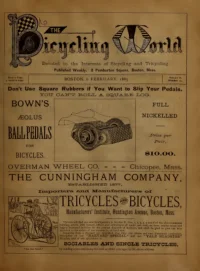
Articles in this issue
- The editor addresses two related concerns: whether the League board should defer to the Buffalo Club's proposal to fix the 1885 annual meet in July, and how the amateur rule should be applied to cyclists who have competed in roller-skating rink polo. The editorial argues that the board alone should set the meet date, and warns that the polo craze will force a clearer definition of amateur status.
- Editorial notes cover Singer and Co.'s lack of an American agent, a medical journal's assertion that cycling cannot reduce weight without dietary change, and the League Gazette editor's public acknowledgement of the Bicycling World's friendly criticism. The issue also celebrates the Boston Bicycle Club's eighth anniversary dinner.
- A reader writes to praise the League Gazette and its editor, defending the current publication against recent criticism and urging members to appreciate what they receive for their one-dollar annual subscription. The letter represents a body of supportive opinion that the editor is glad to publish.
- Correspondence on the proposal to hold the League meet in Buffalo in July, with arguments centring on whether the date serves the League's broader membership or mainly accommodates the organisers of the Big Four Tour. The debate reflects a recurring tension between local hosting ambitions and the League's national interests.
- Dr. George E. Blackham argues that the amateur rule leads to absurd results, citing an L.A.W. member expelled for playing rink polo against a team tainted by professionalism and a Chicago rider who lost his standing by pacing a professional. He gives notice of a motion at the next League meet to abolish the class distinction and open membership to every respectable rider over sixteen.
- Henry W. Williams, a Boston patent solicitor, furnishes the latest bicycle and tricycle patents, including Richard G. Shute's bicycle bell, an elastic tire with semi-hard rubber core assigned to the Revere Rubber Company of Boston, a velocipede-spring clip assigned to the Pope Manufacturing Company, and tricycles by inventors in Toronto, Ohio and New Jersey.
- A member of the first American cycling party to tour Bermuda reports that twelve riders sailed from New York on the steamer Orinoco on 22 January, weathering a gale before reaching the islands. Highlights include the run to St. Georges under local guidance, entertainment by United States Consul Allen, and the freedom of the Royal Bermuda Yacht Club extended to the whole party.
- A St. Louis rider signing himself "R." argues that coasting with legs over the handles and two fingers on the brake lever is far safer on steep, rutty hills than back-pedalling with feet on the pedals. He calls for brake levers that reach within two inches of the handle tip and offers to show doubters the twenty miles of gravel-road hills outside St. Louis.
- Notes from the English cycling press mock the slangy quotation-mark-laden style of the new London cycling journalism and catch the Cycling Times printing a woodcut of Louise Armaindo supposedly on her Royal Mail that is plainly a Yale of 1881-82 pattern. Jack Keen is quoted on liking Americans, provided you ignore what they say when you have just beaten one of their favourites.
- "Eph." relates tall-but-true tales from the St. Louis wheelmen's 1884 season: a rider near Clarksville who grabbed a bald eagle by the leg while coasting and kept the stuffed bird as a memento, a scheme to claim a $10 reward offered for a cyclist's own apprehension, a fancy rider who fell down a freight-elevator shaft, and a lampless night run to Manchester that ended at a collapsed bridge.
- Julius Wilcox continues his series, surveying the rush of "safety" machines that followed the Kangaroo race — the Paragon, B.S.A., Antelope and Singer's 44-inch 'Xtra — and pronouncing the Kangaroo patent as hollow as its pretence of novelty, with every design owing its existence to the Facile's success. He closes with a mechanical analysis of geared-up driving, concluding gearing suits heavy, strong riders on easy roads but is unquestionably bad for the mass of riders.
- Miscellaneous notes open with the tricycling poem "She" and range over New Orleans' shell roads, a fifty-mile race challenge between Louisville and Chicago that fell through, Buffalo's home-trainer mile records led by Gideon Haynes Jr. at 1.59, a sketch of Canadian champion W. G. Ross, and the death of Binghamton bicyclist and polo player C. H. Rogers after a rink collision.
- A first inspection of the new Victor bicycle at the Overman Wheel Company's offices details its moulded red rubber tires, Warwick rims, laced steel spokes, AEolus ball bearings, Andrews head with detachable hollow handle-bar, and a 52-inch weight of forty-two pounds ready for the road. The Victor Tricycle for 1885 keeps its ribbon steering, reconstructed and improved, with a new wire-coil saddle spring and lamp brackets.
- Trade notes report Elliot C. Lee's repeated six-mile test of the Butcher cyclometer, a large Butcher order from Hillman, Herbert & Cooper for Kangaroo-fitted instruments, A. G. Spalding & Bro.'s photos of the new Spalding, and Singer & Co.'s thirty-five patterns for 1885. Also noted are a 23-pound Rudge racer built for George M. Hendee, the Overman Wheel Company's opening levee on Tremont street, Iroquois cycles, and the Massachusetts Bicycle Club's annual election.
- Club news from across the country covering elections, new members, recent rides, and coming events. The column provides a weekly snapshot of American cycle-club life as the 1885 season approaches.
- The second slow race at Chicago's Le Grand Rink was won by Brown over Gibson, with A. G. Bennett giving a fancy-riding exhibition. At the Coliseum Rink in Lynn, Walter Faulkner on a bicycle gave E. L. Maddocks two laps' start on roller skates over five miles and won in 19m. 10s. with three laps to spare.
- Notes from the American Division under Chief Consul Frank W. Weston list the State consuls so far appointed, new membership applications from New York, Massachusetts, Michigan and Washington, and the appointment of E. C. Clarke as consul for Holyoke, Mass. The Canadian Division, under chief consul Horace S. Tibbs of Montreal, appeals for consuls in every city and town.
- The editor responds briefly to reader letters, directing some correspondents to appropriate League officers and clarifying points raised in recent articles. Several writers receive an acknowledgement that their letter will appear in a later issue.