The Bicycling World, Vol 10, No 15
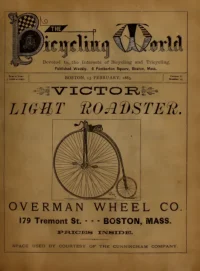
Articles in this issue
- The editor continues the running debate on the amateur rule, arguing that professionalisation of cycling is inevitable but should be managed rather than resisted through increasingly inconsistent enforcement. The editorial calls for co-operation between all athletic associations to arrive at a workable definition that reflects American democratic values.
- A brief editorial note commending Julius Wilcox's series of articles on safety bicycle history and design, urging readers to engage with his arguments carefully despite his obvious commercial interest in one particular machine. The note credits the series with stimulating genuine debate about the mechanical merits of the new safety designs.
- Unheaded editorial squibs dismissing the protest of C. C. Philbrick of the Chicago Bicycle Club as a needless 'test case' on professional polo players, weighing Mr. Jenkins's bid for reinstatement after his 1884 expulsion from the L.A.W., and praising the Hartford races' courtesy of finding cheap board for visiting racing men. The section closes by noting the paper has grown to twenty pages.
- A correspondent signing 'Officer' protests the Buffalo Club's scheme to shift the League year a month ahead so it can host the 1885 L.A.W. annual meet, and objects to the League going to cities as the guest of local clubs with axes to grind. If Buffalo cannot take the meet in May, the writer suggests Philadelphia, Baltimore, or Albany instead.
- A detailed description of the light double-driving tricycle of the popular central-geared pattern that D. Rudge & Co. of Coventry has built for importers Stoddard, Lovering & Co. of Boston, contracted during Mr. Corey's recent trip to England. Specifications include 46-inch driving wheels with Starley's gear, a Humber head, rack-and-pinion steering, Rudge ball bearings throughout, an 85-pound weight and a $175 price, with a rear attachment coming to convert it into a tandem.
- Trade notes covering C. H. Lamson's new gas-jet tire heater, the Pope Manufacturing Company's twelve-colour chromo panel hangers and the closing of its riding rink, the pivoted 1885 McDonnell cyclometer, and Wilmot's purchase of an Expert Columbia for his trick riding. A reprinted Bicycling News report says English amateur champion Herbert Walker Gaskell is coming to Boston to represent the Coventry Machinists' Company.
- A report on the Stanley Show, opened 28 January at the 'Wheeleries' on the Thames embankment, covering the Royal Mail racer and two-track tandem in charge of 'Bob' James, the St. George's Engineering Company's New Rapid, Starley and Sutton's first showing of the Rover safety bicycle and Coventry Chair, the Centaur Ladies' Tandem, and Harrington's spring novelties. The writer judges the show not such a success as formerly and faults the choice of venue.
- An obituary of Chittenden H. Rogers of Binghamton, N.Y., a charter member of the Binghamton Bicycle Club who died of a fractured skull in a recently reported accident; he held the club's three-mile championship and long-distance road record. His funeral on 4 February was attended by the Binghamton and Scranton clubs, and the club's memorial resolutions are printed in full.
- Notes from English cycling: 'Violet Lorne' writing in Wheel Life, its new weekly cartoons of Sturmey and Etherington, Robert James of Birmingham depositing money with the Sporting Life to challenge Howell for the one-mile championship of England, and Jack Keen riding his newly patented water bicycle from Putney to Westminster on the Stanley Show's opening day. Cortis's letter comparing the fatigue of horse riding and bicycling is also quoted.
- A Birmingham paper's report of Bown v. Humber, Marriott & Cooper before the Court of Appeals, where Birmingham ball-bearing maker Bown defended his 1877 patent against the Beeston cycle makers' claim of prior anticipation. The parties settled before argument: judgment was entered for the plaintiff, with the defendants paying costs and back royalties and taking a license for the patent's full term.
- A correspondent's letter describing Galveston, Texas as a cycling destination for visitors to the New Orleans World's Fair, praising its oleander-lined streets, boulevarded West Broadway, and hospitable people. The writer recounts a fifteen-mile spin along the hardened beach with champion John S. Prince, who brought down ducks, a six-foot gray eagle, and two seagulls with his breech-loader.
- The miscellany column opens with 'Musical Reform in Olympus', L. W. Seely's comic verse response to the toast 'Club Music' at the Capital Bicycle Club's sixth anniversary dinner at Willard's Hotel in Washington. Shorter squibs promise next week's trade outlook, report a New Jersey wheelman riding in near-zero weather, note R. V. R. Schuyler of New York leaving the bicycle business, and announce three new Pennsylvania L.A.W. representatives.
- The Boston Club plans a grand road race from South Natick to Boston open to all kinds of cycles, with new club medals cut by Shreve, Crump and Low; the Citizens' Bicycle Club sets its second annual race meeting at the Knickerbocker Roller Rink for 17 April. Also reported are the Macon, Ga. club's monthly races, Minneapolis rink results for Frank Cutler and John Nicholson, and the Racing Board's vote to locate the ten-mile championship at the Springfield tournament.
- A full account of the Boston Club's annual dinner at Parker's with 150 covers, presided over by E. C. Hodges with speeches from F. W. Weston, Capt. Harrison, and J. S. Dean, followed by annual election results from the Salem, Greenfield, New York, Albany, and Ixion clubs and the new Buffalo Ramblers. Further notes cover a proposed consolidation of the St. Louis clubs, the Kings County Wheelmen's tournament, and club balls and entertainments from Washington to Peabody.
- American Division news from Chief Consul Frank W. Weston of Savin Hill, Boston, listing the state consuls so far appointed, provisionally elected members including C. K. Overman and a large St. Louis contingent, and new appointments such as A. G. Carpenter as Rhode Island consul. A Canadian Division notice from chief consul Horace S. Tibbs of Montreal appeals for consuls in every city and town.
- The editors answer reader queries on protecting bright parts with vaseline, the Sanspareil's centre-nut spoke adjustment, ribbon steering, and amateur status where gate money is charged. One reply to E. D. F. gives the measured dimensions of Corey Hill — 2,300 feet long, 199 feet high, with the steepest grade 1 foot in 7.85.