The Bicycling World, Vol 11, No 26
Articles in this issue
- Leading editorial arguing that the 1885 season conclusively proved American-made bicycles equal in every respect to English imports, and predicting that an open market and keener competition will reduce cycle prices, to the importers' cost.
- Unheaded leader settling the disputed measurement of the Boston Club hundred-mile road race course: five cyclometers (Butcher and Lakin makes, ridden by W.A. Rhodes, F.F. Ives, W.S. Doane, C.I. Swan and C.R. Overman) all make the alleged fifty-mile circuit about 94.5 miles, so Weber cannot claim ninety-five.
- Report of the Boston Club's hill-climbing contest of 24 October on Corey Hill, Brookline, with statistics of the grade and the full list of successful riders, including W.W. Stall's fastest 3.24 1-4 on a Star, fourteen-year-old W.M. Haradon on a Royal Mail, and J.W. Williams's Quadrant tricycle climb.
- List of recently issued American bicycle and tricycle patents furnished by Henry W. Williams, patent solicitor of Boston, covering safeties, saddles, pedals, lever-driven velocipedes and tangential-spoke wheels.
- Gossip column of pointed questions: whether Rowe should be sent to England next spring, what English cavillers will say of the Chicago records, whether the Boston Club machines insist on stopping at Perkins', whether Bob Huston can beat Tommy Lambert, and when Karl Kron's book is coming out.
- Account of the Massachusetts Club's lantern parade of some 200 wheelmen, describing the decorated machines (McKay's lantern-outlined sloop Puritan, the Charlestown Club's illuminated hat-boxes) and the hoodlum attacks that ended with W.W. Stall wrongly seized by Officer McCarty of Station 5 after collaring a stone-throwing youth.
- Report, from advance sheets supplied by C.J. Fox of the Bicycling Times, of the banquet given at Ryde to M.V.J. Webber in honour of his racing at Hartford and Springfield, where Col. Malone presented a gold locket and Webber defended the American records made on his Marriott & Cooper machine.
- Correspondence signed H.L.N. comparing cradle springs and rigid saddles for tricycles, concluding the swaying cradle is best for coasting but a firm saddle and spring, as fitted to the Club machines, gives the steadiest pedalling when weight is borne on the pedals.
- Letter from Edward J. Shriver returning to the cycling-etiquette debate, arguing that now cycling is an every-day pursuit the custom of saluting every stranger on a wheel is an out-of-date and silly habit.
- Letter signed Racer insisting handicappers must judge racing men by public performances, not supposed abilities, and that new men deserve their taste of the slow class races despite Springfield shelving the fast men of 1885.
- Letter signed Harry pleading for courtesy on the racing path, suggesting cracks like Hendee, Rowe, and Burnham surrender the pole to weaker men and that riders stop claiming fouls for accidental interference.
- Letter signed W.F. endorsing record classification, arguing that racing decided on the last quarter is stupid to watch and that ranking competition records above records against time will make men race from scratch to wire.
- Letter signed H.L.S. replying to Mr. Hart, praising the spring-cover oil cups on his Apollo tricycle over screw-plug reservoirs and asking why makers cannot standardise oil-hole sizes and threads.
- Letter signed Customs asking how many used cycles a traveller from abroad may bring in duty-free, after the paper's statement that two used machines can be imported.
- Letter signed Road Rider warning that road races should never be made spectacles for spectators, urging the League to regulate road racing as clubs multiply in the Boston Club's wake with shortened distances and massed starts on public highways.
- Letter from Karl Kron reporting that his overworked right hand has struck, so he is finishing his ten-thousand-mile book left-handed; with 425 pages in type he assures his 3,224 one-dollar subscribers the volume will reach them sometime.
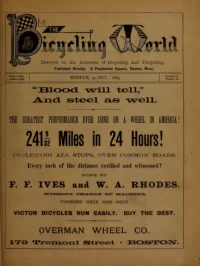
- Full account of F.F. Ives of Meriden and W.A. Rhodes of Dorchester riding 241 9-32 miles in twenty-four hours on 58-inch Victors over a 48 1-4-mile road circuit from the Faneuil House, Brighton, supervised by Abbot Bassett with pacemakers on every round.
- Review of Chris Wheeler's volume of cycling and rowing poems in four departments, including Lays of Lancaster Pike and Songs of the Schuylkill River, published by E. Stanley Hart of Philadelphia at $2.00.
- Extract from the American Sports complaining that Eastern makers refused to send Richard Howell to the Chicago meeting and ordered its only drawing-card amateur back East, leaving local wheelmen who spent $2,500 on a fine track to bear the deficits; Stoddard & Lovering come in for pointed criticism.
- Paragraph department opening with the poem 'A Tandem Tale' by C.E.D., followed by notes on the hoodlum outbreak, Rowe wintering under Dr. Sargent before settling in Springfield, the Boston Club's final run to the Faneuil Hotel, the ladies' run to Bailey's at Natick, the Nemo Club's last run, and a new riding school at the Olympian Club rink.
- Exchange story of Stephen Pickens, who was chased twice around the old half-mile track on the Fry farm near Elkton, Pa., by his uncle's blooded bull, which finally charged the wheel and hurled machine and rider into the grass, wrecking the bicycle.
- The Cyclist's summing-up of its long correspondence on the rival merits of the ordinary bicycle, safety, and tricycle, concluding that a sensibly built ordinary is no more dangerous than any other velocipede and that each type is right in its place.
- A.A. McCurdy's ride to recover the twenty-four-hour road record from Ives and Rhodes, covering 255 1-8 miles on Columbia bicycles from the Faneuil House, Brighton, despite a collision at West Newton that buckled his big wheel and forced a change of machine.
- Racing News from Springfield's Hampden Park: Rowe lowers the two- and three-mile records and the mile against time, while professional W.M. Woodside smashes the four- and five-mile records and later rides fifty miles unpaced, setting an American professional hour record of 20 miles 285 yards.
- Tabulated list of records made since the last issue, including Woodside's professional marks, Ives and Rhodes's twenty-four-hour road record, McCurdy's 255 1-8 miles, and John Williams's fifty-mile Quadrant tricycle road record of 4.27, with notes on L.D. Munger of Detroit starting his own twenty-four-hour quest.
- The Worcester Club's first straightaway road race to Boston over about forty-one hard miles through Shrewsbury and Framingham, won by G.D. Putnam on an Expert in 3h. 20m. 20s.; the results columns also carry the Royal Rollicking Wheelmen's Washington-to-Uniontown race and race meets at Philadelphia, Mott Haven, North Adams and Manchester.
- News that a new racing-minded L.A.W. bicycle club has been started at Hartford, Conn., alongside the Connecticut Bicycle Club, and that the Maryland Bicycle Club of Baltimore will warm its new clubhouse on Mount Royal avenue.
- C.T.C. column under acting chief consul C.H. Potter of Cleveland, giving dues, the list of appointed State consuls from Connecticut to Wyoming Territory plus the Canadian Division under Horace S. Tibbs of Montreal, and the provisional election of George S. Atwater of Massillon, Ohio.
- Editor's answers to readers, telling K.K. the records will be published when riders let them rest, explaining to H.S.G. that the Quadrant takes its name from its quarter-circle steering, and noting the C.T.C. Gazette comes only with club membership.