The Bicycling World, Vol 12, No 14
Articles in this issue
- Editor Abbot Bassett answers Editor Aaron of the L.A.W. Bulletin, who has been prodding his exchanges for taking official announcements without credit, arguing that League notices are public property once published and that the League should send them to all the cycling papers.
- A tour of Boston's cycle depots previewing the 1886 machines: Wm. Read & Sons' Royal Mail, the Coventry Machinists' new Marlboro Club and Ranelagh shown by Mr. Gaskell, the Overman Wheel Company's improved Victor, W. W. Stall's new Star, W. B. Everett & Co.'s Apollo and Cripper-form tricycle, Stoddard, Lovering & Co.'s Rudge line and Crescent tricycle, the Pope Manufacturing Company's Expert plans, and J. A. R. Underwood's Quadrant and Rover.
- Opening the Correspondence department, James S. Dodson of Bethlehem, Pa., tells 'Inquirer' where the American Star is, citing his brake-controlled descent of Corey Hill, W. W. Stall's record ascent of the hill in 3.24 1-4 on a 54 roadster Star, and Geo. E. Weber's 6.57 ride in the Boston Club's road race of October 1885.
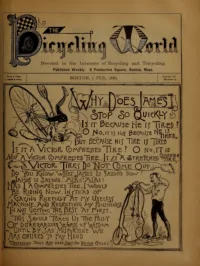
- First instalment of a humorous illustrated feature reprinted from Funny Folks' Annual, presenting scenes of cycling mishaps and absurdities including an indignant cabby, a knowing racing tipster, and a rider who almost crests a hill but fails for lack of local knowledge.
- Fred Jenkins writes that on 1 February he resigned his position as managing editor of the Wheel and severed his connection with that journal.
- A joking reply signed 'KOM' to G. R. J.'s sad case from the 22 January issue, consoling him that if he becomes split up much farther he will at least never have to wear a vest.
- Wm. D. McCoy of Orange explains that the Humber tandem's gear chains slipped climbing Orange Mountain through Llewellyn Park only because they had been slackened as an experiment, and disclaims any charge of misrepresentation against correspondent 5,678.
- A correspondent compares the Star safety bicycle with the ordinary, arguing that a larger front wheel would improve it and that the Rover safety's success is largely due to the size of its front wheel; the writer, James A. Chase of Hazleton, Pa., has ridden 48, 51, and 42-inch Stars and advocates a 24-inch front wheel Pony Star for road use.
- A letter signed 'Amateur', reinforced by a reprinted Globe article, condemns the spreading 'makers' amateur' practice of manufacturers giving or loaning wheels to prominent clubmen who then drum up sales among their fellows, and urges clubs to pass formal protests against these begging amateurs.
- The correspondent '5,678' regrets that the Indispensable annuals — the last Bicyclist's of 1882, Tricyclist's of 1884, and the 1885 Safety Indispensable — cannot appear yearly, proposes a combined bound volume, compares the Tricyclist's Vade Mecum, and urges wheelmen to read the cycling press and push League membership past the 10,000 mark.
- Final instalment of the Peculiar Patents series presents a few more odd velocipede designs including a rocking-chair tricycle patented by A. Cooke in 1874, and concludes the series with the observation that the articles may have entertained readers and pointed out the fate of ideas inconsistent with mechanical laws.
- The Surrey Machinists' Company has perfected the 'Invincible' crank with adjustable throw, variable from five to seven inches by a cog-wheel and eccentric mechanism while riding at full speed, weighing only about 2 1-2 lbs. per pair more than a plain crank; reprinted from the News.
- A humorous dialogue in verse between a cycling schoolmaster and his pupil defines a 'bicyclist' as one fond of meets and ham and eggs, and a 'tricyclist' as one who can draw a check without keeping balance, with further wordplay on brakes and tricycling terms. The column's news notes cover the Cleveland Club's race meetings, B. B. Ayers's proposed 1887 European tour outlined at the Chicago Club social, the roster of F. A. Elwell's Bermuda party, and Rev. Sylvanus Stall's August clerical tour through New York State — about three hundred miles via Saratoga, Cooperstown, and Howe's Cave, limited to twenty-five clergymen.
- Daisie's column welcomes the growing influence of women in wheeling circles, noting makers building machines for ladies' use, questioning claims that a bar-steering tricycle is hard to mount, and observing that while the Royal Mail was the only tandem two ladies could ride last year, the Quadrant, Club, and Singer are in prospect.
- At a large Massachusetts Bicycle Club meeting, retiring president Williams is presented with a set of the International Cyclopaedia by A. S. Parsons; Col. T. W. Higginson is elected president after Parsons withdraws in his favour, and A. D. Peck, Jr. defeats W. S. Slocum for captain by eighty-five votes to forty-one.
- The six-day twelve-hours-a-day race at Minneapolis's Washington rink ends with Schock the winner at 923 miles over Woodside (911), who at once challenges him to a rematch for up to $1,000 a side; in Boston, I. S. Moulthrop's $2,000 series of championship contests opens at the Highland Rink, where George E. Hutchinson beats William W. Marshall for the fancy and trick riding prize.
- Club notes report ladies' night at the Massachusetts clubhouse with music and dancing, the York County Wheelmen of Biddeford narrowly failing to vote to join the League, the new Richland Ramblers of Mansfield, O., the Boston Bicycle Club's plans for a wheel exhibition and its resolution favouring H. E. Ducker as chief marshal, and officer lists and receptions from Waterbury, Harrisburg, Hoosick Falls, Poughkeepsie, and the King's County Wheelmen of Brooklyn.
- The official C.T.C. column from Acting Chief Consul C. H. Potter of Cleveland gives dues and application details, the list of State consuls from Connecticut to Wyoming Territory, provisionally elected members including applicants from Berlin, New York, and Springfield, and the appointment of the Holyoke House as club hotel for Holyoke, Mass.