The Bicycling World, Vol 12, No 20
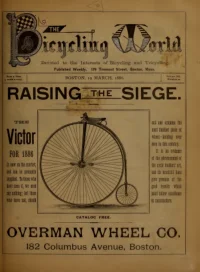
Articles in this issue
- An editorial notes that the Nonantum Club of Newton has placed itself on record in favour of the makers' amateurs after two of its members were suspended, and argues that the League must either repeal Rule H or live up to it, since no good can come of a dead-letter law.
- J. R. Hogg of the North Shields Bicycle Club writes that practically all the English amateurs who crossed to America last year were paid by makers, and argues against the National Cyclists' Union special committee's plan to suspend suspected riders, holding that the amateur distinction is wrong in principle and its evils incurable.
- An obituary of Herbert Liddell Cortis, the Wanderers' B.C. champion who died at Carcoar, Australia, on 29 December 1885, recounting his four B.U. championships of 1879, his defeat of Jack Keen at Wolverhampton, and his famous feat of riding twenty miles within the hour at the Crystal Palace in 1882.
- The pseudonymous columnist "London W." describes War No. 1, the Overman-Pope patent battle in which the court's verdict favoured Overman, and War No. 2, the Racing Board's suspension of makers' amateurs, urging Rowe, McCurdy, Hendee, Rhodes and Ives to turn professional or form their own class; the column closes with "Things I Should Like to Know", the languishing Nemo Club, Papa Weston's devotion to sociables, and anticipation of the League Meet parade.
- A satirical account of a clandestine dinner of the eminent cyclists of "Yankeenia" at the Athens Club, reported by the Cycling Sphere man and Harley Coward, featuring a mock menu with Mock Amateur soup, Record Venison a la Mike Hurdy and Bown Patent Potato Balls, the ejection of Mr. Jorse from under the table by Secretary Dodgkins, and a burlesque programme for the League Parade with Col. Pope escorted by lawyers and Gen. Overman by legal gentlemen.
- The "Random Pencillings" column, signed "5678", argues that Rule H covers two distinct classes — riders paid to advertise wheels, who should be made professionals, and poor riders helped by clubs or friends, who should stay amateurs under guarantees that no trade money is involved — then turns to the search for the perfect wheel, a rumoured American lever-action rear-steering tricycle, the demise of Sturmey's Indispensable for 1886, and whether the Apollo will be this year's fashionable mount.
- The Nonantum Club's formal resolutions on the Racing Board's suspensions, resolving that unless a satisfactory conclusion is reached on or before the League meeting in Boston on 28 May, the club will withdraw its membership from the League.
- B. B. Ayers of Chicago announces the annual preliminary meeting of the Big Four bicycle tourists in parlor A of the Genesee Hotel, Buffalo, on 21 March 1886, to discuss the auspices and route of this year's tour.
- A manufacture review of the Coventry Machinists' Company's new automatic-steering Marlboro' Club tricycle, with two 40-inch driving wheels, a 20-inch front steerer, a central-tube frame, concealed steering spring, and hand or foot brake, judged comfortable, speedy and elegant and well suited to lady riders.
- A note on the Facile's new detachable handle-bar for the year, divided in the middle of the head-lug with coned, mortised ends drawn tight into their seats by a single key.
- Several New York State clubs, including the Citizens', Buffalo, Kings County, Ixion, Binghamton, Ariel and Genesee clubs, put out a League ticket naming George R. Bidwell of New York for chief consul, with Dr. N. M. Beckwith, William W. Share, W. S. Bull and John C. Gulick among the representatives.
- Committee chairmen for the L.A.W. Meet in Boston met at the New Marlboro' Hotel under Chief Consul Ducker: A. S. Parsons reported the banquet must be held in a hall since 500 wheelmen are expected, A. D. Salkeld proposed a Music Hall concert and an entertainment at Winslow's Skating Rink, and A. D. Peck, Jr. outlined morning runs to Chestnut Hill, Harvard College and Dedham, with the Hotel Vendome as headquarters.
- Delegates from seventeen clubs around New York organized an "Inter-club Bicycle Team Road-Racing Association" to promote road racing, with a challenge cup to become the property of any club winning it three times and team races of four to be held on Decoration Day and election day.
- Reprinted from the Republican: the Racing Board's war on makers' amateurs leaves the Springfield Bicycle Club's tournament position uncertain, and Henry E. Ducker, finding a conflict between the board and the club he heads, has resigned from the Racing Board, arguing the money interests in tracks, racing wheels and manufacturers' plants are too great to be dealt such a blow.
- Letters to the editor: "Investigator" of Brockton welcomes judicial scrutiny of cycle patents; a Buffalo rider (L.A.W. 1611) praises the oval T-handles of the Buffalo Home Trainer; "Quad" asks for a pleasant one-or-two-week touring route; W. G. Kendall of Boston proposes a World subscription fund to send Rowe and a Star rider such as Weber or Kluge to England's annual races; and A. O. Lemeris compares the close build of the Expert Columbia and Victor after 7,000 miles.
- A paragraphs column opening with the Wheeling verse "What Breaks a Man up", then noting Chief Consul Ducker's appointment of John Amee as consul for Cambridge, 782 League memberships and renewals in a week, the failed reception-committee meeting called by A. A. Pope that made E. G. Whitney permanent chairman, and Robert Todd's letter from the N.C.U. favouring an international one-mile amateur race at Hampden Park.
- The Orange Wanderers' first race meeting at the Park Rink, Orange, N.J., drew about 1,800 spectators, with a drill by the Hudson County Wheelmen, Star bicycle polo by the Gilfort Brothers, fancy riding by Thomas R. Finley, the mile open won by Gates of Plainfield, and the mile safety won by W. A. Belcher.
- The Leominster Bicycle Club's concert and ball on 4 March cleared $108, with the hall decorated with six suspended bicycles and a gilded L.A.W. badge made from a rear wheel; visiting wheelmen included A. D. Peck, Jr. of the Massachusetts Bicycle Club and E. G. Whitney of Boston.
- Albert Schock of Chicago won the six-day, seventy-two-hour race at Minneapolis with a world's long-distance record of 1,009 miles and three laps, beating William Woodside by nearly 100 miles and eclipsing F. J. Lees's English record, spurred by a $500 purse from the Champion's makers; further items cover Mlle. Armaindo's 100-mile win over John W. Snyder at Faribault, Phillip Hammel's five-mile defeat of Grant Bell at St. Paul, George C. Dresser's Hartford times, the Ilderan Club races in Brooklyn, the Bay City Wheelmen's fifty-mile road race won by F. D. Elwell, and Howell's challenge to Wood.
- Club news and annual elections: M. C. Craver heads the Binghamton Bicycle Club, Louis Chauvenet the Missouri Bicycle Club, George A. Jessup the Scranton Club (whose treasury handled nearly $2,500), with further officers chosen by the Roselle Ramblers, Florence Cycle Club, Newton Bicycle Club and Pawtucket club, plus notes on the Leominster club's full associate roll and the Westfield wheelmen's new rooms in Parker's building.
- The Cyclists' Touring Club publishes acting chief consul C. H. Potter's address in Cleveland, annual dues of $1.00 for the first year, and its list of state consuls including F. A. Pratt for Massachusetts and W. M. Brewster for Missouri, alongside provisionally elected members such as Miss Corinne Widdleton of New York.