The Bicycling World, Vol 12, No 3
Articles in this issue
- Unheaded leaders declaring 1885 a year of experiments in tricycle design — loop-frame, two-track, T-frame and now small-wheeled handle-bar steerers — and predicting the 1886 machine must have small drivers, a large steerer, automatic handle-bar steering and a simple hand brake; also a rebuke to a club man who complains of scant notice while sending no items, and a wish that American makers heed Faed's suggestion to exhibit at the Stanley and Speedwell shows.
- Correspondence on the proper wheel size for tricycles: H.S. champions his light, strong 42-inch wheels on a seventy-five-pound machine, while F.E.C. insists the 50-inch is the proven size, warning that going up gives a weak, heavy wheel and going down gives bumpity-bump riding.
- A correspondent signing 'Quadrant' declares for 40-inch tricycle wheels, admitting every gentleman swears by his own machine but saying he would not take a 50-inch as a gift.
- 'Racer' derides Mr. Kirkpatrick's claim at the L.A.W. officers' meeting that strict classification of riders will solve the makers' amateur problem, arguing the promoters of big Hartford and Springfield tournaments will always get the best men because without them there are no profits.
- An essay on the 'man of gaul' who borrows other riders' machines uninvited — thumping Smith's new bicycle, trying Jones's Star and banging Robinson's tandem — citing a bent loop-frame backbone costing twenty-five dollars and a smashed Sociable at the reservoir, and urging wheelmen to teach meddlers to leave their wheels alone.
- 'L. A. W.' answers J.S. Dean's quotations from Boston's seven- and twelve-mile-an-hour ordinances, conceding his error on the six-mile limit but arguing that Rhodes's fifty miles in 3.32, McCurdy's 255 miles in 22.30 and Webber's hundred-mile run still show road records are made in violation of law.
- 'Duffer' challenges X.Y.Z.'s claim that handicappers use judgment of a man's abilities, asserting that at Springfield and all the large tournaments Baird handicapped purely from his book of records, and asking where the difference lies between handicapping and classifying.
- Nineteen lady and gentleman riders, on three tandems, five single trikes and eight bicycles under Grand Commander Munger, ran from W.W. Stall's residence in Brighton through Newton, Waltham and Auburndale to dinner at the Faneuil House, covering twenty to thirty-five miles under command of the 'Veteran'.
- A.A. McCurdy of Lynn breaks the 100-mile road record in 7.51.30, riding four laps of a 25-mile Newton Centre–Needham–Dedham course into a near-gale wind, paced by L.D. Munger of Detroit and David Drummond of Cambridge, beating C.E. Stone of St. Louis's 8.28.
- H.D. Corey writes from Coventry that the Rudge Safety and the Rover lead the booming safety trade — Howell's 2.43 mile, Golder's fifty miles in 3h.5m. and Hale's hundred in 6h.39m. proving them equal to the ordinary — and reports Woodcock of Rudge & Co.'s dinner to Howell, Chambers, Marriott and others, and Canary's sensational London performances.
- Faed's London letter: the Surrey Machinists' eighteen-pound racing bicycle for the Stanley and Speedwell shows; George Smith winning Starley & Sutton's 100-mile Rover race in 7.5.16 and E. Hale regaining the record on a Kangaroo in 6.39.5; the N.C.U. investigating Adams's doubted Rudge Rotary 24-hour claim and the Rucker records-committee correction; F. Gibbons of Wolverhampton's automatic steering for Humber-pattern tricycles; and Quadrant splash guards.
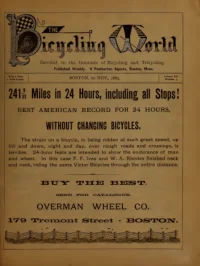
- L.D. Munger's third try at the 24-hour bicycle record ends when a dump cart crosses his path on Chester park; thrown from his wheel, he re-injures his sprained ankle, stops at Dedham for bandaging, and is told by Dr. F.A. Smith he cannot mount again for a week or more.
- Lynn turns out en masse to welcome champion Wm. A. Rowe home from Springfield with a torchlight parade of the Lynn Cycle Club and Boscobel Club led by the National band; at the Boscobel Hotel banquet Mayor Baldwin presents a gold club badge and Col. A.A. Pope declares himself proud that his wheel captured the records.
- 'Daisie' praises the Chestnut Hill reservoir ride via the Highlands and Longwood routes from Mr. Atkins's guide-book, advises 'Miss Carrie' that the corset is the cause of her riding fatigue, recommends fingerless jersey gloves and close-fitting sleeves for winter, and reviews 'Chris Wheeler's' volume of poems.
- An editorial from the Cyclist arguing that crank length should be proportionate to wheel size — one inch of crank per nine inches of wheel or gearing — crediting the Kangaroo's seven-inch throw for the safety's road speed, citing Furnivall's six-inch crank, and calling for longer cranks next season.
- Foreign notes: four Pickwick Club members of London ride two hundred miles in an October day, Mr. Hill scoring 220; the Cyclist Christmas number 'Cyclonia' is announced with Faed writing and George Moore illustrating; F. De Civry retains the professional championship of France with Sevres cups presented by President Grevy; and eight Gainesborough club members take sixty-nine prizes.
- The Manufacture column presents the first cut of the adhesive tire tape invented by Zacharias and Smith of Newark, N.J., claimed to fasten a loosened tire without heat and hold more tightly than any metallic tire fastener, demand forcing the makers to extend their facilities.
- Editorial paragraphs and squibs: C.S. Wady's verse 'It's Got to Come!'; W.H. Huntley's coming 24-hour attempt on a Rudge; the Chicago Club's Thanksgiving hare and hounds chase; the St. Louis Ramblers' Son-of-a-gun Hill medals won by Hendee, Felix Young and four others; Brantford's invitation to the C.W.A.; the North London Tricycle Club's denial of the Springfield Wheelman's Gazette yarn; and the New York Clipper's position on records against time.
- Grant Bell on a Star beats Woodside on a Rudge Safety by half a lap in their second five-mile match at Minneapolis; the Boston Club's Thanksgiving 25-mile road race offers gold and time medals with entries to Dr. W.G. Kendall; Prince's St. Louis three-mile time is voided by a short track; and California clubs plan a fifty-mile team road race.
- George M. Hendee's Springfield attempt on the records to one hundred miles ends at the ninety-third mile from weakness, with a full mile-by-mile table showing a long string of best American records, C.S. Fiske as referee and Merrill, Homer and Curtis judging.
- Club notes: the Baltimore Junior Wheelmen elect W. Hills president; the Newton Club raises its membership limit from thirty-five to fifty and plans a minstrel entertainment; and the disbanded Brattleboro' Cycle Club reorganizes under president H.L. Emerson and captain F.T. Reid.