The Bicycling World, Vol 12, No 9
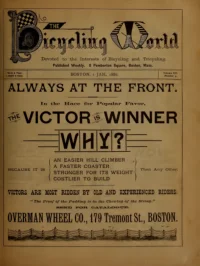
Articles in this issue
- The annual year-in-review editorial surveys American cycling in 1885 under its Cycling Institutions, The Trade, and Machines heads: the League of American Wheelmen's new constitution and Bulletin under Editor Aaron, the Missouri secession, the collapse of the Cunningham Company, new dealers including the Coventry Machinists' branch under Mr. Gaskell, W. B. Everett's Singer agency and Gideon's Invincible imports, Overman's new American bicycle, and the tandem's rise over the fading sociable.
- The racing section of the year's review covers the Racing Board's new rules adopted by the N.A.A.A.A., the English invasion of amateurs and professionals (Furnivall, Webber, English, Howell, Fred Wood among them), the disabling first-day crash of Hendee and Cola Stone, twenty miles ridden within the hour for the first time in America, and a table of League championship winners including Weber, Hendee, Knapp, Rich, Rowe, and Burnham.
- The review's road-racing section tabulates the twenty-four-hour road record's progress through Munger, McCurdy, Ives, Rhodes, and Huntley to Munger's 259 miles, notes Corey's 198 miles on a Safety and Huntley's 186 on a tricycle, and criticises the Boston Club's hundred-mile race whose course proved only about 92.5 miles, warning against ever-shorter record courses.
- Closing notes of the year's review: the $1,200 English benefit fund for veteran racer John Keen, F. A. Elwell's Bermuda winter tour, the deaths of poet Samuel Conant Foster and racer Cola E. Stone, the Big Four tour from Buffalo, Thomas Stevens resuming his round-the-world ride, W. W. Stall's Corey Hill climb win, and Karl Kron's three-thousandth road-book subscriber.
- Foreign notes: E. Oxborrow of the Aeolus Bicycle Club claims 267 miles for the 24-hour record, Sanders Sellers is seriously ill with typhoid, the Otto Machine Company winds up after losing $9,000, Dan Canary performs in a Bristol pantomime, and the C.T.C. is rumoured to be planning a million-dollar London clubhouse and adopts a new patented badge.
- A verse tribute to the pseudonymous lady contributor "Daisie," the mysterious rider-writer who has unfurled the banner of the wheel over every cycling land.
- The third instalment of the illustrated velocipede patent series (cuts on the facing page, credited to the Overman Wheel Company), featuring S. Wortman's 1869 lever tandem, Walter Knight's foot-steered 1875 machine, M. E. Croft's pole-propelled tricycle, A. Christian's 1869 lady's machine, and O. T. Gleason's vertical-action velocipede.
- A review of the Cyclist's Christmas number, "The Great S—," by A. J. Wilson and A. Morrison, compilers of "Our Camp," recounting a journey through the mystic land of Cyclonia with illustrations by George Moore; the January calendar plate is reproduced in this issue.
- A response to Bell's Life proposal for a vigilance committee to spy on amateur cyclists suspected of receiving manufacturer payments, arguing that such a body would be practically useless since nearly every visiting English racer relied on manufacturer support.
- A report from the Louisville Argus on a League member attending school in Princeton, Kentucky who was unjustly fined for riding a bicycle in the street, calling on the L.A.W. to take legal action against an unconstitutional local ordinance or risk losing Kentucky's cycling community.
- J.S. argues that crank length is not merely a question of leverage but also depends on a rider's extensor muscle length, critiques Sturmey's nine-to-one rule, and calls on experienced riders to share their memories of the change from long Harvard cranks to modern shorter ones.
- Joseph Butcher stands by his charge of fraud against A. A. McCurdy's twenty-four-hour record, demands the detailed cyclometer registers from the record race, and rebuts A. E. Pattison's anonymous statement in the Boston Herald defending McCurdy, promising to prove his charge in the Bicycling World.
- A detailed technical defence of chain-geared safety bicycles against Julius Wilcox's recent criticism, arguing that chain safeties can be built for any wheel size and gearing, that their alleged mechanical difficulties have been solved, and that sales figures prove their acceptance with serious riders.
- G. Lacy Hillier of Anerley, London continues the dispute over the Springfield timing, pressing for publication of the timers' names and citing Wheeling and the Cyclist, with an editorial reply defending the timekeeping of Mr. Whipple's department and Mr. Robinson.
- A Boston correspondent signing "London W." seconds the call of "43" for a discussion of safety bicycles, recounts his rides on the Facile and the Kangaroo (including a spin with inventor Mr. Hillman in Coventry), and announces he has ordered a Rover from Stanley and Sutton for its 36- and 30-inch wheels and long wheelbase.
- A Facile owner (L.A.W. 3,932) rebuts correspondent "43," declaring the Facile unsurpassed for ordinary country roads, noting it comes with or without gearing, and wagering that "43" is a maker's amateur.
- New Year greetings to Sturmey, Hillier, Etherington and the cycling press, with notes on the Boston Club's Christmas gathering, George E. Hutchinson's fancy-riding challenge, the Oregon dismount law contested by the Portland Bicycle Club, bicycle polo by the Buffalo Ramblers, Charles E. Buell's compressed-air tricycle patent, and Outing magazine's move to New York under editor Poultney Bigelow.
- W. M. Woodside, hampered by cramps, fails to close T. W. Eck's three-mile start in a 50-mile race at the Washington rink, Minneapolis; Eck deposits $25 toward a challenge to Neilson; a six-day race is announced for Minneapolis; and the St. Louis Ramblers' handicap races at the Globe see Morris beat Whittaker, with Percy Stone defeating skater Felton.
- Officer elections at the Portland (Oregon), Norristown, Yale College, Genesee (Rochester), and Berkshire County clubs; the Citizens' Club of New York nears its hundred-member limit; the Connecticut Bicycle Club hosts a fashionable afternoon tea in Hartford; and the Leominster Bicycle Club's whist tournament is won by Bates and Tyler.
- The C.T.C. department under acting chief consul C. H. Potter of Cleveland gives membership terms and lists the American State consuls from Connecticut to Wyoming Territory, along with newly provisionally elected applicants from Newark, New York, and Boston.