The Bicycling World, Vol 2, No 14
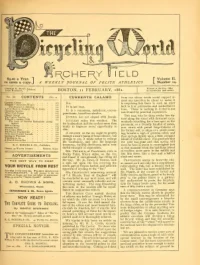
Articles in this issue
- The editor describes cyclists making the most of winter weather by riding on ice, and covers the Boston Club's annual dinner, noting the club's proud standing as the oldest in America.
- A practical analysis breaks down the true annual cost of bicycle ownership, covering purchase price, repairs, and accessories, to show cycling compares favorably with other recreation.
- Champion rider H.L. Cortis contributes an article on physical training for racing cyclists, emphasizing moderation in diet, gradual build-up, and practical experience over theory.
- A humorous column written in the voice of a young woman asks whether ladies can join the L.A.W. and argues for the social acceptance of women cycling.
- Club reports include Henry B. Colby's account of the Waltham Bi. Club, the Crescent Club's vote for New York as the next L.A.W. meeting place and a history of its runs to Providence and Swampscott, the Milwaukee Bicycle Club's planned Decoration Day run through Waukesha County, and President A. S. Parsons's statistics on the Massachusetts Bicycle Club at its annual election.
- Clippings from the English press include the Wheelman's Year Book on sound club management, a Cycling writer on commuting to the office by bicycle along the seashore, and Bicycling News suggestions that racers wear distinguishing colors and a lady's fanciful 'omnicycle'.
- A Bicycling Times review charts the sport's rise from persecution to independence, with statistics showing English provincial clubs growing from 124 to 364 and metropolitan clubs from 64 to 185 between 1878 and 1880, and the Bicycle Touring Club nearing 3,500 members.
- On the report that a party of English riders plan a bicycle tour of the United States, the editors warn that beyond a twenty-mile radius of Boston good roads are scarce and that American touring at large is hardly worth the effort compared with England.
- The Archery Field leader laments the lethargy settling over archery, contrasting archers' mild insensibility with the enthusiasm of bicyclers and urging clubs to support the sport through the press and by example.
- Frank H. Walworth wittily dissects Mr. Brownell's proposed 1-to-5 target valuation for archery scoring, defending the British and American 9-7-5-3-1 ring values with worked string-measurement computations.
- A defense of 'Captain Jack's' rawhide Express-Taffy bows, praising their low arrow flight and speed off the string, and noting the makers alone dare warrant their bows against legitimate usage.
- Correspondence on where the L.A.W. should hold its next annual meeting; L. W. Seely of Washington, D.C. presses his city's claim, citing forty-five miles of asphalt-paved streets, favorable authorities, and rail access, against New York's awkward bicycle transfers.
- A review of the B.T.C.'s year: membership reached 3,356 by December 1880 under Secretary Welford, some 500 consuls and 800 hotels accepted the club tariff, and the Harrogate annual meeting elected T. H. Holding president, with constitutional reforms proposed after member criticism.
- Gleanings from English advertising columns cover the cradle spring, Bown's AEolus ball bearings, Wood's rear-wheel scroll springs, lamps such as the King of the Road and Cooper's No. 2, Etherington's forthcoming Encyclopaedia, and the Pope Manufacturing Company's bid for English agencies.
- A Wisconsin correspondent describes riding a bicycle across frozen lake and river surfaces, reporting surprisingly smooth and enjoyable conditions.
- A report on the pleasures and challenges of riding a tricycle on ice, noting that the three-wheeled machine offers superior stability on slippery surfaces compared with the ordinary bicycle.
- Two brothers on 55-inch machines, a Timberlake and a Hillman, Herbert & Co. D.H.T., train from London to Exeter and wheel to Dawlish, Starcross, Honiton, and Tiverton, charmed by flower-bearing Devonshire damsels along the way.