The Bicycling World, Vol 3, No 19
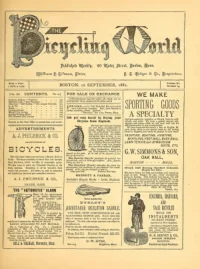
Articles in this issue
- The regular miscellany column reports on the upcoming Montreal wheelmen's meet that Wednesday, the newly formed Holyoke Bicycle Club with twelve members, and that the League championship medals are being made by Jaques & Marcus of Seventeenth Street and Broadway, New York, to be displayed one week before the race.
- Brief club notes from Cincinnati's Buckeye Club and from the San Francisco cycling community, reporting on local membership and cycling activity on the Pacific coast.
- The editorial addresses hill riding as a test of bicycle and rider, and previews the imminent League of American Wheelmen championship contests, noting arrangements for the races and who is expected to compete.
- The official League of American Wheelmen section describes the paper's mission as the League's organ, covering all American bicycling events including clubs, races, excursions, meets, inventions, and routes, with selected items from foreign journals.
- Lists upcoming race meetings including the Montreal Bicycle Club's annual meet on 21 September at the Montreal Lacrosse Grounds, bicycle races at the New Jersey State Fair at Waverly on the same date, the Marlboro Farmers and Mechanics' Association tournament, and a three-mile scratch bicycle race at a joint New York Athletic and Manhattan Athletic Club meeting.
- Letters from members across the country include a detailed Baltimore race report in which Abram G. Powell of the Germantown Bicycle Club won both the one-mile and two-mile standing-start scratch races, with Samuel T. Clark of the Baltimore Club taking second in each, plus a touring narrative describing a rough riverside descent and road adventures including a rider going headfirst off his machine onto a scow.
- Club reports from multiple cities including Montreal (5 September 1881), St. Louis (Missouri Bicycle Club organized 24 July, first run to Forest Park on 31 July), Ohio Wheelmen state organization news, and Buffalo (annual run indefinitely postponed due to four to six inches of dust on the roads).
- Reports on the rates charged by English railways for carrying bicycles, providing comparative information of interest to American wheelmen regarding British practice.
- Detailed account of the British hill-climbing contest on Muswell Hill, describing the course profile: 1,750 feet of ascent before the steepest section of 310 feet at a gradient of 1 in 8.7, which falls near the top just as the rider's strength is most taxed, followed by only 340 feet to the winning post. Includes a breakdown of bicycle makes ridden by successful competitors — Humber 3, D.H.F. Premier 2, Hydes and Wigfull 2, and eleven other makes — and notes a wet week redeemed by a fine race day.