The Bicycling World, Vol 3, No 20
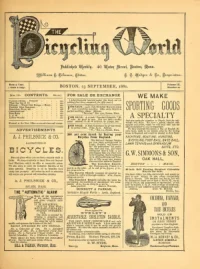
Articles in this issue
- Brief miscellaneous notes on cycling personalities and club news, including the Boston Bicycle Club's run to Lexington, a runaway accident where a bicycler rendered assistance, and anecdotes about well-known wheelmen at the Worcester and Hingham meets. A 'Personal' sub-column reports on individual riders including Mr. Wilson's retirement from racing, Master Francke's fancy riding in Louisville, and Messrs. Eaton and Cressman's Philadelphia-to-Boston wheel trip.
- A tongue-in-cheek column presenting mock-complimentary press notices about The Bicycling World clipped from contemporary newspapers, including the Boston Herald, Puck, the Daily Graphic, the Boston Transcript, the N.Y. Clipper, and the Pittsburg Leader.
- Notes on President Garfield's death on 19 September 1881, followed by a detailed critique of an inaccurate New York Herald reporter's article on American bicyclists that overstated New York's cycling population, misstated the history of the wheel's arrival in Boston and New York, and entirely omitted the New York Bicycle Club from its list of clubs.
- Club reports from Hamilton, Ontario (officers elected, seeking a practice ground); the Hermes Bicycle Club of Providence, R.I. (annual election results); and the San Francisco Bicycle Club (new members, a joint Oakland ride and drill, an invitation to perform at the Mechanics' Fair, and preparations for a Thanksgiving tournament at Golden Gate Park).
- A coming-events calendar listing amateur races at fairs and club grounds across New England, the Midwest, and Canada from 24 September through 8 October, followed by detailed reports of recent races including the Toronto exhibition tournament, the Marlboro Bicycle Club championship at Hudson, the Staten Island Athletic Club fall meeting, the Buffalo Bicycle Tournament (with full results of half-mile, mile, three-mile, and slow races), French professional results featuring De Civry's victories over Keen, and races at Hoboken and the New York Athletic Club grounds.
- L.A.W. President Bates writes after a month's illness and a trip up the Great Lakes, describing his relief work in the devastated Lake Huron fire zone where over three hundred people perished, twenty thousand were burned out, and entire villages were destroyed. He uses the occasion to renew his call for the L.A.W. to establish a race bureau to standardize rules, oversee amateur/professional distinctions, and preserve official race records, arguing that other sports are already governed by central authorities.
- Tour account by H. F. Libby of the Portland Bicycling Club describing a multi-day ride from Portland through the White Mountains in late July and early August 1881 with C. H. Lamson, covering roads to Bridgton, Fryeburg, Upper Bartlett, and the Crawford Notch, with notes on road conditions, distances, the historic Abel Crawford House, and a pleasant social stay in Bridgton.
- Day-by-day excursion account by Frank G. Eaton and Chas. H. Cressman of the Germantown Bicycle Club describing their week-long 54-inch Columbia bicycle ride from Philadelphia to Boston in early September 1881, passing through Trenton, Princeton, New York City, West Point, Hartford (including a tour of the bicycle works), Springfield, and Worcester, with candid notes on road quality, the reception by local wheelmen, and coverage in the Springfield Republican.
- Report on the founding of the Nashua Wheel Club on 17 September 1881, organized by the Gilman Brothers who arranged a public street parade of about twenty riders, three fancy-riding exhibitions by boy wheelman Master Georgie Girard (including stand-stills and step-up tricks on a 52-inch wheel), a club drill at the driving park, and an elegantly set bicycle dinner at the Laton House attended by the Mayor.
- Correspondence from E. J. W. in Pittsburgh endorsing President Pratt's L.A.W. record and defending club secretary Mr. Cross against 'Bernard's' insinuations, reporting that local bicyclers have had an inactive summer of hot weather and dusty roads, and calling for better race prizes than thin medals and for the L.A.W. Hand-Book to include definitive race rules.
- Milwaukee cycling column 'Cyclum' reporting on pleasant moonlight rides along Whitefish Bay boulevard, broken fork accidents on 1879-pattern D.H.F. Premiers, a visit from Detroit's Elmer Irish, club members heading to the Jefferson County Fair races in Wisconsin, and praise for Eastern hospitality experienced by local rider P. H. Sercombe during his Boston vacation.
- Humorous letter from Montreal club member 'K.K.' describing the club's eclectic mix of riders ranging from 225 to 70 pounds and 56-inch to 42-inch wheels, puns about a machine a Mr. Winter wished to sell, and a pledge to report on an upcoming race at Terrebonne in his next letter.
- Opinion piece signed 'Practical' arguing that gold and silver race medals are practically worthless — their intrinsic metal value is below the racer's expenses — and advocating for the English 'winner's choice' system, whereby the winner receives an order redeemable at jewelry, bicycle, or outfitting establishments, so he may select something genuinely useful.
- Letter from Albert G. Carpenter, President of the Providence Bicycle Club, rebutting R. Lincoln Lippitt's published accusation that club secretary Mr. Cross improperly erased a membership record, explaining that the secretary merely drew a corrective line through an incorrect entry and that Lippitt misunderstood the meaning of the word 'erase' in club record-keeping practice.
- Comparative summary of the L.A.W. amateur definition adopted in September 1880 and the more detailed English Bicycle Union rules, covering six categories of conduct that turn a bicyclist professional, with a note that bicycle manufacturers and agents are not automatically classed as professionals unless they personally teach riding as a sales means.
- League of American Wheelmen membership notices including admission fees, badge ordering details, and a list of new membership applications from individuals in Worcester, Poughkeepsie, New York City, Quebec, and Pennsylvania, plus additions to the Dayton Bi. Club, Rockingham Bi. Club, Missouri Bi. Club, Champion City Bi. Club, Crescent Bi. Club, Framingham Bi. Club, Hill City Bi. Club, and Boston Bi. Club.
- Description, reprinted from the Cyclist of 23 August, of Mr. Overman's new open-fronted double-driver tricycle demonstrated in England, notable for its ability to drive either or both wheels independently, keep feet stationary on down gradients, and mount two steps with a single pedal thrust; a Coventry firm has reportedly arranged to manufacture it for the 1882 season.