The Bicycling World, Vol 3, No 23
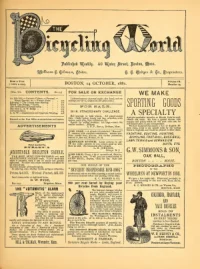
Articles in this issue
- A humorous verse following a young man named Snyder who buys a bicycle, masters riding without ever taking a header, uses his brake wisely on hills, and earns the nickname 'good fellow' among cyclists for his skill and grit.
- The weekly column of running notes: Boston is elated at bringing away three League medals including the championship won by Frye, the Barnet Meet drew forty-five clubs and 389 wheelmen, and readers are urged to attend the great ten-mile return race between the Massachusetts and Boston bicycle clubs at Beacon Park. Other squibs cover Lafon's 'Yale Invincible', a Chelsea run to Marblehead, and advice to take the Chelsea ferry when wheeling east to Lynn, Swampscott, Salem and Marblehead.
- Personal notes: League champion Lewis T. Frye is in business on High street, Boston; Lemuel Hitchcock gave the Marlboro' Bicycle Club a supper at his father's residence; Consul Fred. T. Sholes of the Cleveland Bicycle Club visited Boston; professional John Shillington Prince can find no one to race him for a purse of $200 or upwards; and A. E. Swartout of Auburn, N.Y. combines clothing manufacture, a bicycle agency, and editing an advertising monthly.
- Reader queries and notes: a Woodstock, Ont. rider asks whether frosty or damp weather loosens bicycle tires; 'Meteor' answers a Marblehead query on corduroy roads; 'Ixion II' relates that bicyclers on the Forest River road between Swampscott and Salem surprised a hotel clerk by ordering lager; and the Capital Bicycle Club's secretary notes that Pope prize winner C. E. Hawley is the club's president in Washington.
- News from France: the death of Baron de Graffenreid, an esteemed pioneer of long bicycle journeys who covered nearly 2,500 miles in forty days through France, Italy and Switzerland in 1878; Le Sport Velocipedique describes a hunchbacked watch and clock maker who travels the country on a tricycle; and La Revue des Sports reprints accounts of Miss Von Blumen's races, including her contest with the trotting horse 'Dan'.
- A sharply critical editorial calling the League of American Wheelmen race meeting in New York 'a fizzle': entries were few, times slow, and barely 250 people attended, in contrast to the successful Newport, Boston, Worcester and Brockton meets. The editor rebuts Commander Munroe's suggestion that the Bicycling World under-advertised the races, arguing the League's officers and the New York clubs failed to promote or parade for the event.
- Club news: the Louisville Bi. Club elected Aaron Cornwall president and Thomas Moran captain; the Middlesex Bi. Club of Malden, Mass. reorganized under president L. S. Ipsen; the new Bay State Wheel Club formed in South Boston; and the Crescent Bicycle Club of Boston held its annual meeting and dinner at Hotel Brunswick, electing H. P. Robinson president.
- Race reports from across the continent: the Salt Lake (Utah) Bicycle Club's first meeting won by James Jennings, the Montreal Athletic Association three-mile won by F. C. Holden, the Williamsburg Athletic Club fall meeting, the G.A.R. field day races at Springfield, meets at Elkton, Md. and Willimantic, Conn., and the Brockton races where Frye won and Blackinton broke his wrist in a header. The department's centrepiece is a full report of the L. A. W. race meeting at the Manhattan Polo Grounds, where William Smith of Bristol, England took the two-mile amateur championship of America, Frye won the one-mile League championship in 3.12 1/4, and Jenkins beat Munroe in the professional race.
- An open letter from John S. Prince of Boston challenging any professional bicycle rider in the country to race him from scratch, one to five miles, for one hundred to five hundred dollars a side and the professional championship of America, preferably on an open-air track near Boston; he claims the title of champion of America and offers to cover any deposit lodged with the editor.
- Description of a proposed new League of American Wheelmen membership badge designed by Mr. Lamson — a miniature suspension wheel on a pin, worn on the lapel or scarf as a discreet fraternal emblem similar to Masonic or Odd Fellows insignia; the design has been patented, and the Board of Officers is invited to make arrangements for its adoption alongside or in place of the existing badge.
- Reader letters: '626' bemoans the muddy streets of St. Louis; a nameless nine-member Boston club recounts a run to Dedham and Needham complete with hard cider; 'Telzah' details inconsistent railway baggage charges for bicycles around Boston, including a successfully contested fifty-cent overcharge; Montreal correspondents describe club expeditions to Terrebonne and Longueuil, the latter featuring a collision with a bread cart and the secretary losing his spectacles while bathing; and a Chicago letter reports the Lincoln Park commissioners voting to admit bicycles.
- League of American Wheelmen membership applications published by corresponding secretary Kingman N. Putnam, with additional names proposed from the Missouri, Toronto and Cleveland bicycle clubs, several unattached riders from Ohio, Pennsylvania and Providence, R.I., and corrections to earlier lists.
- Full minutes of the League of American Wheelmen quarterly meeting at the Metropolitan Hotel, New York, 6 October, with President Charles E. Pratt presiding: membership has grown from 1,652 to 2,103, Commander Munroe reports the race meeting cost about $200 out of pocket, a proposed hotel tariff for touring wheelmen is debated, the Lamson badge is recognized as a League badge design, English visitor A. H. Llewellyn Winter is elected the League's first director for England, and members debate whether Mr. Burrill's erroneous filing should void amateur champion Smith's membership application.