The Bicycling World, Vol 4, No 1
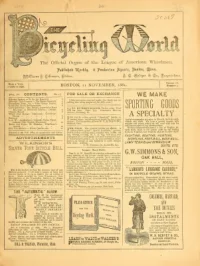
Articles in this issue
- A column of brief editorial observations on cycling news, including sceptical notes on horse-car cheap fares, warnings against untrustworthy English bicyclers visiting America, and commentary on Chicago press coverage of cycling. Includes the humorous poem "To the Six Hundred," urging League members who have not yet paid their one-dollar annual assessment to do so.
- An editorial addressing the organizational challenge of administering the League of American Wheelmen across a country of nearly three million square miles, prompted by the formation of the League of Ohio Wheelmen. The editor argues that a system of state sub-leagues subordinate to the national body—modelled on Masonic Grand Lodge structures—is the only way to preserve national unity as membership grows.
- A comic narrative by Detroit Club president Bates recounting how club members organised an impromptu late-night bicycle serenade for a fellow member, Mr. Bumps, who was calling on his fiancée Miss Marietta Tonish. The piece describes the musical misadventures—a trombone dropped on a corn, an accordion wrestling Mr. Lowe on a jolting wheel—and the warm reception the serenaders received inside.
- A detailed cycling tour narrative by Kol Kron tracing a multi-day bicycle journey from Whitehall, through the Lake George region, and down the Hudson River to New York City, with precise cyclometer mileages for each stage. The author gives frank assessments of road conditions—corduroy plank roads, deep sand, and a desperate stretch ridden between railroad tracks—and suggests an optimal four-day itinerary for New York and Boston wheelmen.
- A nostalgic retrospective by "St. Saens" on the Boston cycling club-rooms at 40 Providence Street, which have been vacated and taken over by a new tenant. The piece recalls the social life, debates, the planning meetings for the first L.A.W. annual meet, and the antics preserved in the club register, celebrating the fellowship those cramped quarters fostered.
- A letter from the L.A.W. consul in Cincinnati reporting that members who obtained League badges on his advice—believing their deposit would be refunded on return—are now being mocked by those who waited. The writer urges the League to rectify the misunderstanding and warns that seemingly small administrative errors can seriously damage confidence in the organisation.
- A letter signed "Practical" advocating that the League establish a formal race bureau with a published code of rules covering everything from advertising to prize presentation, drawing on the English Bicycle Union's regulations to create a consistent and internationally compatible system. The writer argues that without such a framework, judges at remote meetings are left to make arbitrary decisions with no standard to consult.
- A letter from H. Blackwell Jr. of the Bicycle Union announcing that the Union's executive has unanimously resolved to establish a comprehensive reference library of all cycling books and periodicals at its London offices. He appeals to wheelmen to donate scarce old volumes before they are discarded, warning that the difficulty of assembling a complete collection grows with each day's delay.
- A lively letter from correspondent "Steno" reporting on cycling coverage in Chicago's newspapers, praising the Tribune and criticising the Times. The letter also offers a comparative assessment of ball-bearing technology across front wheel, rear wheel, and pedals, drawing on first-hand experience with several bearing types and brands, and notes the opening of the Chicago Bicycle Club's new indoor riding hall and gymnasium.
- International racing dispatches covering a closely contested twenty-mile match between French champion De Civry and H. O. Duncan at Surbiton, and Keen's subsequent solo run that broke the professional twenty-mile record; the All England one-mile handicap final at Birmingham; a dispute over the Eastbourne Burial Board's refusal to permit Bicycle Union danger boards; and news of a bicycle fraudster sentenced to twelve months' hard labour at Wolverhampton.
- Club news from three cities: the Cincinnati Bicycle Club's newly elected officers and its negotiations to use the Exposition Buildings as a winter riding hall; the founding of the University Bicycle Club in Madison, Wisconsin, with seven founding members hoping to use the university gymnasium; and the Boston Bicycle Club's monthly meeting, where new members were elected including L.A.W. champion Lewis T. Frye, and plans were agreed to lease new club headquarters.
- Brief personal notes reporting that British professional Fred Cooper will not visit America that season though Keen and Vesey still may; a notice for President Pratt's pamphlet of bicycle care suggestions; and a report that the Hawthorne Bicycle Club led the Massachusetts Club on an impromptu hill-climbing contest into Salem in a gale of wind.
- Official League of American Wheelmen business across several sub-sections: new membership applications from individuals and clubs in New York, Pittsburgh, Cincinnati, Toronto, and elsewhere; newly appointed consuls for Maritime Provinces, Ohio, and Pennsylvania; a letter from P. Devillers of the Union Velocipedique de France explaining a revised two-tier amateur classification adopted to align with international definitions while accommodating domestic racing for money; and a letter from L.A.W. President Charles E. Pratt inviting English members to express their preferences regarding the proposed establishment of an English directorate.
- Brief notices on two publications: an enthusiastic review of the first number of Vol. IX of St. Nicholas magazine, praising its wood-engraved frontispiece after Sir Joshua Reynolds and its varied illustrated content; and an announcement that the Wheelman's Annual for 1882 is in press, to feature ideal bicycle construction specifications from prominent wheelmen and an opening novelette by "Ixion."
- A personal statement from Elsa Von Blumen, a professional lady bicyclist performer, describing her public bicycle exhibitions as entertainment that simultaneously demonstrates the physical benefits of cycling exercise, particularly for American women. She credits her bicycle athleticism with saving her from a consumptive decline, quotes encouragement from reformer Mary A. Livermore, and declares she will countenance no wagering at her performances.
- A short reader query column: a Lewiston, Maine, reader asks how to learn the "stand-still" trick on a bicycle; and a Peabody correspondent reports favourably on three months' use of a Pope Magnetic Cyclometer, finding it more accurate than the Excelsior model he previously used.