The Bicycling World, Vol 4, No 10
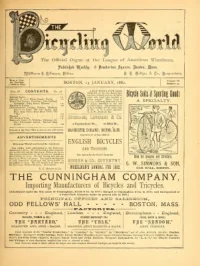
Articles in this issue
- Brief editorial notes on upcoming events including the Prince-Keen and Frye-Vesey races, preparations at the Fair Building track (five laps to the mile), requests to club secretaries, and observations on Louisville's growing bicycle press coverage.
- The Union Athletic Club's winter games at Mechanics' Building are praised for including four bicycle events — one-mile, two-mile, and slow races plus a Crescent Club exhibition drill — with gold and silver medals as prizes; the editor urges other athletic organizations to follow suit.
- Editorial defense of bicycle racing as essential to the sport, arguing that racers drove improvements such as long handlebars and ball bearings, generated public interest in cycling, and that neither road riders nor racers should disparage the other's pursuits; signed J.S.D.
- Reports from six clubs: Worcester's annual election of new officers, New Bedford's new secretary, Springfield's planned spring tournament with $1,000 in prizes, Hub Bicycle Club No. 2's first annual ball (noting it is the only club composed of colored young men), Essex Club's winter reception, and the expulsion of Mack Evans from the Missouri Bicycle Club.
- A travel essay comparing cycling conditions across England, France, and Germany: England is praised for its universal adoption of the bicycle and tolerant horse-drivers; France is noted for superb roads but general athletic indifference; Germany treats cyclists as curiosities; the Black Forest is recommended as the ideal touring destination.
- Letter from 'Aeriel' of the Aerial Club reporting on brilliant New Year's Eve moonlit rides on Chicago's boulevards, a petition by Michigan Avenue residents to ban bicycles, and John Shortall's successful advocacy before the park commissioners to keep the boulevards open to cyclists.
- Letter from 'Sixty' of the Chicago Bicycle Club clarifying that a widely-reported quarter-mile record was made on a club training machine combined with a 60-inch wheel rather than in a regular race; also notes indoor mile training at the Exposition Building and Milwaukee's last-minute refusal of the proposed inter-club race challenge.
- Brief letter from 'Freshman' describing a successful bicycle ride across a frozen Madison lake, where a thin coating of snow provided just enough traction to maintain speed against a stiff headwind; a subsequent heavy snowfall ended outdoor cycling for the season.
- Letter presenting an 1849 poem by Ebenezer Elliot ('Rub or Rust') as prophetically applicable to bicycle maintenance, followed by a humorous paraphrase adapted for American cyclists urging them to keep their machines clean and polished; signed 'Geesee and Nal' of Marblehead.
- Detailed evaluation by Edward K. Hill of Hill & Tolman after 1,000 miles on a 52-inch Yale light roadster, praising its exceptional stiffness, minimal wear, and low maintenance needs, while noting the rear wheel's tendency to slip on hard-surface hills and the hazard of the curved handlebar during falls.
- Short letter from 'Bert' of Philadelphia arguing from road experience that at least seven-eighths of an inch of tire thickness is necessary for rider comfort on average American roads, and proposing an elliptical (not oval) tire cross-section with its major axis in the plane of the wheel.
- Extended technical letter from 'Cyclos' responding to 'B.' of Detroit in the ongoing tire-geometry debate, using a spool-and-pencil experiment to demonstrate geometrically that round tires provide uniform road contact regardless of wheel diameter, and that the round section is the only form broadened uniformly whether the wheel is vertical or inclined.
- Letter from Julius Wilcox of New York arguing that rubber tire flattening under load is greater than previously measured, that a broader tire in a broad rim might reduce rolling resistance on sandy roads, and rebuking 'Enthusiast' for discouraging critical discussion of whether bicycling is advancing.
- Brief notes on riders and upcoming events: Frank Sivret's sprained arm, planned fifty-mile and hundred-mile races (including a proposed Armaindo-vs-Rollinson contest in Louisville), Mr. J.S. Dean joining the Bicycling World as editorial contributor, and Lewis Frye's ten-mile straightaway challenge against English amateur champion C.D. Vesey.
- A humorous poem in the style of Poe's 'The Raven,' written by a Baltimore lady, recounting a midnight bicycle excursion through Pittsburgh with an expanding group of wheelmen dubbed the 'Reckless Three,' ending in a bugle-waking tumble of broken spokes and bent pedals.
- Brief notices of recent publications: the St. Nicholas January issue, The Christmas Cyclist pamphlet for 1881 (sixty-four pages of cycling humor and verse), the forthcoming Wheelman's Annual for 1882 featuring contributions by Ixion, Cyclos, President Bates, and others, and the newly launched Harvard Daily Herald.