The Bicycling World, Vol 4, No 11
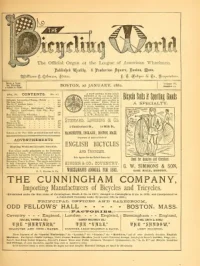
Articles in this issue
- Editorial arguing that recent race results prove American cyclists can beat the British, centring on Lewis Frye's decisive ten-mile victory over English long-distance champion Cuthbert Vesey at the New England Institute Fair Building. The editor declares that British racing prestige is 'seriously imperilled' and that Boston wheelmen believe their fastest rider has yet to be tested.
- Editorial survey of the principal bicycle pedal types — rat-trap, rubber, and hybrid — weighing grip, shoe wear, and safety, followed by a comparison of cone, plain, and ball-bearing pedal mechanisms. The piece recommends ball-bearing pedals as the superior design despite their higher cost of about $12, and advises riders on dust protection and minimising tread width.
- A short melancholy poem signed 'J. Park Street' in which an old jockey leans against the rail watching bicycle wheels spin past, sighs at his obsolescence, and concedes 'My day is done' as an angel records his resignation.
- Detailed match-by-match report of the 14 January 1882 races at the New England Institute Fair Building before 1,500 spectators: the five-mile amateur inter-club contest won by H. D. Corey (Meteor Club) in 18:49½, the international ten-mile amateur race in which Lewis Frye defeated Vesey in 35:44½ (a new American record), and the professional ten-mile match between English ex-champion John Keen and John Prince, won by Keen in 33:03 after Prince misjudged his sprint. Mile-by-mile time tables are included for both the Frye-Vesey and Keen-Prince races.
- A comic tribute poem by Henry Talbott, Poet Laureate of the Missouri Bicycle Club, honouring club president Richard Garvey's return from Europe. The poem catalogues Garvey's global travels — camel across the Sahara, droschke in Russia, ice-boat on the Hudson, balloon from Brest to Paris — before concluding that the bicycle is 'boss of the world wide.'
- Brief reports from seven clubs announcing annual officer elections and social events: Marblehead (twelve members), Buffalo, Chicago, Germantown (Philadelphia, with new constitution and rooms), Falls City (Louisville consolidation proposal and a planned team race with Chicago), Keystone (Pittsburg, drilling in Armory Hall), and Essex (Newark annual reception attended by forty couples).
- A humorous multi-chapter narrative by 'Ellsworth' of Newburyport recounting a Saturday run to Egypt (twelve miles) by four cyclists who compulsively quote Shakespeare in every situation — dodging a runaway hay-cart, nursing a header into the gutter, teaching a terrified novice to ride, and encountering strangers, a small boy, and a blacksmith who all respond in kind with lines from Macbeth, Lear, Hamlet, and Coriolanus.
- Letters from five correspondents: a Scranton club surgeon humorously advocating bicycle exploration of the Arctic (with 'polar bear-ings') and praising cycling's health benefits; a Philadelphia rider sceptical of the city's streets for the League Meet and lobbying for Washington D.C.; a Cleveland wheelman proposing a postal poll of League members on the Meet location; a Detroit rider (signed 'B.') giving a detailed mechanical critique of the Invincible/Yale bicycle's tendency to break front-wheel spokes at their screw threads; and a Boston correspondent ('Practical') urging L.A.W. officers to appoint consuls in every town.
- Calendar of forthcoming cycling events for January–February 1882: Union Athletic Club games including bicycle races and club drill at Mechanics' Fair Building (25 January); the Crescent Bicycle Club ball (1 February); the Boston Bicycle Club's fourth annual dinner at Young's Hotel (6 February); and the Missouri Bicycle Club's 25-mile race on Washington's Birthday (22 February) at the Amphitheatre Fairgrounds, St. Louis, with prizes donated by President Garvey.
- Column of short cycling news items: the Star Bicycle Club (Lynn) party; the Missouri Bicycle Club to be photographed en costume; a new riding school opened by Davis & Hunt in Cleveland; champion Keen's endorsement of Frye as the American most fit to challenge the best English riders (citing heart and pluck over raw speed); and a notice redirecting mail to editor William E. Gilman to avoid confusion with the new daily paper called The World.
- Three reader queries: one asking how to stop rear-wheel ball-bearing rattle on a Harvard Roadster; one requesting opinions on Fairfield's cyclometer; and one from Fredonia, N.Y. recommending 24-inch handle bars fitted with soft rubber ball grips as comfortable, non-slip, and vibration-absorbing at fifteen cents each.