The Bicycling World, Vol 4, No 12
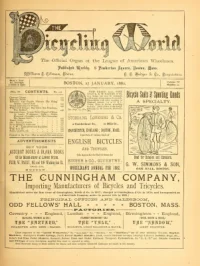
Articles in this issue
- Weekly miscellany column with news briefs including the Hub Bicycle Club's ball (a club of Black cyclists) in Boston, the formation of the Marine Bicycle Company in Portsmouth N.H. for manufacturing water bicycles, a correction of earlier reporting about a disputed dinner bill at the Blue Bell Inn in East Milton, and upcoming handicap races at the Institute Fair Building.
- A reader calling himself "Practical" reports that after 4,000 miles of testing, plain pin pedals—at $5 a pair—perform within five percent as well as ball pedals costing $12, are significantly stronger, and gave no trouble, while his subsequent experiment with ball pedals resulted in two pedals being shoved off in a single month.
- Editorial covering three topics: the unexplained abrupt departure of visiting English racing cyclists Keen and Vesey after agreeing to rematches in Boston; an optimistic preview of the coming riding season; and an argument that park commissioners have no legal authority to bar bicycles from Central Park in New York.
- Reprints advance sheets from the Pope Manufacturing Company's forthcoming catalogue listing all U.S. bicycle patents from 1865 to 1882 owned by the company—covering the double-cranked axle, round rubber tire, tubular rim, hollow forks, and more—with a notice that unlicensed manufacture, import, or use of machines embodying these patents constitutes infringement.
- Club news from three clubs: new officers elected at the Bay State Wheel Club in Boston; the San Francisco Bicycle Club's third anniversary banquet at the Windsor Hotel, including a whimsical bicycle-themed menu with dishes such as "Chicken Cream with Ball Bearing" and toasts by officers and visiting Oakland club members; and the New Bedford Bicycle Club's report of growing to twelve active members and securing the skating rink for winter indoor riding and trick exhibitions.
- Reader F.C.H. from Scranton, Pennsylvania argues that Philadelphia is the ideal location for the next League of American Wheelmen annual meet, citing its central position, the Fairmount Park commissioners' welcoming attitude toward wheelmen, and the opportunity for New York and other cities to learn how Philadelphia secured bicycle access to its parks.
- Correspondent "Ariel" from Chicago makes a detailed case for the Midwest hosting the L.A.W. meet for the first time, noting Chicago's 200 riders, two clubs, fifty miles of boulevards including a belt boulevard encircling the city, and the likelihood of 500 or more attendees from across the region—while criticizing the Eastern directors' habitual bias toward Eastern host cities.
- St. Louis wheelman "S." candidly concedes that the city's notoriously bad streets and hills make a League Meet parade impossible there, comparing the dream of riding Eastern roads to Moses gazing on Canaan, and recommending Chicago, Philadelphia, or Washington as the three cities genuinely able to fulfill the requirements.
- Correspondent C.G. reports on the Capital Bicycle Club's second uniform soirée dansante at Marini's Hall in Washington D.C., attended by more than 300 guests; the evening featured a 54-inch nickelled wheel decorated with the club badge as a centrepiece, uniquely designed dance programmes printed on silver bicycle-wheel cards, and the club's blue uniforms much admired alongside the ladies' gowns.
- Buffalo club news: the club is drilling on Saturday evenings in the 74th Regiment drill room, includes a humorous New Year's Day incident where a rider was upended when a boy's sled caught his wheel on a main street, and reports the arrival of Smith's new 54.5-inch Yale Racer greeted at the riding hall with a cartoon and a comic verse about his racing prowess.
- Two items from Worcester: the Æolus Club has secured the skating rink (thirteen laps to the mile) for daily practice ahead of a February exhibition of club drill, slow race, and fancy riding; and a personal endorsement of the 52-inch D.H.F. Premier bicycle, which survived 700 miles including a severe header downhill with nothing worse than a bent saddle, and which a street boy admiringly called "the boss."
- Reader "B." closes his contributions to a weeks-long debate about bicycle tire design, distilling the conservative position—that the present round tire is already perfect—against the speculative possibility that broader, thinner, or differently shaped tires could transform the bicycle into a practical all-road vehicle; he argues only experiment, not theory, can decide and invites inventors to pursue the field.
- Members of the Allston district's Meteor Bicycle Club formally rebut an anonymous correspondent who dismissed them as too "vague" to merit the name club, rebutting each claim in parenthetical brackets woven through the original text and asserting that the Meteor Club is active, properly organized, and will continue to shine regardless of detractors.
- Notes translated from French cycling publications: a French writer corrects an English claim that bicycles are barred from the Champs Elysées and Bois de Boulogne; La Velocipédique Belge reports a Brussels club reduced to a dozen members after officers resigned over a membership ballot dispute; and Le Sport Vélocipédique covers a Saumur club that now has a president but no club after an unauthorized election, plus the continuing professional-versus-amateur controversy in France.
- Month-by-month chronicle of major American bicycling events during 1881, drawn from the Bicycling World's own pages: race results from Boston, New York, Philadelphia, Chicago, Baltimore, and as far as California and Utah; key organizational moments including the League Meet in Boston with 800 riders in the parade; and Elsa Von Blumen's 1,000-mile six-day ride at Pittsburgh in December.
- Announcement of an open amateur exhibition contest at Foster's Riding School in Baltimore around the end of February, offering gold and silver medals for proficiency in a defined sequence of mounts, dismounts, and standing tricks; from the competitors, Foster plans to select a uniformed eight-man "Foster's Brigade" team in blue corduroy to challenge other clubs for medals and trophies.
- Notices of upcoming cycling events: the Union Athletic Club games including bicycle races and club drill at Boston's Mechanics' Fair Building on January 25th; the Boston Bicycle Club's fourth annual dinner at Young's Hotel on February 6th; and a 25-mile race at the St. Louis Amphitheatre Fairgrounds on Washington's Birthday, with gold and silver L.A.W. badge prizes donated by the Missouri Bicycle Club president.
- Two reader exchanges: a Portland, Maine correspondent asks whether the serrated edges of rat-trap pedals have caused any leg injuries or clothing damage; another reader reports successfully using a specially-made viscid oil—as thick as molasses—to stop Harvard rear-wheel ball bearings from rattling, and offers to share the recipe.