The Bicycling World, Vol 4, No 14
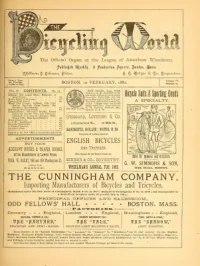
Articles in this issue
- Editorial urging delegates preparing for the upcoming L.A.W. Annual Meeting to study the constitution before proposing amendments, and advocating for state or district sub-leagues to better represent Western wheelmen. The editor also proposes that the rule fixing the date to May 30th be revised so each annual meeting sets the time and place for its successor.
- Editorial arguing that convict labor should be organized in chain gangs to repair America's deteriorating public roads, directly benefiting cyclists and stimulating roadside commerce. League members are urged to inform consuls of dangerous road conditions so that town authorities can be held liable for injuries.
- Detailed specifications for an ideal road bicycle suited to riders of average weight, compiled from the Wheelman's Annual: 50-inch rear wheel, 60 front and 24 rear spokes, crescent or Invincible rim, double-ball front hub, 5.5-inch cranks, and a double-lever spoon brake — total weight approximately 42 lbs. Larger tires are recommended for heavier riders.
- Report of the club's fourth annual dinner at Young's Hotel on 6 February, attended by 75 members and distinguished guests including Mayor Green and Councilman Parkman, who hinted at plans for a bicycle racing track on the parade ground. Governor Long sent a letter of regret, and speeches by the Rev. Mr. Weston and Ex-Collector Simmons kept the company amused past midnight.
- Account of the second annual party of Boston's Crescent Bicycle Club, held 1 February at Odd Fellows' Hall with 200 guests, Germania band music, and dancing until 1:30 a.m. The hall was decorated with a nickelled bicycle entwined with smilax and flowers, and ladies wore fans embroidered with crescents.
- Officers' election reports from Rutland, Falls City (Louisville), Boston, Hartford, Kings County (Brooklyn), and Massachusetts clubs, plus an account from the San Francisco Bicycle Club's annual meeting showing 85 percent membership growth and monthly runs averaging 36 miles. The Massachusetts club announces new dark-blue uniforms with a turn-down collar and plans all-day monthly runs April through November.
- Best racing records of prominent American cyclists for the 1881 season, listing times and distances for riders from Philadelphia, Boston, Chicago, New York, and California. W.W. Stall of Brighton holds the best American outdoor records for 1-mile (3m.11.5s.), 10-mile (36m.22.5s.), and 20-mile (1h.23m.5s.); L.H. Johnson of Orange, N.J. holds the best 5-mile outdoor record (17m.14.5s.).
- Letters from Milwaukee's Eseirfaw and a Wisconsin writer championing Chicago as the site for the 1882 L.A.W. Annual Meet, arguing the city offers superior hotels, parade boulevards, and railroad access and could draw 1,000 cyclists. Additional letters from Cleveland on their new bicycle riding school, from J.C. Garrood on never oiling ball bearings, and from Scranton and Massachusetts on club life and uniforms.
- Essay by Julius Wilcox of New York debunking speed-gearing devices for bicycles, arguing from mechanical law that speed and power are inversely related and no gearing can overcome the limits of human muscle. Wilcox specifically criticizes Mr. Hogan's patented multiplying-wheel device as impractical, asserting that claimed road speeds of 32 mph are a physical impossibility.
- Reader inquiries including a Chicago correspondent's report on a cyclometer that has worked perfectly since June and a Cleveland question about riding on the front wheel and riding backwards. A correspondent also provides partial details about a patented bicycle training machine whose wheel rests on two grooved wheels connected by a worm-and-gear mechanism.
- Translated accounts from the French cycling press describing the Italian monocyclist Scuri's exhibition in Paris, where he demonstrated mounting unaided, riding zigzag among bottles, carrying a child on his shoulders, and riding backwards on a machine made by cutting off the backbone of a standard bicycle just below the saddle. Parisian observers were divided on whether the monocycle would displace the bicycle.
- Poem by Reade H. Marble conjuring summer cycling sensations — highways lined with orchards, pine-tree shade, birdsong, and open sky — as an imaginative escape while sleet drives against a winter window. The bicycle is cast as a magic wheel capable of summoning absent summer and the freedom of the open road.
- Brief miscellaneous column noting the forthcoming marriage of L.A.W. Corresponding Secretary K.N. Putnam, the Massachusetts Bicycle Club dinner at Hotel Vendome, and H.W. Tufts's bicycle gymnastics exhibition in Fall River. The column also notes that the National Amateur Athletic Association has barred L.A.W. race participants from its games.