The Bicycling World, Vol 4, No 17
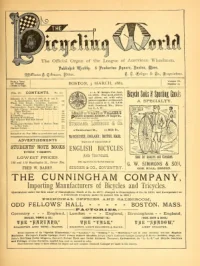
Articles in this issue
- Editorial covering three topics: a critique of the New York Bicyclers' Ball as a failure, a note on the potential amalgamation of the British Bicycle Union and Touring Association into a body resembling the L.A.W., and a report on a race between English riders Keen and Vesey. The editor stresses the importance of cyclists holding club members to high standards of conduct.
- News from Columbia, Cortlandt, Hollis, Syracuse, Columbus, and Boston clubs, with editorial comment that membership in a club of good standing is a letter of introduction in bicycular society and that poor behavior by any member brings the club's reputation into question. Reports include trick-riding exhibitions in Albany, club drills, and notes on graceful wheelmen in Louisville.
- Letters from Peoria, Keokuk, Chicago, and Montreal debating the time and place of the L.A.W. Annual Meet, with a Chicago correspondent arguing that giving the West a turn will bind Western wheelmen more firmly to the League. Other letters discuss the rubber tire's merits and cheap imported machines undermining American manufacturers.
- League of American Wheelmen department giving membership terms (fees payable to treasurer Dillwyn Wistar of Philadelphia, applications to corresponding secretary Kingman N. Putnam of 54 Wall Street, New York) followed by the week's published applications. New names include unattached riders from Sandy Lake, Pa., Philadelphia and Baltimore, plus additions to the Missouri Bicycle Club of St. Louis.
- A humorous Q&A piece posing pointed questions about the state of American cycling: why has no standard light American roadster been made available, why must racing men import their speed machines, and whether American ladies' reluctance to take up tricycling stems from the high cost (about $175 in the United States). The editor answers in wry one-liners, effectively drawing attention to gaps in the domestic industry.
- A satirical piece in the style of a children's reading primer, using a Q&A format to describe recognisable figures in the Boston cycling community — including a stout stock-tipster, a carpet-cleaning inventor, and 'Handsome Ernest' who stops clocks by looking at them. The piece pokes gentle fun at familiar faces while celebrating the social world of the Boston wheelman.
- Abram G. Powell of Philadelphia furnishes certified proof of his half-mile record of 1:24 3/4, set 29 September 1881 on the Oxford Agricultural Society track, beating the previous best American mark of 1:27 1/2 by J. C. Sharp, Jr. For comparison, England's Cooper (professional) holds 1:24 1/2 and Cortis (amateur) 1:24.
- Gossip column 'By a Hue Bub' with notes on Boston Bicycle Club members: Lew Frye rumoured to be riding miles inside three minutes at the Institute Building rink, Brooklyn's W. T. Wintringham joining the club, and Capt. Shillaber expecting good records from his command through liberal use of acid phosphate.
- A short poem signed J. S. D. celebrating the bicycle as a charm against care and a source of health's 'electric flame', likening the rider drawing vigour from his pedal wheels to Franklin drawing lightning from the clouds.
- At Boston's Institute Fair Building on Washington's Birthday, professional John S. Prince rode five miles against time in 16:16 1/4, followed by a five-mile handicap won by H. D. Corey of Boston in 17:51 after A. D. Claflin of Newton was disabled in a collision. In New York, the Manhattan Athletic Club's one-mile handicap was won from scratch by L. Stearns in 4:50.
- Short news paragraphs: a correction dating the round rubber tire patent to 1869 (not 1859), W. D. Wilmot succeeding Mr. Atkins as riding instructor for the Pope Manufacturing Company, Joseph Murray's new pedal slipper on show at the Cunningham Company's salesrooms, and bicycling to feature at Atkinson & Gilbert's summer Casino under John S. Prince's direction.