The Bicycling World, Vol 4, No 3
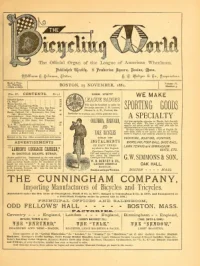
Articles in this issue
- Notes the Massachusetts Bicycle Club's successful Thursday run and the Scranton Bicycle Club's new constitution and road-rules handbook; announces plans for a 15,000–20,000 copy Midwinter special issue and the Massachusetts Bicycle Club's new multi-floor headquarters on Columbus Avenue opening November 28.
- A humorous poem questions why a cyclist should feel proud of race victories and a fine seat in the saddle, cataloguing the inevitable mishaps—blisters from the saddle, dust-dimmed wheel, and a stone carelessly thrown that brings the rider crashing down—that turn the crowd's applause into "wildly hilarious" laughter.
- Reader letters address technique and equipment: "Ajax" of Fort Edward explains how a clubmate learned to stand still on a bicycle by bracing against a tree with the right pedal at upper centre; two other correspondents ask about the reach difference between a 52-inch Ætna Challenge and a 58-inch Harvard Roadster, and about the compatibility and price of ball pedals for Columbia machines.
- The Thanksgiving editorial expresses gratitude to readers, correspondents, clubs, and the press for their year of support, with wry asides about escaping headers, tearing breeches only once, and telling no journalistic lies worth mentioning during the cycling season.
- Club meeting reports cover Oakland Bicycle Club (secretary Dr. Godard resigned, replaced by E. Booth; Thanksgiving events discussed), San Francisco Bicycle Club (planning supper at the Windsor House hosted by Mr. Warschauer, with toasts and an epic poem), Providence Bicycle Club (annual election; Carpenter re-elected president, dues raised from four to eight dollars), Hub Bicycle Club, and Boston Bicycle Club's growing associate membership and planned monthly entertainments.
- California race reports cover the Golden Gate Fair in Oakland (Finkler edges Smith by two feet in a one-mile handicap in 3:13½, with C.L. Leonard winning a gold medal for fancy riding), the Sacramento State Fair (Finkler beats Eggers, 3:26½), and the San Jose fair (Finkler wins easily over Rabe and McLaughlin, 3:36, with the promised medals found to be worth barely $13 in metal); shorter results appear from Bridgewater MA, Montreal, Natick MA, and St. Catharines Ontario.
- "Kol Kron" of Washington Square, N.Y., endorses Consul Dean's advice on touring hotels, arguing that wheelmen need bath-rooms, drying facilities for wet clothes, and quiet rooms rather than reduced rates, and suggests the L.A.W. Hand-Book should certify hotels pledged to these standards—similar to arrangements commercial travelers already enjoy.
- "Ajax" from Fort Edward, N.Y., corrects Kol Kron's report that local riders dare not descend the Sandy Hill incline, stating that even two-month beginners ride it on a full coast with ease, and urges Kol Kron not to rely on bar-room loungers who know nothing about bicycling when gathering road intelligence.
- The Capital Bicycle Club of Washington D.C. staged the country's first full-dress uniform bicycle ball at Marini's Hall with a thousand invited guests on November 14, following a weekend that included a theatre party of twenty-five uniformed members who occupied four private boxes at the leading theatre—displacing a request from General Sherman—and dress runs with visiting Boston, Germantown, and Columbia College clubs.
- A Cleveland writer describes the club's failed November 11 race attempt: most riders followed Consul Sholes around the half-mile clay track in the rain and returned covered in yellow mud, to the convulsions of the three who had stayed behind; the club reschedules its races for Thanksgiving Day at Euclid and Case avenues and invites all unattached city riders to join.
- "B." of Detroit reports that the Detroit Bicycle Club shows little sign of life after the worst fall in years for constant rain reduced Michigan's roads to rivers of mud and made even the city's wood-paved streets unridable; the club has suspended riding and meetings until fair weather but has not broken up, and the writer commends the Bicycling World's race notices and reports.
- Alfred Ely, Jr. of Cleveland answers the Bicycling World's November 11 editorial, explaining that the Ohio League's constitution provides only for an annual meeting of Ohio wheelmen in some centrally located place, offers no protection to members, and no more usurps the L.A.W.'s work than the yearly meets at Worcester or Milwaukee.
- A Chicago writer describes a packed entertainment at Natatorium Hall, the Chicago Bicycle Club's headquarters, featuring the club drill from bugle signals, Mlle. Louise Almaindo's mile against time in six minutes (sixteen laps, falling twice), champion F.S. Rollinson's trick riding on a 50-inch Special Club, and sparring by middle-weight champion Geo. H. Benedict; he also reports John Wilkinson taking over the Columbia agency and pitting the British Challenge against Mr. Fairfield's D.H.F. Premier on Chicago roads.
- "Steno" argues that Sunday bicycle runs in full club uniform—badge, colors, and high-water pants—damage the sport's public reputation and that ordinary dress is perfectly adequate for riding; he then describes the "bicycular millennium" attained after a year or two of steady riding, when balance becomes unconscious, exertion ceases under six miles of moderate gait, and the wheel is enjoyed with a calm, deeper pleasure than the novice's thrilled novelty.
- A San Francisco correspondent writes on 7 November that G.L. Cunningham has returned to the wheel on his physician's advice and George A. Aldrich is back from an Eastern summer praising Eastern roads; eleven club members joined a moonlight run called by Sub-capt. Chas. A. Butler from Van Ness and Golden Gate avenues to the Cliff House, and a well-attended meet captained by H.C. Finkler battled high wind and threatening fog.
- "Pacific," another San Francisco correspondent, urges wheelmen to keep their own tracks, management, and audience after the shabby treatment at California's fair races rather than serve as an advertising convenience for an agricultural "hoss-trot"; he reports negotiations with the Garfield Monument Fund people to share Thanksgiving Day (bicycle games at 11 A.M., horses at 2 P.M.) and notes the Oakland Club's pleasant twelve-mile lunch run to San Pablo.
- The League of American Wheelmen publishes proposed membership applications from John W. Bowers and Charles H. Cleaves of the Saco Bicycle Club, Maine, and announces the appointment of Albert Trego of 230 Wayland Street, Baltimore, as Maryland director to fill the vacancy left by Director Tomlinson's resignation.
- Three cyclists—Brown, Smith, and Jones—ride from Orange, New Jersey, to Pompton over improving roads past the Passaic River and Pequannock powder works; they dine on a full menu including oyster soup, sirloin, and ice cream at the Norton House for seventy-five cents each, then spend the afternoon boating and swimming in Pompton Lake before spinning home under leafy arches.
- Messrs. King, Stokes, and Lewis of the Philadelphia Bicycle Club ride 184 miles through the Shenandoah Valley from Hagerstown, Maryland, to Staunton, Virginia, in 32 hours 46 minutes, praising the Valley Pike as the finest road in the East; they detour by train to visit Luray Caverns after finding the road unridable, and list recommended hotels from Hagerstown to Staunton at fifty cents a meal and lodging.
- Sixteen Massachusetts Bicycle Club members in full uniform, joined by Col. Pope at Newton who supplied the club drink of milk, ride forty-two and a half miles on November 17 through Waltham and Weston to Concord and Lexington, visiting the Minuteman, the homes of Emerson, Thoreau, and Alcott before a good dinner and long rest at the Massachusetts House—originally the Massachusetts Centennial building at Fairmount Park.
- The secretary of the Worcester Bicycle Club and the president of the Aeolus Wheel Club cover forty-four miles from Worcester to Providence on a cold November 12, battling sandy roads from Uxbridge to Millville and a head-wind from Woonsocket; a near-plunge into the Blackstone River and a broken handlebar mark the trip, which finishes at the Hotel Dorrance just as heavy rain sets in.
- Translated from Le Sport Vélocipédique, a French cyclist recounts a two-day ride from Genoa along the Italian Riviera covering 58 miles on the first day through Savona and Albenga to Alassio; on the second day near Mentone his companion suffers two falls and a broken machine head, while the narrator is launched 30 feet into a dry watercourse when a French customs officer grabs his large wheel to search for smuggled cigars.