The Bicycling World, Vol 4, No 8
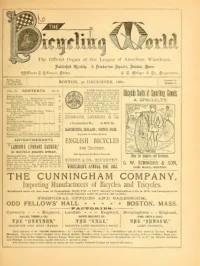
Articles in this issue
- New Year greetings open a column of short notes: the Prince-Keen race is set for the New England Manufacturers' and Mechanics' Institute (the Institute Fair Building, with a six-lap track) not later than 14 January, the Boston Bicycle Club holds a reception at its club house on 2 January, Chicago's Louise Armaindo challenges Elsa Von Blumen for the female championship, and Philadelphia's Vesper Boat Club plans a Fairmount Park club house with stalls for nearly two hundred bicycles.
- Second instalment of a tour reprinted from the Marblehead Messenger: the riders visit Concord's elm-bordered streets, the Summer School of Philosophy, the Alcott House and the State Prison with its six hundred convicts, then wheel through Acton, Maynard, Sudbury and Saxonville to Framingham, camp with Captain McClearn and tea with Major Anderson, and return home via Natick, Wellesley, Boston and Swampscott to Marblehead.
- Under first lieutenant Shillaber, and joined by several Crescents, the Massachusetts Bicycle Club rode about nineteen miles on Christmas morning from headquarters through Roxbury, Dorchester Mills and Mattapan; the frozen, rutty ground on Cliff street produced the day's first header, while the newly paved mile-and-a-half stretch from Dorchester to Mattapan was pronounced superb.
- "Steno.'s" Correspondence letter from Chicago reports the city's conservative South Park board has opened the parks to bicycles with full carriage privileges won through club influence, the Chicago Bicycle Club has framed rules enforced by fines, and repairman Mr. Jeffery is praised for rebuilding a D. H. F. Premier with a new steel axle and improved ball bearings for $18; the riding school's elderly learners are noted to learn as quickly as the young ones.
- "B." of Detroit continues the rubber-tire debate, endorsing G. W. Pressey's practical experiments toward a flattened or oval tire over the standard round form, proposing pulley-and-weight tests of rolling resistance over small obstructions, answering the theoretical objections of "Cyclos", and urging makers to send out each machine with its spring adjusted to the rider's weight.
- "Icycle" reports that Washington's riders have grown from the original seven to over two hundred in two years, gliding over smooth concrete to splendid suburban roads; the Capital Club (about forty members) and the Arlington (about twenty) lead the scene, Baltimore riders' experience shows barely one horse in five hundred miles frightened, and the city is urged as the most suitable place for the League meet.
- Responding to "Ixion's" article, a correspondent judges the Yale the stiffest machine of any weight he has seen, praising its tangent spokes, D. S. H. R. rim and elliptical backbone, but questions whether its extreme lightness can last against heavier machines like the Harvard, Matchless or Timberlake, and asks for reports from riders who have given a Yale or Modern Invincible a 2,000-3,000-mile trial.
- W. D. Wilmot, secretary of the Framingham Bicycle Club, recounts riding through an entire winter: a monthly coating of vaseline kept rust away, a Christmas-night run of twenty-two miles to Boston was made through fresh snow, he logged one hundred and one December miles and 1,960 miles since 1 January, and he found the hub mount indispensable in snow while his 54-inch Standard Columbia outcoasted every other machine.
- A fifty-mile race at the American Institute Rink in New York on December 19, fraudulently billed as the amateur championship of America, was won by G. D. Gideon of the Germantown, Pa., Bicycle Club in 3h. 13m. 8¾s.; fifteen-year-old J. Howard, riding a borrowed Columbia roadster with old-fashioned cone bearings, finished just two laps behind Gideon despite having been a full mile behind at the ten-mile mark.
- John Keen's engagements in England push his meeting with John S. Prince forward to about 14 January in Boston's Institute Fair Building: a ten-mile straight-away race open to all comers covering the $100-a-side forfeit, with no championship at stake since both men agree titles won on covered board tracks are doubtful honors; preparations for the six-day bicycle tournament under Boston Club auspices continue.
- Robert Patrick of Wolverhampton, England, offers to take one hundred yards' start from American champion John Prince over five miles, or to ride F. Rollinson of Chicago level over the same distance, for $50 a side or upwards on any fair track.
- John S. Prince, champion of America, replies to Mr. Rollinson's 12 December letter, insisting that Rollinson send his $100 forfeit rather than continue what Prince calls tiresome racing on paper.
- Louise Armaindo of the Bicycle School, Michigan Avenue, Chicago, formally challenges Elsa Von Blumen or any lady bicycle rider in the world to a race of twenty-five to one hundred miles for $100 to $250 a side or a championship medal; a following note reports San Francisco Bicycle Club president Columbus Waterhouse and ex-president R. De Clairmont preparing a club run to San Jose.
- The League of American Wheelmen department reprints joining instructions — fees payable to Dillwyn Wistar of Philadelphia, applications to corresponding secretary Kingman N. Putnam of New York — and publishes new membership applications from the Keystone Bicycle Club of Pittsburg (T. S. B. Wood and John C. McCullough) and unattached rider O. L. Hurlbut of Chattanooga, Tenn.
- Missouri Bicycle Club president Richard Garvey visited Coventry's major factories during an English trip and was received at The Cyclist's office; notes also cover a Cheltenham court case where a farmer who drove his horse-and-trap into a well-lit tricycle was fined £2 11s. 6d., and a discussion of whether handicappers who accept fees should be classified as professionals.
- G. D. Gideon won the fifty-mile race on a Harvard semi-racer; sixteen-year-old J. Howard, who finished second on a borrowed cone-bearing Columbia, is urged to be presented with one of Pope Manufacturing's best machines; the Bicycle Touring Club expelled member A. H. Llewellyn Winter following a council inquiry into his conduct.
- A Salem Post writer reports a triocycle trip from Salem to Gloucester and back (32 miles) in three hours and twenty minutes of riding over frozen roads, noting the triocycle outperformed a bicycle on rough surfaces; the New York Sun comments that English-promoted bicycle racing has repeatedly failed with American audiences and suggests the League of American Wheelmen should organise such events instead.
- Reviews include Our Little Ones (Russell Publishing, Boston) for January 1882 with illustrated holiday verses and stories; Vick's Floral Guide for 1882, a 130-page illustrated annual with two full-page colored plates for ten cents; and The Century for January featuring a Thiers portrait engraving by Cole after Bonnat and Mary Hallock Foote's Mexican papers.
- The Notes and Queries section presents reader responses on bicycle lamp fuel, with two riders endorsing a two-thirds lard and one-third kerosene mixture as brilliant, cool, and easy to light; two further correspondents evaluate the British Challenge bicycle, one praising its rigidity and spring-cushioned brake behavior, and another noting it suits lighter riders while heavier men should consider alternative machines.
- A sentimental poem reprinted from the Bicycling Times mourns winter's end to cycling, recalls a joyful summer romance shared on a double tricycle through rural lanes, and concludes with the melancholy discovery that the beloved has married another.