The Bicycling World, Vol 5, No 10
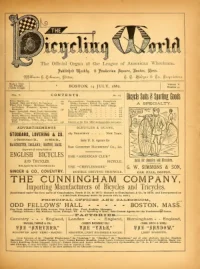
Articles in this issue
- The Notes and Queries column answers correspondents: League clubs may hold races at county fairs if conducted per L.A.W. rules; readers seeking tricycle advice are directed to Henry Sturmey's Indispensable; and Prof. F.S. Rollinson provides detailed instructions for constructing a proper bicycle race track, requiring a clay base, brickbat foundation, and sieved-ash surface, at a cost estimated under $400.
- Editorial recommending that seashore wheelmen of moderate means have the felloes, spokes, hubs, forks, and backbones of their machines painted rather than nickel-plated: street-sprinkling carts draw their water from the sea, and the salt mud absorbed through the plating leaves permanent rust stains that paint resists.
- Editorial noting that Boston-area bicyclers have long enjoyed respect and equal road rights, but that some, now that bicycling is a fixture, are becoming arrogant and rude toward drivers and pedestrians; it cites a recent dispute over the fifteen-cent admission at the Point of Pines resort on Chelsea Beach and urges wheelmen to conform to such rules and set a better example.
- Club news: the Middlesex Bicycle Club of Malden ran to Salem via Swampscott on Independence Day; the new Hudson-on-the-Hudson Club organized 2 June under president Charles Gifford; the Worcester Club re-elected Waldo Lincoln and adopted a green-velveteen uniform; Percy Doolittle's Aylmer (Ont.) Club plans a trip to Buffalo via Brantford and Niagara Falls; the Xenia (Ohio) Club voted to join the L.A.W. and ran to Yellow Springs; and the Brunswick Club of New Brunswick, N.J. toured the Orange Mountains.
- Race reports from the Springfield Bicycle Club's July 4 meet at Hampden Park: the competitive drill was won by the home team over Holyoke, New Haven, Natick, and eight other clubs; the one-mile went to J.Q. Hatch of Boston in 4m. 01s.; and seventeen-year-old Yale student L.B. Hamilton of Waterbury won the five-mile in 22m. 30s., beating a larger field in rainy, heavy-track conditions. Further reports cover Battle Creek, Steubenville, Louisville, Utica, Williamsburg, Staten Island, Baltimore, Brantford, the English 25-mile professional championship won by R. James, the Bicycle Union's disciplinary order, and a Keen-Prince challenge.
- Letters: a Poughkeepsie correspondent reports nine or ten new riders at Newburgh and warns tourists that the Hudson steamer Mary Powell charges $1.25 to carry a wheel; S.G.B. of Marietta, Pa. disputes F.B. Wells's claimed 90-mile run to Philadelphia; Syracuse describes a rain-soaked run with Vice-President Parsons; C.B. Longenecker of Lancaster denounces English maker Ford & Co. as unreliable; a Marblehead rider praises the road to Manchester-by-the-Sea; and L.A.W. President Bates contributes a comic account of the speech he never delivered at the Chicago banquet.
- League of American Wheelmen department: membership terms and Hand-Book details, followed by corresponding secretary Kingman N. Putnam's list of applicants, including additions to the Marietta, Meteor (Detroit), and Philadelphia clubs, the new Ovid (Mich.) club, the Somerville (Mass.) club roster, unattached riders from Louisville to Biddeford, and corrections to the Woonsocket and Syracuse lists.
- The second installment of 'Along the Potomac' (by Kol Kron) describes the final day on the Chesapeake and Ohio Canal towpath from Point of Rocks to Washington: stones, sand, mud, and waded waste-ways allowed rarely more than half a mile without stopping; the day's 51 miles brought the tour's total to 180 miles from Frederick; the 184-mile towpath between Cumberland and Georgetown offers lodging only at Hancock, Williamsport, Harper's Ferry, and Point of Rocks.
- Brief items: Boston Club members make their usual Saturday run to Canton and return Sunday; L.A.W. members are reminded polls close Saturday July 15; Capt. Miller of the Chicago Bicycle Club reports the city's parks and boulevards were permanently opened to wheelmen after the L.A.W. Meet; H.E. Parkhurst of the Massachusetts Club embarks on a two-year European bicycling tour; and Frank W. Weston's English party sails on the Samaria on Saturday.
- A scientific article from the Oarsman (by J.G.P.) explains why a bicycle carries a rider farther and faster than walking despite the extra weight: like an ice-boat sailing at an angle to use the wind's force, the bicycle's wheel converts wasted muscular energy into forward motion, covering three or four times the distance per unit of effort on level roads; hills and sand are the bicycler's bane, but a smooth slope is paradise.