The Bicycling World, Vol 5, No 20
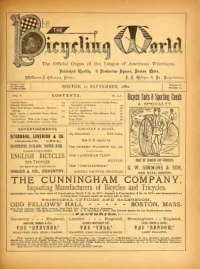
Articles in this issue
- Editorial weighing the merits of bicycle bells over loud gongs, praising the quiet, easily-removed English spherical "sleigh" bell and Challis's stop-bell, and noting the American "Automatic Alarm" gong as a popular home-grown alternative.
- Club-news roundup: Boston Bi. Club and Massachusetts Bi. Club list their September fixtures; the new Sacramento Bi. Club (formed 24 August, President Douglas Lindley) and Montreal Bi. Club (monthly mileage report, plus a 3-mile race at the Caledonia sports won by F. C. Holden) file reports; and the Chicago Bicycle Club votes to change its uniform color and accepts an invitation to races at Waukegan, Ill.
- Race-calendar notices for late September and October: bicycle races at the Essex County fair in Haverhill, Mass.; a Manhattan Athletic Club handicap in New York; Montreal Amateur Athletic Association championship races; and meets at Stenton, Pa. and Philadelphia's bicentennial celebration.
- Report on the Boston Bicycle Club's third annual twenty-mile championship at Beacon Park on 16 September, won by Lewis T. Frye (his first race since a serious road accident) in 1h. 15m. 34s., breaking W. W. Stall's record, with F. Morris second and W. H. Edmands third by four and a half seconds.
- Covers the 13 September amateur and professional races at Beacon Park: English amateur Frank Moore of Birmingham wins the ten-mile handicap and breaks several American records, while J. S. Prince beats Thomas Harrison and J. E. Mellen in the five-mile professional handicap by two-fifths of a second; trailing notes report J. S. Dean's retirement from racing and the New York Clipper's questioning of V. C. Place's amateur status over a proposed match race against the pacing horse Ben Hamilton.
- Correspondence from Massachusetts Chief Consul Fred S. Pratt defending the L.A.W.'s quiet post-Annual-Meet period as a natural lull, and detailing the League's plans for consul-supplied route maps, roadside guide-boards, and a two-day State run for members.
- A skeptical letter signed "Aeolus" argues that L.A.W. membership alone confers no real distinction or respectability, citing the two hundred riders at the recent Worcester meet as evidence, and proposes organizing wheelmen into five or six regional "leagues of clubs" instead.
- A Baltimore correspondent signed "m.b.c." argues for small, socially select clubs over large ones effectively run by a bicycle agent for his own commercial benefit, contrasting his own thirty-to-forty-member club unfavorably with a smaller, ten-member rival.
- Letter signed "G.M.F." compares the historical refinement of racing-shell rowing equipment (Walter Brown's sliding seat, lighter outriggers, paper-built hulls) to the still-underdeveloped state of American-made bicycle parts, which cannot yet match English patterns.
- A Springfield, Ohio correspondent signed "B." rebuts an earlier "Falstaff" report that the Champion City Club was withdrawing from the L.A.W. over the Columbus meet, denying the club authorized any such statement and praising Columbus's "Buckeyes" for a successful gathering.
- "Kol Kron" argues railroads should carry bicycles free as baggage at tournament time, citing the Baltimore & Ohio and Pittsburgh, Columbus, Cincinnati & St. Louis lines as good examples, and criticizes the Springfield Bicycle Club's tournament circular for vague, misleading reduced-rate wording.
- A column of humorous one-line squibs signed "I.XION" on bicycle costs, rough American roads, and a satirical exchange about tricycle skirts, followed by a blow-by-blow account of a Manhattan Athletic Club fifty-mile race in which V. C. Place's Burleigh roadster beats "Shadow" Hamilton's American Star.
- "London W." replies to correspondents "Chic" and "Geesee" over a dispute about Mr. Pitman's amateur status and the L.A.W./B.T.C., then advises touring cyclists to wear serge or flannel rather than linen and complains that Coventry Convertible tricycles need better-fitted tires, recommending Hancock's.
- Signed "Mech.," this letter argues American bicycle manufacture is held back by the Pope Manufacturing Company's control of backbone-tubing patents, estimates Pope's royalty profits at roughly $280,000, and calls for a free market so American makers can compete with English firms like Bayliss, Thomas & Co. and the Coventry Machinists' Company.
- Reports on the founding of the League of New Hampshire Wheelmen at a Portsmouth meet organized by Chief Consul Hazlett; about 27 wheelmen rode the New Hampshire shore on Sunday and paraded through Portsmouth on Monday; at a dinner at the Rockingham House, the State League was organized with C.H. Wilkins of Manchester as secretary, making it the first State League to organize under the national L.A.W.
- League of American Wheelmen membership applications from Cleveland, Detroit, Zanesville, Boston Ramblers, Cincinnati Wanderers, Pioneer, and Massillon bicycle clubs, plus several unattached riders including one from Salisbury, England.
- A Washington correspondent describes A. H. Overman of Hartford, Conn.'s new double-driving, front-steering Victor tricycle, with 50-inch wheels and a Harrington's cradle-spring saddle, judging its finish as good as the best English makes.
- Reports that importer Weston will bring Bayliss, Thomas & Co.'s Victa Harvard (based on the Victa Excelsior) to the U.S. as a double-driving front-steerer with Stanley rudder-head steering and ball bearings throughout, and that John M. Fairfield of Chicago has returned from England with sample National and Premier tricycles while the Pope Manufacturing Company plans its own National-style tricycle; trailing notes add John Hawkins Jr.'s 113-mile sociable-tricycle ride to London and Alfred Nixon's 1,007-mile John o' Groat's-to-Land's-End tricycle ride.
- Personal notes include L.A.W. President Miller's daughter riding a tricycle, Lewis T. Frye's return to the Beacon Park race track, the Boston Ramblers' moonlight Canton run, Frank Moore's plan to return to England at month's end, a Grand Rapids club's tour of Michigan and Canada, and the Prince vs. Morgan 100-mile race set for the Boston Casino in November with Morgan receiving a 1-mile handicap.
- A poem signed "Geesee" of Marblehead, Mass. (8 August 1882) addressing the rider's bicycle as a gleaming, mysterious steed that glides past field, wood, and shore, casting an irresistible magic spell over its rider.