The Bicycling World, Vol 5, No 25
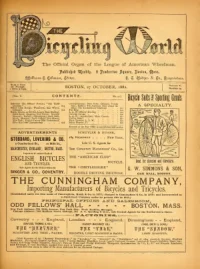
Articles in this issue
- The leading editorial argues that Rule 36 vests dangerous power in the L.A.W. board, after just seventeen officers at the Boston meeting changed the amateur rule — a quorum of eight in New York could rewrite the whole constitution; a second leader rebuts 'The Tariff Question' article in the October Wheelman, calling it a special plea for the Pope Manufacturing Company and backing the wheelmen's petition to reduce the duty on steel and bicycles.
- The Star Wheel Club forms in East Rochester, N.H. with Frank B. Parshley president and Elbridge H. Corson captain; the Wanderers' Bicycle Club organizes in Toronto under President Lieut.-Col. Otter with sixteen members; and thirteen Taunton, Mass. wheelmen found the Cohannet Wheel Club with George E. Whitehead president and John M. Hardy captain.
- At the L.A.W. fall race meeting at Beacon Park, Boston, on 20 October, George M. Hendee of Springfield beat champion Lewis T. Frye in the one-mile championship (2m 57 1/5s) and V.C. Place of Greenville, Pa. won the five-mile open in 17m 39s; other results come from Great Bend (Binghamton Bicycle Club), Emporia, New Haven, Montreal and Columbia College, with R. Howell winning the English twenty-mile professional championship at Leicester and W.M. Woodside the fifty-mile Irish championship at Phoenix Park, Dublin.
- 'Chic' of New York celebrates Will R. Pitman's admission to the League and mocks the Columbia College handicap won by R.C. Kemp; the Chicago letter describes the new six-lap cinder track at Pullman on Lake Calumet; further letters cover the Buffalo club's tournament, the American Star's first-premium medal at the Cincinnati exposition, 'Jumbo' of St. Louis attacking the standing start, and a rider's long defence of the 'Xtraordinary Challenge against Julius Wilcox's criticisms.
- A poem by J. Park Street likening the beginner's tumbles and eventual mastery of the bicycle to the legend of the king who cast his ring into the sea, only for a fisherman to recover the gem.
- The League board meets at the Hotel Vendome, Boston, filling vacancies (Beebe for South Carolina, Dodge for the District of Columbia, Bates for Indiana, Beddo for Kentucky, Carpenter for Rhode Island); treasurer W.V. Gilman reports receipts of $1,717.88 and 1,408 active members; amendments to the track-measurement and amateur rules (25 and 26) are adopted, a racing board elected, and Will R. Pitman admitted to membership.
- Paragraphs note the Boston and Providence clubs fraternizing, a projected six-day professional championship of America in New York, President T. Sedgwick Steele's gift of a silk flag to the Connecticut Bicycle Club, the Star Wheel Club's planned run from East Rochester to Boston, and C.L. Clark as the only officer to vote against changing the amateur rule.
- C.J. Holland and W.L. Jackson of Medford, members of the Tremont Bicycle Club of Boston, ride 154 miles on 22 October via South Framingham and Gloucester in 20h 30m running time — claimed as the longest one-day run by any bicycle club in America.
- Corresponding secretary Kingman N. Putnam publishes membership applications from the Dunkirk Bi. Club, Nashua Wheel Club, Cortlandt Wheelmen of Peekskill and unattached riders; Chief Consul Fred S. Pratt lists ten new Massachusetts consuls, including Lewis T. Frye of Marlboro' and Adams D. Claflin of Newtonville.
- 'London W.' reviews the fall meeting — only eighteen of the sixty-five officers answered the roll-call — consoles Lew Frye on losing the championship medal to Hendee, credits trainer Prince (whose graduates include Moore, Underwood and Dean) with Hendee's form, and argues against adopting the flying start in bicycle racing.
- Thirty-eight riders headed by Chief Consul Pratt, with President Miller of the Columbus Buckeyes and Chief Consul Lamson of Maine among them, wheel from Trinity Square, Boston to South Canton, where the Massachusetts Division of the L.A.W. is organized with F.P. Kendall of Worcester as secretary and C.P. Shillaber as treasurer, and a committee is appointed to erect road signs.
- Julius Wilcox examines the Facile — a lever-driven safety with a 32-to-52-inch front wheel, 22-inch back wheel and three-inch crank — working out power and foot-travel comparisons against a 50-inch ordinary, citing its road records including 214 1/2 miles in a 24-hour race, and noting his 44-inch specimen is the only Facile yet in America.