The Bicycling World, Vol 5, No 6
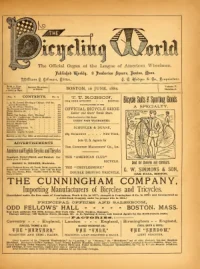
Articles in this issue
- Full report of the League of American Wheelmen's second annual meeting, held in Chicago on 30 May 1882 under Vice-President J.M. Fairfield after President Charles E. Pratt's resignation: delegates revised the constitution and election rules, adopted the Lamson League badge, and elected W.H. Miller of Columbus president, A.S. Parsons vice-president, Kingman N. Putnam corresponding secretary, and William V. Gilman treasurer, along with a full slate of state directors and standing committees. A floor fight over the four Boston Bicycle Club members seated as Crescent Bicycle Club delegates dominated the credentials vote, and the meeting closed by declining consul E.R. Shipton's proposal to pool dues with England's Bicycle Touring Club.
- The L.A.W. board of officers convened at the Grand Pacific Hotel, Chicago, on 29 June, with Vice-President Fairfield presiding over seven directors including Hodges, Putnam, Garvey, and Kitchell. The board endorsed the membership committee's rejection of W.R. Pitman of New York and William Smith of Bristol for misrepresentation, reviewed the correspondence with the National Athletic Association, approved the Lamson L.A.W. badge and revised constitution, and appointed committees on credentials and nominations before adjourning.
- Secretary J.S. Dean of the Boston Bicycle Club writes to the Crescent Bicycle Club explaining that their four delegates — Everett, Clark, Barrows, and Dean — were excluded from voting at the L.A.W. Chicago meeting after A.S. Parsons challenged their right to represent a club of which they were not members. The Crescent Club formally endorsed its delegates' actions, maintaining that the League's ruling violated Rule 9 and was taken without proper parliamentary procedure.
- Answers to correspondents include an estimate of Corey Hill's grade near Brookline (205-foot vertical rise over about 2,000 feet, averaging one foot in ten), a ruling that amateurs may compete in races with entrance fees under L.A.W. Rule 25 but that 'winner's choice' money prizes are questionable, and a note about Pennsylvania bicycle road laws. A reader from Pittsburgh inquires whether a head-light device made by E.K. Pflueger of Akron, Ohio is of any practical use.
- Lists upcoming amateur and professional bicycle races: a ten-mile and half-mile amateur race at Druid Hill Park, Baltimore (17 June); Keystone Bicycle Club championship races in Pittsburgh and Kentucky Bicycle Club handicap events in Louisville (both 24 June); Norwalk, Connecticut amateur and professional races (28–29 June); a two-mile handicap at the American Athletic Club games in New York (1 July); and a grand four-event bicycle tournament at the Springfield, Massachusetts skating rink (4 July) with prizes valued up to $200.
- Announces coming runs by Boston-area clubs including the Crescent Bicycle Club's seashore run to Marblehead (17 June) and the Roxbury Bicycle Club's two-day ride to Gloucester via Lynn and Salem. Also reports the newly organized Ovid Bicycle Club of Michigan, with Charles Reeves as president, and the Westboro' Bicycle Club of Massachusetts — formed 28 April with eleven members under President Walter Blanchard — which has rooms in Union Block and a uniform of dark-green cap, light-olive shirt, and dark-green knee-breeches.
- Instructs wheelmen on joining the League of American Wheelmen ($1.00 admission, or 50 cents for members of qualifying clubs), with applications directed to Corresponding Secretary Kingman Putnam at 54 Wall Street, New York, and annual dues to Treasurer William Gilman of Nashua, N.H. Publishes new membership applicants from Illinois, Pennsylvania, Massachusetts, Nebraska, New Jersey, New York, and Washington, D.C., and warns that members failing to pay annual dues by 15 July 1882 will be stricken from the roll and must return their badge.
- The Hamilton Bicycle Club held its monthly meeting on 19 May, admitting three new members and finalizing a grand bicycle tournament for Dominion Day, 1 July, in conjunction with the Irish Protestant Benevolent Society picnic. The programme includes one-mile and five-mile races with gold and silver medals, fancy riding, and club drill, with a morning parade headed by the 13th Battalion Band to Crystal Palace Park and an afternoon procession to Dundurn Park; Canadian clubs and American wheelmen are cordially invited.
- Twenty-four members of the Kings County Wheelmen and Brooklyn Bicycle Club made a Decoration Day run to Orange, New Jersey via the Pennsylvania Railroad, where Captain Johnson and members of the Orange Wanderers met and escorted them over what the writer calls the finest roads in the United States, with a side trip to Montclair for milk and soda before dinner at the Mansion House. The party returned to Brooklyn by train at 6:50 p.m., all declaring it one of the most enjoyable runs they had ever taken.
- The Bremen Bicycle Club reports three club runs in spring 1882: to Oberneuland via Horn, to Vegesack and back (21 miles, with bad roads and a stiff headwind), and a 45-mile ride to Ottersberg via Worpedorf and Kirchtimbreken, where the party endured a notoriously rough stretch of sandy moorland road near Steinfeld before reaching good macadam and arriving in Ottersberg in 57 minutes. Secretary Norman Leete, now in London, has resigned and been replaced by Robert Carew.
- A Philadelphia newspaper item reports plans to convert the former centennial and machinery building grounds in West Park into a public concourse with a 100-foot carriage drive, a 30-foot equestrian circuit, and a pedestrian walk. The Park Commission discussed reserving an inner lane of at least 15 feet for bicycle divertisement, positioned safely away from horse traffic, pending appropriation of funds to clear the building debris and lay out the avenues.
- The cyclists depart Longford and ride over 80 miles to Dublin in a single day, passing through Edgeworthstown (birthplace of novelist Maria Edgeworth), along Lough Owel in Westmeath, through the garrisoned town of Mullingar, Kilcock, and Maynooth College before arriving in Dublin at 9 p.m. The author concludes with practical touring advice: thirty miles a day is ample for an extended tour, early morning hours are best for riding, and one or two companions are the ideal party size.
- Brief news notes include the announcement that The Bicycling World has been appointed the official L.A.W. organ for the coming year; the Troy and Albany clubs plan a joint run to Stillwater on 4 July; and about twenty Boston Club members made a gaslight run around Barnum's elephant Jumbo one Wednesday evening. Ex-Recording Secretary Samuel T. Clark of Baltimore has returned from visiting English bicycle manufacturers and imported a comprehensive stock of English machines for sale at 105 South Street.
- The editors compare British amateur and professional racing records from three competing 1882 annuals — the Cyclist & Wheel World Annual, the Wheelman's Year Book, and the Bicycling Times Annual — finding close agreement on amateur times but notable discrepancies in professional tables at 3–5-mile distances. Questions are raised about the claimed records of John Keen and Fred Cooper, who have failed to beat Howell in direct races despite faster stated times, and no published annual credits De Civry for beating Keen at 11–16 miles in August 1881.