Vol 52, No 9
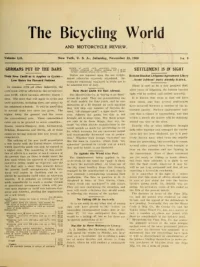
Articles in this issue
- Sets out the revised German tariff taking effect 1 March and its schedule of duties on cycles, motorcycles, tires and parts, noting the lower conventional rates granted to Russia, Austria-Hungary, Italy, Switzerland, Belgium, Roumania and Servia and the lack of a new treaty with the United States.
- The Mead Cycle Co. is pushing hard into the export trade, guaranteeing its models for four years and shipping any number of bicycles "all charges paid" on a $5 deposit, while boasting that no other maker spends as much on advertising.
- With the wood rim "pool" applying the thumbscrews, H. G. Shepherd & Sons of New Haven, Conn., whose rim-bending machinery is still intact, is considering resuming production and easing the market.
- The paper's Australian correspondent, writing 17 October, reports no special indications of a falling off in the coming season's trade.
- L. J. Mueller, the Cleveland, Ohio, dealer, is taking motor bicycles and tricars to Palm Beach, Florida, for the winter to run a motorcycle livery there.
- Conferences among the bottom bracket litigants suggest the long patent fight will be settled within a month, just as Pope Mfg. Co.'s patent No. 392,973 expires; the Miami Cycle & Mfg. Co., the Crosby Co. and the Toledo Metal Wheel Co. are the nominal defendants and several jobbers' suits are already adjusted.
- A technical account of the two-cycle motor for motorcycle use, crank-case compression, port timing, deflector-plate scavenging, and the double impulse per revolution, set against the four-cycle engine's better thermal efficiency and the two-cycle's poor throttling and irregular firing.
- Sidney A. Grant of Enfield, Conn., who claims to have invented the first chainless bicycle, recounts sinking $118,000 in the League Cycle Co. before it failed and Pope Mfg. Co. bought the patents, leaving him with two Springfield flathouses to show for it.
- Describes an English motor bicycle of about 60 pounds with a two-cylinder horizontal opposed 2 3/4 horsepower engine of 2 3-16 inch bore and stroke, clamped between the saddle post tube and lower frame strut, with chain drive to a countershaft, friction clutch and flat belt to the rear wheel.
- Warns that storing a bicycle in a continuously heated room over-vulcanizes the rubber until the tires crack, while freezing does little harm, one cyclist who left his machine in a woodshed all winter got five years' service from the tires.
- Andrew Kinloch, a dealer at Paterson, N. J., lost about $100 worth of goods when burglars entered his shop over the weekend, stock he had packed up and meant to remove the following Monday.
- An Essex man advertises a three-roomed cottage and five plots of land in exchange for a light, low-framed 1905 motor bicycle.
- Urges dealers to lay Christmas plans now, stocking mechanical toys, pedal-propelled toy wagons and automobiles, rubber-tired velocipedes and juvenile bicycles, and to dress and light their windows properly instead of cramming them with a jumble.
- Argues that Germany's new rates are fair notice that two can play the high-tariff game, and that American makers, long able to meet any competition, have been harmed rather than helped by protection.
- Blames complaining dealers for carrying no stock of ordinary sundries, citing failures to buy single-tube repair plugs on a travelled Long Island road, a patching kit, an emergency chain link, a telescopic pump and a Billings & Spencer wrench.
- Urbain McDonald of the Tiger Wheelmen won the one-mile home trainer race in 1:17 3-5 at the Roy Wheelmen's first entertainment and ball at Tammany Hall, beating Gustave Duester, Edward Fanning and Anthony J. Revello, while Charles Sherwood of the New York A. C. set a 1:12 3-5 record on the same rollers.
- Urbain McDonald took the Tiger Wheelmen's 1906 club championship over nine races with 93 points, winning the Gliesman cup, while runner-up George B. Hunter's 70 points earned a gold medal; the club's roll has roughly doubled under president Harry A. Gliesman.
- The Brooklyn Motorcycle Club will bar riders under 135 pounds from its 25-mile handicap road race, requiring lighter men to carry ballast, with a 10 minutes 25 seconds handicap limit and gold medals for first place and best time.
- Richard Phillips, off 45 minutes, won the Bay City Wheelmen's forty-mile San Francisco to San Jose road race on 12 November; Charles McLaughlin, off twenty-five minutes, made fastest time of 1 hour 53 seconds.
- The San Francisco Motorcycle Club added 18 names at its November meeting to reach 80 members and has taken clubrooms in the Jefferson Square Building on Golden Gate avenue.
- Serge Outochkine, one of Russia's champion riders, is not expected to live after being attacked by a revolutionary mob while trying to save a Jewish shopkeeper.
- C. W. Risden of Los Angeles, who held the roughly 500-mile Los Angeles to San Francisco road record until H. P. Christopherson broke it, has challenged Christopherson and all comers to race over the course.
- Previews the six-day race at Madison Square Garden, 4-9 December: teams must ride in chosen colors to help the scorers, $350 is offered in lap prizes, purses run from $1,500 down to $200, and the entered teams are listed from the Belgian-Holland pair of Vanderstuyft and Stol to the Irish Keegans.
- The Manhattan Beach track has been dynamited and carted away for building lots; veteran Will Pitman rode a last circuit of it shouting "Dago! Spare that track!" and carried off pieces of cement bearing the painted finishing mark.
- Tommy Hall, the English pace follower teaming with Boston amateur Matthew Downey for the six-day race, has attached the receipts of the Frankfort track over prize money he alleges is unpaid.
- New York dealer and rider Harry A. Gliesman recounts a Sunday run to Southampton, L. I., ruined by a loose driving sprocket, repeated punctures, nine dismounts from one battery wire, a lost switch plug and watch fob, a broken lamp bracket and cyclometer, rain, and a garage boy caught pouring oil into his gasolene tank.
- Indoor flat-floor racing at the 65th Regiment Armory in Buffalo on Friday 17 November drew a one-mile novice won by H. S. Sykes of the Ariel A. C., a two-mile handicap won by E. Koch, and a five-mile open in which Fred Schudt of the Standards beat Charles McCracken in 14:10 1-5.
- The eccentric "Karl Kron", Lyman H. Bagg, author of "Ten Thousand Miles on a Bicycle", has appeared at Blairgourie, Scotland, on his familiar 52-inch nickelled Columbia ordinary, telling the Scots he set out on 24 April 1884.
- P. A. Dyer, who twice paid personally for prizes, steps down as president of the Century Road Club of America; A. G. Armstrong of New York is slated to succeed him, with H. F. Watrous, Albert D. Rice, Harry Early and Fred E. Mommer on the national ticket.
- Daniel M. Adee of New York City and Metropolitan, L. I., has been renominated as president of the Century Road Club Association despite wanting out, with Paul Thomas, F. Breit, Lee E. Ferguson and Dr. A. C. Griffin on the slate; the election runs by mail vote from 1 to 18 December.
- Traces calcium carbide from Wilson's 1888 process at Niagara through the failed British works near Birmingham and at the Falls of Foyers, explains that only the purest coke will serve, and describes how paraffine and sugar coatings slow deterioration and let a lamp be relit repeatedly.
- "L. H. R." of the Newark (N. J.) News, riding a bicycle for the first time in ten years, was bitten by dogs three times a block and blames the automobile for teaching dogs to snap at anything on wheels.
- John Casey, a ten-year-old Springfield, Mass., boy, was arrested for stealing bicycles and selling them for 25 cents apiece.
- W. E. Hawley, off 25 minutes, won the Dunlop road race from Warrnambool to Melbourne on 30 September in 7:52:26 for 165 miles from 197 starters, on single tube tires; the promoters forwarded riders' luggage by rail and fed them at six stations on 90 gallons of milk, 90 dozen bananas and 65 pounds of bovril.
- The Bay View Wheelmen of Newark, N. J., have bought the entire gymnasium outfit of the Elizabethport Turn Verein plus a home trainer from Root and Dorlon, and engaged Turner wrestling champion Theodore McLear as physical instructor.
- The French Association has recognized as world's records the old pace follower Bouhours's 1:37:53 for 100 kilometres and 2:45:30 for 100 miles, made behind a 30 horsepower automobile.
- The winter track in the Galerie des Machines may go at the end of December, when the season is at its height, because the Town Council has decided to pull down the 1889 exposition building.
- Examines a French engineer's theory that strained metal left to itself recovers its resisting power, and the crystallization theory used to explain otherwise inexplicable fractures of sound bicycle parts.
- A cyclist named Thibal, whose machine was allegedly stolen by Bidard, had to identify it among 2,000 at the Paris lost property office, was refused it because the ticket bore Bidard's name, was then indicted as Bidard, and finally gave the bicycle up as a bad job.
- Abstracts four grants: Arthur S. Allen's pneumatic tire with oppositely wound wire coils, Walter H. Cocks's motor-cycle brake, Waterhouse and Green's device for removing sediment from gasolene, and William F. Beasley's resilient tire core.