Vol 53, No 25
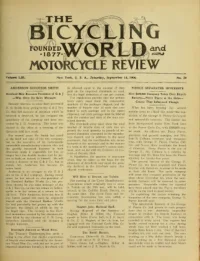
Articles in this issue
- H. O. Smith resigns the presidency of the G & J Tire Co. because his Indianapolis automobile manufacturing interests left him no time for it, and J. D. Anderson, lately vice-president of the Hartford Rubber Works Co. and once G & J's sales manager, is elected in his place. V. B. Lang, heretofore with the Morgan & Wright interests, fills the vacancy Anderson leaves at Hartford.
- The Treasury Department rules that bicycle rims manufactured by the American Wood Rim Co. with imported aluminum linings earn a drawback equal to the duty paid less one per centum, and sets out the package-labelling, consecutive-numbering and sworn-statement requirements, the latter on file with the Collector of Customs at Detroit, Mich.
- The Cycle Manufacturers' Association shifts its meeting of the 19th inst. from Toledo to the Cadillac Hotel, Detroit; the Cycle Parts and Accessories Association has called its own meeting for the same time and place.
- C. L. Hughes, having sold the Terre Haute, Ind., National agency of Hughes, Miller & Miller to J. E. Sayre & Co., has engaged with the National Cycle Mfg. Co. and will represent Nationals on the road.
- Trade changes of the week: H. O. Nelson of Coshocton, Ohio, sells his Main Street store to W. D. Tracy, and Hughes, Miller & Miller of Terre Haute, Ind., sell out to J. E. Sayre & Co.
- The George N. Pierce Co.'s cycle business is incorporated separately under New York laws as the $300,000 Pierce Cycle Co., with Percy Pierce president and general manager and William B. Colburn secretary and treasurer. George N. Pierce explains that the Buffalo automobile business had grown until the engines ran twenty-three hours a day and the bicycle side was crowded at every point.
- J. Harry Sager of Rochester, N. Y., of Sager saddle and Sager cushion frame fame, brings to New York a spring fork extension that bolts to any bicycle or motorcycle fork by a Y-shaped bracket and works on two 12-inch helical springs; he demonstrated its flexibility by running the machine violently against a wall.
- Worn cams, lifters and valve stem ends in long-run motors cut the effective lift of the valves and so the power, the inlet side least affected because it is not opened under pressure; the remedy is a complete renewal of the worn parts or building them up with patches, with an earlier valve setting as a temporary expedient.
- Motorcyclists are prone to blame the engine for every strange noise, but a loose, rattling chain on badly worn or misaligned sprockets is the most prolific source of the grinding, clanking and heavy pounding they hear.
- The Corbin Screw Corporation of New Britain, Conn., readies a semi-automatic two-speed hub that marries the Corbin coaster brake to a planetary change gear giving a four-to-three power increase, shifted simply by ceasing to pedal and needing no external levers; stripping the high speed clutch leaves a plain coaster brake.
- Salesmen cut their margins and make extravagant concessions chasing the big order; the writer urges dealers to depend on the little ones, arguing that the man who spends 25 cents a day at a good rate of profit is worth more over a lifetime than a $100 order won by concessions.
- Editorial on racing men who falsify entry blanks and steal prizes, taking as its text the Vailsburg "strike" of Sunday last, when the whole crew refused to ride because the lessee had substituted a motor-paced race for the usual professional events, blackmailing the very lawyer-sportsman who had rescued the abandoned track with his own money.
- Editorial arguing that several years' experience of the devices already on the market has proved the two-speed gear practicable as well as possible, and that with English riders long favouring two- and three-speeds, 1907 should be a record year for its development in America.
- Recommends scrubbing the chain in gasolene or kerosene and boiling it in strong lye to strip all old grease, then soaking it coiled flat in a melted tallow-and-flake-graphite mixture, which leaves a thin unbroken film good for several weeks.
- A touring motorcyclist found his machine hard to start and robbed of power; neither the motor nor the bearings were at fault but mud caked hard between the lower rear fork stays and the mudguard, picked up on sprinkled streets and then dusty country roads, which bore against the tire as an efficient brake.
- Insulating tape on ignition cables conceals the crystallization and breakage that vibration causes, leaving the defective part looking sound; the only way to solve the puzzle is to tug at the cable ends and unwrap any tape that appears loose.
- Reserve inner tubes should be kept cool, dark and uncramped, sprinkled with chalk or talcum powder and sealed air-tight in small tin candy or cracker boxes; outer covers want a shellacked box of their own, with heavy wrapping paper between them so any one can be removed without disturbing the rest.
- Professionals and even amateurs refused to ride at the Vailsburg board track on the 9th inst. before more than 5,000 spectators until manager Beers promised two professional races a meet, the grievance traced to John Bedell's resentment at not being asked to pace. The card that followed included Watson J. Kluczek's Tiger-Roy unlimited team pursuit against Urban McDonald and Martin Kessler, and James F. Moran's 25-mile motor-paced win over Pat Logan.
- Over fifty entries are already in for the Roy Wheelmen's 25-mile "Inter-State Cycling Derby" handicap of September 30th, run over the Merrick road from West's Hotel, Valley Stream, L. I., to Seaford and back, with 29 place and 8 time prizes and Will R. Pitman to referee.
- Plain clothes police in San José, Cal., made fifty-five arrests up to the first of September in a campaign against cyclists riding on the sidewalks, following a city-wide warning issued on Thursday, August 30.
- At the Vélodrome Parc des Princes, Paris, on September 2, the Italian motorcyclist Guippone won a 10-kilometre race in 5 minutes 49 3/5 seconds, 63.3 miles an hour, on a single cylinder machine weighing 110 pounds.
- Louis J. Mueller of Cleveland, Ohio, and George N. Holden of Springfield, Mass., dismounted at Columbus Circle on the 10th inst. after riding 2 1/4 horsepower Indians from San Francisco, cutting the cross-continent record to 31 days 12 hours 15 minutes over a registered 3,568 miles. Their account, continued over the following pages, covers the "gumbo" of Nebraska and Iowa, green scum drunk from desert pools, and Mrs. Mary Shannon's tirade near Laramie.
- Emil Leuly of Hoboken, N. J., of the New Jersey division of the Century Road Club of America, left at 4 a. m. on August 12th and reached Dayton, Ohio, on August 22nd, covering 935 miles; his best day was 112 miles from Montrose, Pa., to Corning, N. Y., and H. E. Fischer accompanied him as far as Niagara Falls.
- Harry Early of Jersey City, treasurer of the Century Road Club of America, rode 202 miles to Atlantic City via Philadelphia on September 2 and returned 101 miles via Tuckerton and Lakewood on Labor Day, completing the triple century in 34 hours 35 minutes.
- The Eastern Division of the Turn Verein Cycle Club of Brooklyn will run its third annual race meet at Rosedale, L. I., on Sunday the 30th inst., the programme comprising a ten-mile club handicap, a slow race, a 100-yards dash, a novelty race and a grand calamity race.
- A young Scotchman was haled before the nearest magistrate and made to pay for failing to ring his bell when approaching a policeman, the court regarding the omission as an insult to the uniform.
- Mayor Mott of Oakland, Cal., has signed a municipal ordinance requiring every motorcycle to be fitted with a proper muffler and to keep it closed while running within the city limits.
- Hiram Hinck of the Century Road Club Association won its 100-mile record run over Long Island roads on the 9th inst. in 5:46:53 from the 2 hour 20 minute mark, ahead of George Glunz, while Joseph M. Eifler took time honours in 5:44:04. A deputy sheriff ambushed riders taking the Hicksville side path and tackled club president A. G. Armstrong, and M. Walters was carried to the Nassau Hospital after his forks gave way at Rockville Center.
- Robert J. Walthour beat Louis Darragon, champion of France, in a three-heat paced match at the Vélodrome Buffalo, Paris, on the 2nd inst., taking the 30-kilometre heat in 24:10 4/5 and the 15-kilometre final; a week later at Lille he defeated Lepoutré by 30 metres and Antonie Dussot by 200 over 10 kilometres in 9:41 1/2.
- The New York Motorcycle Club sets its annual open regularity and speed judgment run for Sunday, Sept. 30th, 80 miles from New York to Bedford and return, with souvenir handlebar watches and holders for all who attain 75 per cent. on a 15-mile-an-hour schedule checked at four points.
- The Garden City Wheelmen and Motorcyclists of San Jose, Cal., held their semi-annual election, choosing Louis Normandin president and B. C. Dale vice-president, then sat down to a "Spanish feed" prepared by member Jack Dermody.
- Worthington L. Mitten, the Iowa "champion" and one-time Davenport farmer, beat Ben Munroe of Tennessee in both heats of a match race at the Salt Lake saucer track on Sept. 8 and was carried round for a "tour de honneur." The same card saw Samuelson beat F. A. McFarland easily in an unlimited pursuit and Iver Lawson take the one-mile professional handicap in 1:59 4/5.
- Over 20,000 spectators at the fourth annual municipal games in Patterson Park, Baltimore, on the 12th inst. watched an unlimited team pursuit between the Lafayette Wheelmen, Patterson Cycle Club, Curbstone Wheelmen and Crescent Bicycle Club, arranged by "Billy" Logue for a 12-inch silver cup; Howard L. Cole of the Lafayettes won after 5 3/4 miles in 16:45 2/5.
- A long telegram from Tom Eck, the famous old trainer now living in Winnipeg, Manitoba, prophesies a revival of bicycle racing, Eck arguing from the sudden return of roller skating that the game is only dormant in the United States.
- Alvin Loftus of Cranston, R. I., beat the Brockton rider Jud Small by half a wheel in 1:12:10 to take the first twenty-five-mile road race ever held at Brockton, Mass., on the 8th inst., promoted by the Brockton dealers and managed by George A. Gove and F. E. Churchill. C. Helander took time honours in 1:10:58, and Tom Panacy and Aubrey Goodrich collided on the last lap.
- Belated results of three Edgecombe Wheelmen championship club races run at Valley Stream, L. I., on the 2nd inst.: Emile Koster won the one-mile handicap in 2:58 and the five-mile in 13:38, and Albert Anderson the two-mile in 5:17, with one race still to be decided.
- Frank O. Ericson of Brooklyn won the ten-mile open motor bicycle race at the Richmond County fair, Dongan Hills, Staten Island, on the 8th inst. from William Wincabaugh and A. Jeanotte; A. G. L. Fritz of New York ran into the fence while "tickling" the carburetter of a borrowed Indian and broke his arm.
- For the first time in about five years St. Louis is to have a road race, the St. Louis Cycling Club arranging a twelve-mile club contest for early October, with a hare and hound chase planned for the latter part of next month and the once famous 20-mile Forrest Park road race to be revived next spring.
- "Jock," writing in the Scottish Cyclist, scoffs at the tourist who makes the bicycle a mere servant of photography, sketching or specimen-hunting, recounting a wearisome archaeological pilgrimage to Ightham, Kent, that ended among ugly chunks of stone and rusty fragments of iron. He concludes, all the same, that the man with an object is the wiser of the two.