Vol 53, No 4
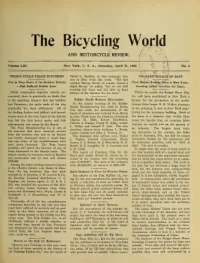
Articles in this issue
- The San Francisco earthquake and fire practically obliterated the city's cycle trade: the Pope Manufacturing Co. branch carried an immense stock and expects losses over $250,000, and the Fisk Rubber Co. suffered a double disaster when goods rushed up from its Los Angeles depot burned with the branch; Baker & Hamilton, J. W. Leavitt & Co., C. C. Hopkins and L. H. B. Bill were all in the swept zone.
- David L. Spraker reports that January and February were the best months in the history of the Kokomo Rubber Co., and that despite a bad March the works are running full force and full time to keep abreast of tire demand.
- The Rubber Goods Manufacturing Co. cut its board from fifteen members to nine at its Jersey City annual meeting, re-electing Charles H. Dale, Ernest Hopkinson, Charles A. Hunter, Frank W. Eddy, Arthur L. Kelley and Samuel P. Colt and adding Anthony N. Brady, Lester Leland and John J. Watson, Jr.; President Dale reported sales of $17,662,453, an increase of $207,768.
- The Fisk Rubber Co., acting for the tire manufacturers generally, obtained a cut in freight rates on rubber tires to Denver, Salt Lake City and common points, bringing the rate down to 43 1/2 cents per hundred pounds.
- Coil maker C. F. Splitdorf has leased the four-story building at 1679 Broadway, taking possession May 1st, where he will carry a full stock of Splitdorf coils and other ignition appurtenances.
- The Pope Mfg. Co. has let contracts for two additions to its Westfield, Mass., factory, one 60 by 100 feet and the other 50 by 150 feet.
- Within six weeks the Badger Brass Mfg. Co. will open a New York factory for the world-famous Solar lamp; treasurer R. H. Welles blames the Lamp Makers' Union at Kenosha, Wis., for capping output, a dispute carried without success to the International Carriage and Wagon Workers' Association and to Samuel Gompers at Washington.
- Both the Cycle Manufacturers' Association and the Cycle Parts and Accessories Association write a $10 fine for absence into their by-laws, a tax intended to secure full attendance and keep interest from narrowing to a 'certain few.'
- New stores: Matt Anheuser at Green Bay, Wis., and J. Saunders at 614 East Eldorado street, Decatur, Ill.; the Riverside Cycle and Sporting Goods Co. has moved from 860 to 960 Main street, Riverside, Cal.
- New York dealer Frank B. Widmayer, convalescing from pneumonia in Florida, reports bicycles, tricycles and 'niggermobile' wheel chairs everywhere at Ormond, Daytona, Palm Beach and St. Augustine, shell and marl roads including the 20-mile Ormond-New Smyrna stretch, and a Washington bicycle police squad of 70 men in a city he calls a cyclists' paradise.
- Hope Brothers, cycle agents in England, have begun selling bicycles on the installment plan, which the Irish Cyclist notes they appropriately term 'deferred payments', some purchasers will be living on Hope.
- A method for freeing a rusted screw: apply a red-hot iron to the head to heat it, then use the screw-driver immediately.
- Why a dry battery that lasts 2,000 miles on a single-cylinder machine dies at 200 on a two-cylinder: polarization and near-continuous short-circuiting; the article explains testing coil consumption with a pocket ammeter rather than a voltmeter and cleaning carbonized platinum contact-breaker points with emery cloth.
- The G & J Tire Co. will establish its own New York branch at 10 West Sixtieth street under Arthur T. Smith; until now its interests had shared the Hartford Rubber Works's branch.
- Veteran Louisville (Ky.) dealer Prince Wells has incorporated as the Prince Wells Co. with $5,000 capital and a $3,000 debt limit; H. L. Wells and M. Ehrle are named as incorporators.
- The Single Tube Automobile & Bicycle Tire Co. has moved its office from the Postal Telegraph Building at 253 Broadway to 42 Broadway, New York.
- Editorial urging cyclists to give according to their means to the stricken city, where dealers and riders alike have suffered sorely, and predicting that the 'free-masonry of cycling' will be rekindled by the disaster.
- Editorial cautioning the rider who has been cooped up all winter against a first spring run of double the sensible distance, and advising ten or twenty miles followed soon by a second ride rather than a long spell of idleness.
- Editorial proposing that a philanthropist buy, beg or borrow the old bicycles thrown on dump heaps and sold to the junk man each year, revamp and revarnish them, and give them to poor children who are anxious to ride but cannot buy a wheel.
- Lester R. Creutz and George E. Holt of Moline, Ill., have plotted their round-the-world route: leaving New York in June for Liverpool, then Britain, the Continent, Stockholm, St. Petersburg, Germany, France, Spain, North Africa, Italy, Greece, Egypt, India, Ceylon, Burmah, Singapore, Manila, Japan and Hawaii to San Francisco, about 50,000 miles, some 30,000 of them a-wheel.
- Race calendar from April 21 (North East Wheelmen's meet at Kensington track, Frankford, Pa.) through November 29, including the Irvington-Milburn twenty-five-mile handicap and the Salt Palace opening on May 30, the New York Motorcycle Club hill-climb, and the world's championships at Geneva, July 29-August 5.
- Bobby Walthour of Atlanta beat Tommy Hall by 19 laps and Menus Bedell by one mile in the 25-mile motor-paced opener at Revere Beach track, Boston, in 37:00 4/5 before some 5,000 people; the three new two-cylinder pacing machines worked for Walthour and Hall but Bedell's misfired.
- Nathaniel Hawthorne Butler, the elongated Cambridge professional, will remain in Europe all summer, riding at Leipsig on April 22, Breslin on April 29 and Cologne on May 6, where he stays for the rest of the season.
- Cambridge's Charles River Park track, practically dead for bicycle racing for some time, has been sold to a company that will develop the site for manufacturing purposes.
- A temporary St. Louis Cycle Club was organized at a meeting of the 'old guard,' with W. M. Butler as chairman and George Lang, Jr., as secretary; Robert Holm, once L. A. W. chief consul of Missouri, made a surprise appearance and predicted the bicycle's return to favor.
- The New Jersey legislature has passed the Frelinghuysen bill and the governor has signed it, effective July 1st; the House amended it considerably but the provisions affecting motorcycles are believed unaltered.
- The National Cycling Association's Board of Control has moved its executive office from Boston to New York, and chairman R. F. Kelsey has taken up his abode in the Flatiron building.
- William E. Samuelson has returned to Salt Lake City from Australia full of braggadocio; suspended a year by the National Cycling Association over a faked match race against W. W. Hamilton at Denver, he tells a Salt Lake paper he will not train unless given a free bill, 'no whitewashing for me; a clean bill, or Sammy don't ride.'
- Veteran William R. Pitman has been given leave to come home on May 30th to referee the Irvington-Millburn road race; a motorcycle is offered for first place, and nineteen prizes including bicycles, tires, lamps and coaster brakes are already secured.
- Floyd McFarland lost his Melbourne suit against Robert McCullah, secretary of the Melbourne Bicycle Club, who deducted 45 pounds 15 shillings and 3 pounds 17 shillings 6 pence in entrance and acceptance fees from his and Iver Lawson's Austral winnings; judgment went for the club and McFarland had to pay costs.
- A small account book picked up in a Toronto street proved to be a ledger of street railway fares, debited against routes such as 'Church Street' and 'Bloor and McCaul,' credited five cents whenever the owner rode his bicycle instead, nearly thirty dollars of unpaid fares in seven months.
- The Long Island division of the Century Road Club Association opens its season with its annual fifteen-mile handicap road race from West's Hotel, Valley Stream, with fifteen time and five place prizes, each class headed by an Elgin gold watch; entries to racing secretary Emil Greenbaum, 1745 Broadway, Brooklyn.
- Since the New York Jockey Club's war on the poolrooms, a 'bicycle express' of half a dozen cyclists has been sprinting between the Aqueduct race track and a telephone station at Ozone Park to carry race results, mystifying the police until their mission was discovered.
- Gus Castle of Atlanta, a Southern representative of the National Cycling Association, is arranging a July 4 meet at the Piedmont track with Atlanta, Georgia and Southern championships under the governing body's sanction.
- Joe Fogler of Brooklyn, who had scoffed at Manager John Chapman's one-way ticket offer and made fun of riders too poor to refuse it, has signed the contract for the Salt Palace saucer, following W. S. Fenn west.
- Three bicycle races formed part of the automobile meet on the half-mile Harrisburg dirt driving track at Houston, Texas: James Rockwell won every event, beating Christopher Neilson by a half wheel in 1:26 1/2 and again in 1:18.
- The Dayton (Ohio) Bicycle Club's annual election chose Edward E. Burkhardt, Wood Patton, E. C. Baird, R. G. Corwin, Orrin Jones, J. Finke, Harry J. Chancellor, J. B. Parmalee and Thomas McGee as directors.
- The House passed the bill exempting denatured industrial alcohol from taxation by 224 to 7, and it now goes to the Senate Finance Committee; the article explains that alcohol is nearly on a par with gasolene as a motor fuel, non-explosive in an enclosed room, extinguishable with water and free from odor, but needs higher compression and a longer stroke.
- William A. Brady has won his $21,000 suit against Patrick T. Powers and the late James C. Kennedy over the partnership formed to hold six-day bicycle races in Madison Square Garden; the Appellate Division confirmed the judgment, though Powers may take the case to the Court of Appeals.
- Australian papers to February 28 show Iver Lawson with 12 firsts and $1,040, Floyd McFarland the same with $1,000 and Samuelson $260, against the imported Germans Walter Rutt ($640) and Henri Mayer ($615); the 27-mile Prospect-Sale road race in Gippsland and the Adelaide carnival are described in detail.
- Argues that while fire chiefs increasingly adopt the automobile, the motor bicycle still deserves attention for the purpose, citing German fire brigades in smaller towns that use a motorcycle or tri-car to reach a fire when seconds count.
- Henry Sturmey tells in Cycling how, as a club captain, he made a rule that no member pass him and then set the pace at eight or nine miles an hour to suit the slowest rider, only releasing the fast men for the last four or five miles, turning previous seasons' 'first runners' into regular attenders.
- Full text of the Federation of American Motorcyclists' revised competition rules, Articles I to XX, framed by Chairman Douglas's committee: sanction fees now $2, $1 or 50 cents a day according to the meeting, contestants' registration cut from $2 to 50 cents, the 'standard' 110-pound race class dropped though the weight limit is kept for records, and only the mile plus one other of the five championships need be run at the national meet.
- Two Yorkshire cyclists charging through a village near Skipton collided with a brass band; hauled back to parley with the bombardon player, who wanted ten shillings, they entered the village sports' scratch bicycle race for threepence, won first prize of ten shillings from the gatekeeper's takings, and handed it straight over to the mournful musician.
- An insurance scribe's tale of a stray yellow dog offered a drink of gasolene by a motorcyclist replenishing his tank; the dog lapped several mouthfuls, went on a rampage, ran amuck and bit several persons, an accident only a State commission could do justice to in recording.
- The new Rochester (N.Y.) Motorcycle Club's by-laws provide that any member charged with scorching or running an open muffler, or otherwise endangering the public, is tried by a committee of club members and, if found guilty, suspended from membership for at least six months.
- Abstracts of newly granted patents, among them 816,990 sparking igniter for gasolene engines (John C. McLachlan, Toronto), 817,066 pneumatic tire (Sidney Hunter, St. Louis), 817,104 igniter for internal combustion engines (Arthur R. Curtis, Golden, Colo.), 817,538 compound air-pump (Howard Wixon, Chicago) and 817,555 speed indicator (Robert Hartmann-Kempf, Frankfort-on-the-Main).