Vol 53, No 6
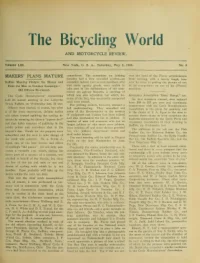
Articles in this issue
- The Cycle Manufacturers' Association's annual meeting at the Lafayette Hotel, Buffalo, on 2 May subscribed funds for a bicycle publicity campaign and engaged Frank A. Egan to run it; George N. Pierce was re-elected president, with Frank E. Southard, J. F. Cox and Harry Walburg also returned.
- The Cycle Parts and Accessories Association, meeting at Buffalo under president W. J. Crosby, elected six new members (Fisk, Kokomo, Pennsylvania, Kelly Handle Bar, Buffalo Specialty and New Departure), cut dues from $50 to $25 and endorsed the Egan publicity plan.
- J. W. Leavitt, the first San Francisco bicycle merchant to reach the East after the earthquake, lost a $85,000 stock insured for only $45,000 yet has ordered carloads of goods for Oakland; C. C. Hopkins, the Indian agent, writes from 1262 Broadway, Oakland, that he is "down, but not out."
- David Robinson, Jr., has been appointed receiver for the Consolidated Mfg. Co. of Toledo, Ohio, makers of the Yale and Snell bicycles, after creditors filed a bankruptcy petition; the plant will keep running and its automobile venture is blamed for the trouble.
- Trade changes: George De Witt opens in the Andrews block, Fenton, Mich.; Hurd & McBride open at 191 Sparks street, Ottawa; Brace, McKay & Co. of Charlottetown, P. E. I., add a bicycle department; and J. W. McMullen removes to the Beckman-Gostlin block, Hammond, Ind.
- J. B. White and C. W. Polsey, long secretary and treasurer of the Frank Mossberg Co. of Attleboro, Mass., have retired and sold their interests to W. I. Tuttle, who assumes both offices.
- F. B. Widmayer of 2312 Broadway, New York City, is marketing special motorcycle lamp brackets that fit the head lug bolt of Indian, R-S and Thor machines, made in one- and two-lamp styles.
- The bicycle dealers of Yokohama have petitioned the Lower House to cut the import duty on bicycles from 40 per cent. to not more than 20 per cent., the ad valorem rate charged on electric carriages and railway locomotives.
- Lester R. Creutz and George E. Holt, the Illinois cyclists who set out on 15 June for a two-year, 50,000-mile circuit of the globe, will report their progress and photographs weekly in The Bicycling World; their route runs from Liverpool through Scandinavia, Russia, Africa and Asia to Japan and Hawaii.
- Louis J. Mueller of Cleveland will start from San Francisco about 1 August on an Indian to ride the continent in thirty days, using data gathered from W. C. Chadeayne, whose transcontinental trip took 48 days, 11 hours, 35 minutes.
- Louis J. Weintz of the New York Athletic Club and the Twenty-second Regiment Engineers won the one-mile military bicycle championship of New York City at Madison Square Garden in 3:12 1/5, beating F. E. Adams and Oscar Becker of the Thirteenth Regiment.
- Charles Dunlap and Homer Elliott of Piqua, Ohio, start from Pittsburg for Des Moines, Iowa, on a wager requiring them to arrive within twenty-five days with $75 each, without begging, stealing or "bumming" their way.
- The leader answers editors who pronounce cycling "dead," arguing that the automobile boom has merely displaced attention and quoting the Reverend Henrietta G. Moore and the Reverend Francis E. Clarke on the bicycle as a means of health and "a means of grace."
- Race and run calendar from 6 May to 8 July, including the Brooklyn Motorcycle Club's century run to Patchogue, the eighteenth Irvington-Milburn twenty-five-mile road race on 30 May, the New York Motorcycle Club's hill-climbing contest, and the F. A. M. annual tour and endurance run from New York to Rochester.
- Full-page illustration of a wheelwoman calling on a friend, her bicycle propped against the porch rail while tea is laid on the table beside them.
- The Vailsburg board track reopened before some 2,000 spectators, with W. S. Fenn winning the mile open from Menus and John Bedell and the two-mile professional handicap from Floyd Krebs; Police Commissioner Castle attended and declared he saw no harm in Sunday racing.
- A survey of the season's high-grade machines, contrasting them with the "gold brick" cheap bicycle, and describing the 1906 Pierce, Pope (Columbia, Cleveland, Tribune, Rambler and Hartford), Gendron, National, Racycle, Reading Standard, Hudson, Yale, Snell and Emblem models with their prices and construction.
- An appreciation of coasting and of the coaster brake that made it safe, with descriptions of the Morrow of the Eclipse Machine Company, Elmira, the Corbin, the Standard two-speed of Torrington, the Atherton marketed by D. P. Harris, and the Forsyth of Buffalo.
- A review of the motor bicycle's rapid rise and of the 1906 machines: the 2 1/4 h.p. Indian of the Hendee Mfg. Co., the R-S of the Reading Standard Cycle Mfg. Co., the Armac of Chicago, the Yale-California of the Consolidated Mfg. Co., the Thomas Auto-Bi, the Crouch and the two-cylinder Curtiss of Hammondsport.
- Advice to the bargain-hunter on buying a used motor bicycle: deal only with a known dealer, take an experienced friend, test the machine on a hill, check compression and bearing wear, and beware the "sharks" drawn to the "motorcycles from $50 up" trade.
- A pair of photographs of an afternoon's outing, showing mixed parties with forecarriages and tandem attachments, offered as the answer to the charge that motorcycling is a solitary pastime.
- Dr. W. Nicholas Lackey of Gallatin, Tenn., writing in the Journal of the American Medical Association, calls the motorcycle the automobile of the poor country doctor, saying he has answered night calls at 30 miles an hour and never failed to reach a patient on time.
- A four-panel cartoon tracing the rider's progress through an engine cycle…"Attracted to It," "Compressed with Knowledge," "Fired with Enthusiasm" and "Ejected a Complete Motorist."
- Full-width illustration of three children riding abreast down a country road, cheering as they go.
- A. G. Armstrong, president of the Century Road Club of America, says he took up cycling solely for its benefits and credits it with saving him from nervous collapse, adding that every child should ride a bicycle.
- The Federation of American Motorcyclists' annual meet will be held at Rochester on 4, 5 and 6 July, with the national endurance contest over the 388 miles from New York on 2 and 3 July; Henry J. Wehman of 108 Park Row is plotting the route and M. E. Toepel announces the annual tour will follow it.
- A review of the surviving parts and accessory trade…Shelby steel tubing, Duckworth and Diamond chains, Kelly handle bars, Persons and Troxel saddles, Veeder cyclometers, Bevin Bros. bells, "3 in 1" and Neverleak, the Schrader valve, Splitdorf and Dow coils, the Eldredge ammeter and the "baby" Gabriel horn.
- A touring essay urging riders to get off the beaten track, noting that the illustrated scenes were all taken within a twenty-mile circle of New York's city hall, including a view from Fort George Hill; with a poem reprinted from Cycling and notes on German cycling vocabulary.
- A survey of the 1906 tire trade covering the G & J detachable clincher, the Hartford, the Palmer and Goodrich lines, the Diamond and Reliance, the Kokomo, Fisk, Morgan & Wright, Goodyear, Continental and International brands, with views of the Hartford, Goodrich, Morgan & Wright and G & J works.
- An illustrated tour of the Racycle plant of the Miami Cycle & Mfg. Co., Middletown, Ohio, following the machine from steel tubing through brazing, drilling and pinning, enameling ovens, nickel plating and the wheel room to crating for shipment.
- A cartoon of a young man between a tandem and a motorcycle forecarriage, each with a lady beside it, captioned "How happy I'd be with either, were t'other dear charmer away."
- Complete tables of professional and amateur bicycle records…unpaced, against time, motor paced, handicap, tandem and multicycle…naming holders such as F. L. Kramer, Major Taylor, W. M. Samuelson, M. L. Hurley, Harry Caldwell and Hugh McLean, with the six-day and paced hour marks.
- A column of mock testimonials for the low-grade machine, among them "The bicycle fully upholds your reputation, it is now on the scrap heap" and "A cycle thief took it away yesterday morning and brought it back again to-day."
- Quoting the veteran cyclist Henry Sturmey, the article traces the motor car's debt to cycle practice…the pneumatic tire, wire suspension wheel, ball and roller bearings, the pitch chain and oil-tight gear case, the differential gear and live axle, connected steering and the Bowden brake.
- The Education Committee of the London County Council has recommended that each of its gardeners be supplied with a bicycle and two cents a mile, the men collecting some 700 boxes of 500,000 botanical specimens monthly for 575 council schools.
- The Reverend J. Westbury Jones of Spa-Fields Church, London, preached on Ezekiel 15-16, "the appearance of wheels and their works," observing that there are punctured Christians as well as punctured wheels.