Vol 57, No 5
Cite this issue
Citation
The Bicycling World 57, no. 5 (1908). cyclearchive.com, https://cyclearchive.com/magazines/the-bicycling-world/vol57-5/
Page numbers are pages of the PDF, which can differ from the numbers printed on the page.
Articles in this issue
- Holds up elderly cyclists as proof that cycling has no age limit: Thomas W. Davis of Peoria, Ill., an octogenarian who rode 5,400 miles last year; Dr. Jesse C. Green, a 90-year-old West Chester, Pa., dentist; and First Assistant Secretary of State Alvah A. Adee. Chiefly describes President Charles W. Eliot of Harvard, 75, who rides out from Cambridge by Brattle street to Fresh Pond before seven each morning, sometimes with Mrs. Eliot, and whose example led Harvard students to start a bicycle club.
- On the bicycle as a working tool, taking the United Gas Improvement Company of Philadelphia's Distribution Department, which began with one bicycle ten years ago and now employs 293 bicycles and 18 motorcycles for turn-on and turn-off men, meter and complaint men, mail carriers, firemen, leak men and asphyxiation experts. Gives the firemen's run of 24 city blocks in fourteen minutes, the 24 pounds of tools on a 38-pound machine, the bicycles built in the company's own shops, and the charge account kept against each wheel; photographs of a mail carrier, an asphyxiation expert with an inspector, and a fireman are printed with it.
- The masthead-page leader, an essay on cycling as a return to nature's laws: in the early days wheelmen treated their machines as a religion and the doctor prescribed a bicycle, not pills, and the same holds today against the strain of modern life and fads like mental healing. Argues that cycling stimulates the heart and nerves, cures dyspepsia and brings hunger, and ends by pitying those who will not seek the open, even on the motor bicycle.
- The annual survey of 1908 motor bicycles, with a price and specification table of American and imported makes. Notes longer wheel bases, lower frames, twist-grip control, roller chains and more twins and magnetos, and scolds riders who open their mufflers. Covers Indian (five models, Hendee Mfg. Co.), Reading Standard twin, Thor's planetary gear, Merkel, Light, Armac, Curtiss, Harley-Davidson, Auto-Bi, Yale-California, Wagner's ladies' model, Thiem, Excelsior, Torpedo, Royal, Manson, Crouch, Minneapolis two-speed, M-M and Reliance. Closes with the imported F.N. four, N.S.U. and Styria.
- Argues that the motor bicycle has become a working vehicle: rural free delivery carriers, telephone linemen, physicians and collectors ride them, and one manufacturer is experimenting with a motorcycle fire engine to put a fireman at a blaze before the engines arrive. Notes a motor bicycle signal corps in the German army and the motorcycle van for light delivery; photographs of a fire-engine motorcycle, a telephone lineman and a rural delivery carrier are printed with it.
- A first-person account, signed H. J. B., of a two-month solo bicycle tour of about 2,500 miles, opening with Huckleberry Finn and Jack London's Tales of the Road. The rider sleeps out under trees and in hay lofts with two blankets, a tool bag and a leather case in the frame, eats at farm houses where he is treated kindly, swims in streams, and sits out wet days with farm families. He covers about forty miles a day, earns a dollar on a hay rake, and comes home stronger, with his eyesight better and his smoking nearly gone; roadside photographs are printed with it.
- The annual spring survey of the season's roadsters, opening with an argument that no two bicycles are alike and that a name plate is worth paying for. It then goes maker by maker: Racycle (Miami Cycle & Mfg. Co., vanadium-steel hanger, $30 to $70), Columbia and the Pope group (Hartford, Rambler, Cleveland, Tribune, Fay juveniles), Pierce cushion frame and chainless, Iver Johnson truss frame, Reading Standard truss tube, Gendron, Yale's Consolidated hanger, Emblem, Hudson's Washington Special ($60), Crown, Excelsior's Cantilever truss and the World.
- The paper's survey of coaster brakes, crediting the Eclipse Machine Co.'s Morrow with winning acceptance and explaining the Morrow's wedging expander, the Corbin's worm and cone clutch and its two-speed sun-and-planet hub with controller. It then describes the Thor (Aurora Automatic Machinery Co.), the new armless Musselman from the Miami company, the Atherton, the New Departure of Bristol, Conn., and the Forsyth, noting that motorcycle brakes are enlargements of the bicycle types.
- The spring survey of bicycle tires, noting that makers keep their rubber compounds secret so buyers judge a tire by its maker's reputation. It covers the Diamond Rubber Co.'s eleven brands including the new Thread and Diamond Oriental, Ajax-Greib's four Ajax tires, Hartford's line, Continental, Kokomo's Defender Special and New Oxford, the Pathfinder, Cactus and Monarch types, Morgan & Wright, the universal Schrader valve and the Neal repair kit. It ends with motorcycle tires (G & J, Goodyear, Empire, Pennsylvania, Harburg, Continental), patches and repair sleeves, and pumps from Ovington, Stevens and Reading.
- Survey of the components and sundries a would-be bicycle builder can buy: Standard Welding Co. tubing, John R. Keim Mills frame sets, Worcester Pressed Steel and Crosby fittings, Fauber and other crank hangers, hubs, spokes, rims, chains, pedals, handlebars, grips, saddles (Persons, Troxel, Mesinger, Wheeler), tool bags, carriers, bells, lamps and speedometers, closing with 3 in One oil and Neverleak.
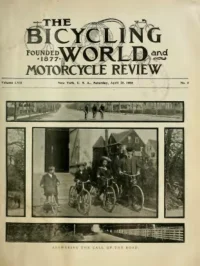
- A five-stanza poem welcoming the return of the cycling season, set in a box among photographs of riders, a boy with a Carroll Cyclers pennant and spring road scenes.
- Guide for the would-be motorcycle manufacturer to where each part is obtained: castings from the Manufacturers' Foundry Co., Aurora and Thiem motors, Standard Welding tubing, Standard spokes, Crosby, Keim and Worcester Pressed Steel parts, chains, belts and the Hipkins change-speed pulley, coaster brakes, bars, grips, pedals and the Sager spring fork, then tanks and battery boxes, carburetters (Schebler, Heitger), coils (Splitdorf, Pittsfield), magnetos (Bosch, U. & H.), spark plugs, saddles (Persons, Troxel, Mesinger, Brooks), tool kits, wrenches, the Eldredge ammeter, stands, speedometers (Jones, Bullard), horns and lamps. It runs to the waterproof goods of the Gilbert Mfg. Co.
- Review of the American racing year: no N.C.A. circuit championships were run, Hugh MacLean won the paced title at Revere Beach, William VandenDries won the amateur quarter-mile in Madison Square Garden, and Walter DeMara broke amateur records before turning professional. Clarke, Kramer and Bedell share the professional records, and Kramer beat Jacquelin and Ellegaard. It explains the road-record table, notes pursuit riders Fogler and Moran, and closes on motorcycle champions Stanley T. Kellogg (three national titles and the Goodwin medal), Goerke (hour) and Derkum, with a remark on the F.A.M. engine limit.
- Tables of world and American records up to the end of 1907: professional track records from a quarter mile to 24 hours (Kramer, Major Taylor, Walthour, Hamilton, Caldwell, Bouhours and others), amateur track records (Hurley, De Mara, Sulkin, Nelson, Wilcox) and amateur road records compiled since the N.C.A. took control of road racing on 1 May 1907 (Sherwood, Nerent, Blum, Eifler).
- Table of motorcycle track records: distances from a half mile to 60 minutes with holder, place and date, including P. J. Q. Derkum's Los Angeles marks of 22 Feb 1908, F. C. Hoyt at Chicago, and Walter Goerke and S. T. Kellogg at Philadelphia on 5 Oct 1907. Also the straightaway mile by Glen H. Curtiss at Ormond Beach, notable performances by W. H. Wray, Jr., on machines over 61 cu. in., and world's track records abroad by the Colliers and H. Martin.
- At Boston's Park Square saucer James F. Moran again beat Major Taylor in a match race, winning the first heat and the pursuit decider after Taylor took the re-ridden second, and Joe Fogler took both professional events. Two nights later Fogler beat Taylor and Walter Bardgett in a three-cornered match, Taylor falling after hitting Bardgett's tyre, with results of the open races, George Wiley, Pat Logan and amateur Fred Hill among the winners.
- Walthour is having a hard time in Paris and Louis Darragon has lost form since parting with the pacemaker Andre, who now paces Parent. At the Velodrome d'Hiver Parent won the 40-kilometre paced final, Walthour second by two laps and Guignard third. Walter Rutt's fist fight with a French cabman over a mistreated horse ended with his discharge at the police station.
- New Jersey's amended law will require motorcycles to carry license numbers; F. A. M. President Betts has proposed to Commissioner Smith at Trenton that numbers painted on the rear mudguard suffice, and Smith will consider it.
- W. B. Stout, a St. Paul newspaper writer known as "Jack Knife," sailed for what is probably the most extensive foreign tour yet by an American motorcyclist, a year in Great Britain and the Continent on an R-S motor bicycle.
- The opening of the Revere Beach saucer track was put off to May 30 by rain; the Boston indoor track closes with a benefit meet for Chelsea fire sufferers, and P. T. Powers may open Madison Square Garden for meets twice a week.
- At the 71st Regiment Armory, New York, Louis J. Weintz broke the one-mile armory record of 2:25 3-5 by 6 1-5 seconds, timed with VandenDries on scratch. He got by VandenDries early but could not overhaul Charles Nerent, on 80 yards, who won by half a length with VandenDries third.
- Otto A. Kleim and Clyde E. Lemly of West Berkeley, Cal., started from San Francisco on April 15 to ride to Valparaiso, Chili, a trip down the coast not made before by bicycle.
- Guido B. F. Pompeji, an engineer in the Canal Zone, is coming to attend the Federation of American Motorcyclists meet in New York, July 1 to 4, as he told Secretary Wehman.
- The Philadelphia Motorcycle Club opens its season with an open race meet on May 15 on the Point Breeze mile track, with E. T. Barnes in charge.
- Describes how jobbers distribute bicycle and motorcycle goods to dealers, their wide stocks and own-brand lines. Names Geo. W. Nock, Jos. Strauss & Son, J. W. Grady, F. A. Baker, E. J. Willis, the Excelsior Supply Co. (with its own bicycles and Auto-cycle), the New York Sporting Goods Co., the Ovington Motor Co. and Charles E. Miller, with some imported specialties.