The Bicycling World, Vol 6, No 12
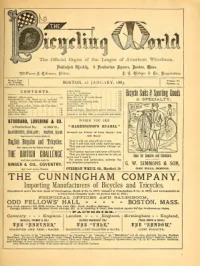
Articles in this issue
- Editorial denouncing a bill introduced in the Ohio legislature by Mr. Green of Shelby that would force cyclists to dismount twenty-five feet from any approaching horse, a measure the editor calls absurd and a violation of common law that would kill bicycling in the state. League president Miller and the L.A.W. officers are reported to be taking prompt measures to fight the bill.
- Correspondence from Julius Wilcox of New York, who met an injured rider leaving the Brooklyn park on New Year's Day who died five days later of extravasation of blood on the brain from his fall. Wilcox argues that care is the wheelman's first duty and that riders should prize severe utility over showy, airy wheels ridden to astonish lookers-on.
- Report of the Kentucky Bicycle Club's first race meeting of 1883, whose main event was a five-mile three-city championship in which N. G. Crawford of Louisville beat W. R. Crawford of Chicago (who fell twice from his Yale racer) and W. H. Reed of Cincinnati in 17.58. The letter also lists Kentucky and Falls City club officers and Louisville's honored racers, including fifty-mile U.S. champion Charles H. Jenkins.
- President Bates argues that the perfect tricycle needs a differential gear shifted by a simple lever, letting any rider adapt power and speed to any road from steep hills to racing descents, plus clutch-released driving wheels, twin lamps and luggage carriage. The editor replies that the National and one or two other makes meet most requirements, with Mr. Handy's attachment promising the shifting gear.
- John S. Prince of Boston beat Lewis T. Frye of Marlboro' in their third ten-mile professional match for a $600 purse at the New England Institute Fair Building on 20 January, riding his final mile in 3m. 3½s. to beat John Keen's American flying-start record; Charles E. Pratt presented Prince a gold medal from the Pope Manufacturing Company before the start. Supporting races saw Frank R. Miller take the Bay State Wheel Club five-mile championship and E. P. Burnham of Newton win the open five-mile amateur in 16m. 26¾s., while at Cincinnati on 18 January W. Reed edged H. N. Kitchell in the first ninety-minute heat for the long-distance championship medal.
- A correspondent (from the Cyclist) contends that ball bearings are inferior to parallel bearings: road vibration hammers the hardened steel balls into their case-hardened surfaces, causing depressions, wedging and ever-harder running, and once the case-hardening wears through the balls grind on soft metal. He adds that balls occasionally split and stop a machine dead, and that ball bearings are costlier, heavier and less rigid than parallel ones.
- A clipping noting that courts have generally held a bicycle has as much title to the road as a buggy and that a horse shying is the driver's fault, before reprinting the key clause of Mr. Green of Shelby's Ohio bill requiring riders of bicycles, tricycles and velocipedes to dismount at least twenty-five feet from any approaching horse.
- Portrait and biography of John Oliver Blake, vice-president of the John Wilkinson Company of Chicago, born in Meriden, Connecticut in 1848, who located the Temescal Hot Springs in California and organized the Brooklyn Archery Club. He is now vice-president of the Chicago Bicycle Club and president of the League of Chicago Wheelmen.
- Mrs. King replies in the Tricyclist to 'Matterhorn', defending her rational tricycle dress against the charge of 'aping men' and condemning heavy kiltings and instep-length skirts that tax women's muscles and catch the wind. She predicts ladies will one day no more mount a tricycle without tricycle trousers than a horse without riding trousers.
- Edward K. Hill presents the guide-board design adopted by the Massachusetts Division L.A.W. — white ground with black lettering and distinctive angles — together with the three official League stencil signs: direction (best road, safe coasting), cautionary (ride with care) and danger (better dismount, no coasting).
- The Springfield Bicycle Club has spent about $600 fitting up new rooms in the Massachusetts Mutual Life Insurance Company's building and is rehearsing for its second grand reception, concert, exhibition and ball on 22 February; the Kentucky Bicycle Club's annual meeting elected Aaron Cornwall president and N. G. Crawford captain. A calendar of coming club dinners and meetings, including the Boston Bicycle Club's fifth annual dinner, precedes the notes.
- H. O. Duncan, the well-known English professional rider, writes to the Bicycling Times urging the Bicycle Union to open a professional branch, since scattered professionals cannot form their own union and are excluded from everything, even the Bicycle Touring Club. He argues a governing body would end the swindles and 'gate money' reputation that make honest professional racing a difficult business.
- A poem by Ninon Neckar, 'Up the hill, up the hill', urging riders to climb with a ready will and steady pace, promising rest at the brow and fortunes for those who push on.
- Notes column: Crimmins and Viele are New York's new park commissioners; English amateur champion H. L. Cortis received a cordial welcome at Melbourne; A. Dolph of New London, Ohio had a finger cut off at the joint by a wheel's spokes yet still started in Saturday's race; and the Massachusetts Bicycle Club's musical and literary entertainment at Horticultural Hall featured a banjo quartet and bicycle balance acts by Wilmot and Atkins.
- An item from the Tricyclist on the multiplying number of tricycle gearings expected at the Stanley Show, predicting that a perfect two-speed gear will let riders paddle home up hills with an 'outside passenger' without distress. The inventor of the cryptodynamic gearing proposes to extend its advantages to bicycles.
- Review of the midwinter Century for February, with the opening chapters of Howells' 'A Woman's Reason', a frontispiece portrait of George William Curtis, and an etching by Philadelphia bicycling artist J. Pennell among Mrs. Van Rensselaer's 'American Etchers'; St. Nicholas for February is largely devoted to valentines, with Joaquin Miller's sketch of an ascent of Mount Hood.