The Bicycling World, Vol 6, No 7
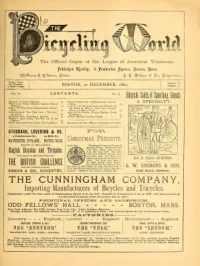
Articles in this issue
- The lead editorial urges wheelmen to order repairs and new machines early for the 1883 season, since manufacturers were swamped with orders the previous year, and notes the fast-growing American interest in tricycles alongside bicycles.
- Club news reports that the Hermes Bicycle Club of Chicago elected Solomon Sturges captain and W. C. Kent president, Capital Bicycle Club's Washington president C. E. Hawley resigned, the Boston Bicycle Club planned a New Year's reception, and the Manhattan Bicycle Club disbanded.
- An eyewitness account of the meet at the Institute Fair Building, Boston, where J. S. Prince beat L. T. Frye by scarcely a yard in the ten-mile professional championship race, breaking several mile records, plus results of the amateur two-mile and one-mile events won by Burnham and Saben.
- Reader letters including a New York Letter on the Kings County Wheelmen's ball and gossip among the Citizens, Ixions and Lenox clubs; Julius Wilcox's technical rebuttal on the 'Xtra bicycle's pedal-stroke claims; and Henry Sturmey's appeal for subscriptions to the James Starley memorial fund in Coventry.
- A comic verse, signed "f. w. b." of Worcester, Mass., about a young cyclist who tumbles into the mud after stealing a glance at a pretty girl's face while coasting downhill.
- A. J. Wilson, captain of the North London Tricycling Club, argues at length that tricycles are safer, more comfortable and better suited to rough American roads and touring than bicycles, citing his own six years of riding and geared-down machines climbing Reigate Hill and Muswell Hill.
- W. D. Wilmot performed trick-riding feats at the Olympian Skating Club rooms in the Mechanics' Association Building, including one-pedal riding, elaborate standstills, and stacking three machines while standing erect on the centre saddle, winning a $25 gold medal.
- Reprinted from the English Cyclist, this piece argues the Bicycle Union should encourage more professional racing to draw dubious "amateurs" out of the amateur ranks, citing the Wolverhampton Mile handicaps as fairly run professional events.
- "London W."'s column reprints verse debating gearing up versus down and discusses pedal fit and headers, and reports that Boston's dutiable bicycle and tricycle imports rose from $1,813 in 1878 to over $121,000 by 1882, with 914 bicycles and 78 tricycles imported in 1881-82.
- Lists new B.T.C. membership applications from Bridgeport, Conn. and Millbury, Mass., plus Massachusetts Chief Consul J. S. Dean's recommended consuls and touring hotels in towns including Boston, Brookline, Gloucester and Worcester.
- League of American Wheelmen notices cover admission procedures through Treasurer Fred P. Shafer, W. V. Gilman's appeal to representatives and consuls, a Chicago Bicycle Club resolution backing the Board of Officers over the amended amateur rule, and Massachusetts consul appointments and duties from Fred S. Pratt.
- Reprinted from the St. Louis Republican, wheelman C. E. Stone was arrested by a mounted policeman for riding in Forest Park after the superintendent banned bicycles, but Capt. Huebler released him, ruling there was no ordinance against bicycle riding.
- A Pall Mall Gazette item describes a civil engineer's electric tricycle designed to evade Britain's traction-engine law by requiring some "animal power" to release the current, followed by a Tricyclist note on two riders planning matched trials comparing bicycle, tricycle and sociable speeds over the same course.
- A comic verse, signed "K. K." of Montreal, mocking an ungainly, overpriced machine that first appeared in Montreal, poking fun at its odd wheels, elastic saddle and roller brake.
- Miscellaneous notes teasing a Prince-Frye rematch, W. M. Woodside's visit to Boston, S. Conant Foster's call from the Mercury Bicycle Club, Lieut. Griffiths moving up to a 62-inch machine, and E. B. Sturges and J. Connell touring Nice and Monaco by tricycle.